QUESTION IMAGE
Question
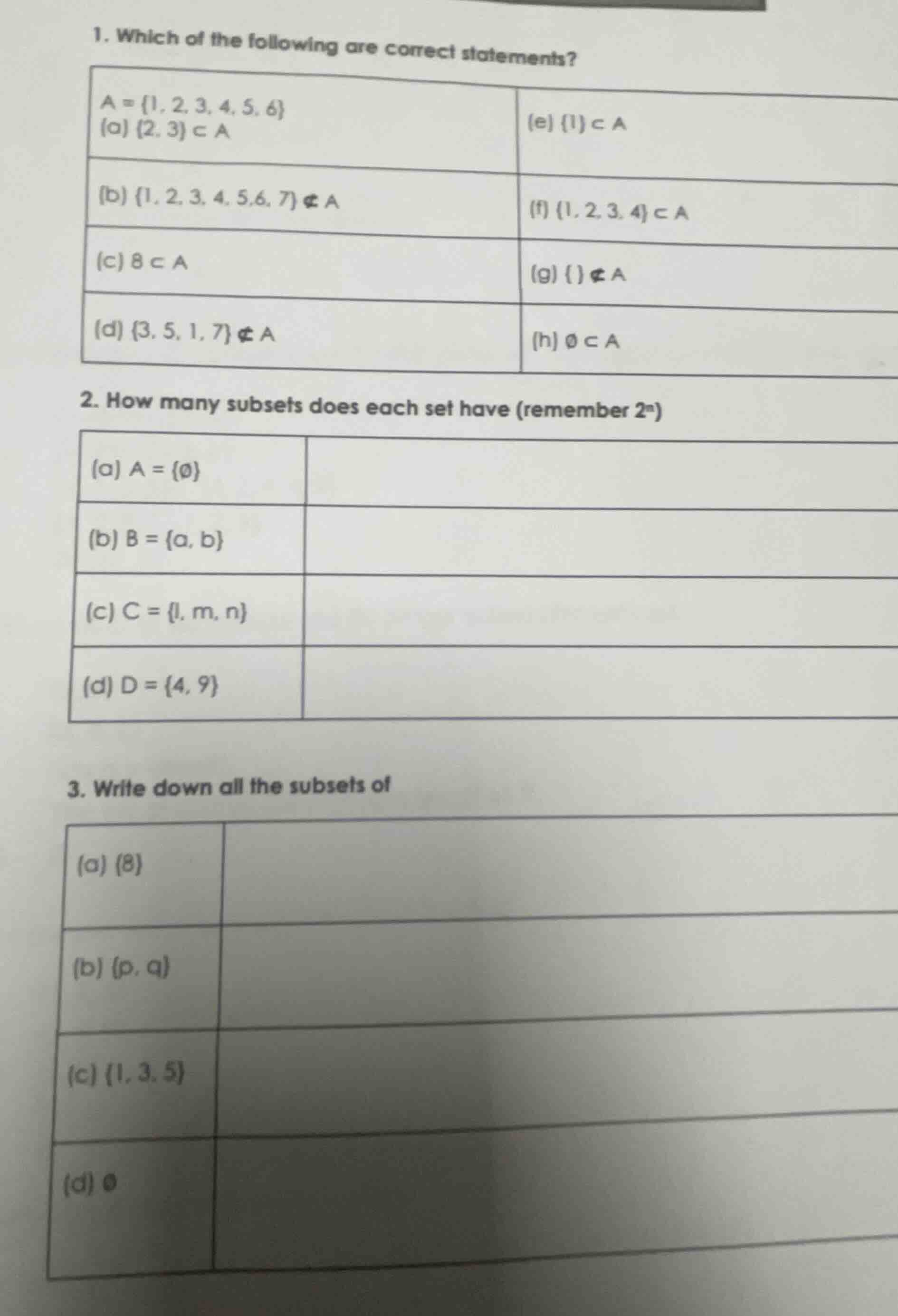
- which of the following are correct statements?
a = {1, 2, 3, 4, 5, 6}
(a) {2, 3} ⊂ a \t\t\t(e) {1} ⊂ a
(b) {1, 2, 3, 4, 5, 6, 7} ⊄ a \t(f) {1, 2, 3, 4} ⊂ a
(c) 8 ⊂ a \t\t\t\t(g) {} ⊄ a
(d) {3, 5, 1, 7} ⊄ a \t\t(h) ∅ ⊂ a
- how many subsets does each set have (remember (2^n))
(a) a = {∅}
(b) b = {a, b}
(c) c = {l, m, n}
(d) d = {4, 9}
- write down all the subsets of
(a) {8}
(b) {p, q}
(c) {1, 3, 5}
(d) ∅
Question 1:
To determine if a set \( X \) is a subset of \( A = \{1, 2, 3, 4, 5, 6\} \) (denoted \( X \subset A \)), every element of \( X \) must be in \( A \). If any element of \( X \) is not in \( A \), then \( X
ot\subset A \). Also, note that \( \emptyset \) (the empty set) is a subset of every set.
Step 1: Analyze option (a)
\( (2, 3) \) is not a set (it's an ordered pair), so the notation \( (2, 3) \subset A \) is incorrect.
Step 2: Analyze option (b)
\( \{1, 2, 3, 4, 5, 6, 7\} \) has 7, which is not in \( A \), so \( \{1, 2, 3, 4, 5, 6, 7\}
ot\subset A \) (correct notation \(
ot\subset \) is used, so this statement is correct).
Step 3: Analyze option (c)
8 is an element, not a set, so \( 8 \subset A \) is incorrect (subset notation is for sets, not elements).
Step 4: Analyze option (d)
\( \{3, 5, 1, 7\} \) has 7, which is not in \( A \), so \( \{3, 5, 1, 7\}
ot\subset A \) (correct notation \(
ot\subset \) is used, so this statement is correct).
Step 5: Analyze option (e)
\( \{1\} \) is a set, and 1 is in \( A \), so \( \{1\} \subset A \) (correct).
Step 6: Analyze option (f)
\( \{1, 2, 3, 4\} \) has all elements in \( A \), so \( \{1, 2, 3, 4\} \subset A \) (correct).
Step 7: Analyze option (g)
\( () \) is not the standard notation for the empty set (should be \( \emptyset \) or \( \{\} \)). If we assume it's a typo for \( \emptyset \), then \( \emptyset \) is a subset of \( A \), so \( ()
ot\subset A \) is incorrect.
Step 8: Analyze option (h)
\( \emptyset \) is a subset of every set, so \( \emptyset \subset A \) (correct).

Snap & solve any problem in the app
Get step-by-step solutions on Sovi AI
Photo-based solutions with guided steps
Explore more problems and detailed explanations
The correct statements are:
(b) \( \{1, 2, 3, 4, 5, 6, 7\}
ot\subset A \)
(d) \( \{3, 5, 1, 7\}
ot\subset A \)
(e) \( \{1\} \subset A \)
(f) \( \{1, 2, 3, 4\} \subset A \)
(h) \( \emptyset \subset A \)
Question 2:
The formula for the number of subsets of a set with \( n \) elements is \( 2^n \) (including the empty set and the set itself).
Step 1: For set \( A = \{\emptyset\} \)
\( A \) has 1 element (\( \emptyset \) is the element), so \( n = 1 \).
Number of subsets: \( 2^1 = 2 \) (subsets: \( \emptyset \), \( \{\emptyset\} \))
Step 2: For set \( B = \{a, b\} \)
\( n = 2 \), so number of subsets: \( 2^2 = 4 \) (subsets: \( \emptyset \), \( \{a\} \), \( \{b\} \), \( \{a, b\} \))
Step 3: For set \( C = \{l, m, n\} \)
\( n = 3 \), so number of subsets: \( 2^3 = 8 \)
Step 4: For set \( D = \{4, 9\} \)
\( n = 2 \), so number of subsets: \( 2^2 = 4 \) (subsets: \( \emptyset \), \( \{4\} \), \( \{9\} \), \( \{4, 9\} \))