QUESTION IMAGE
Question
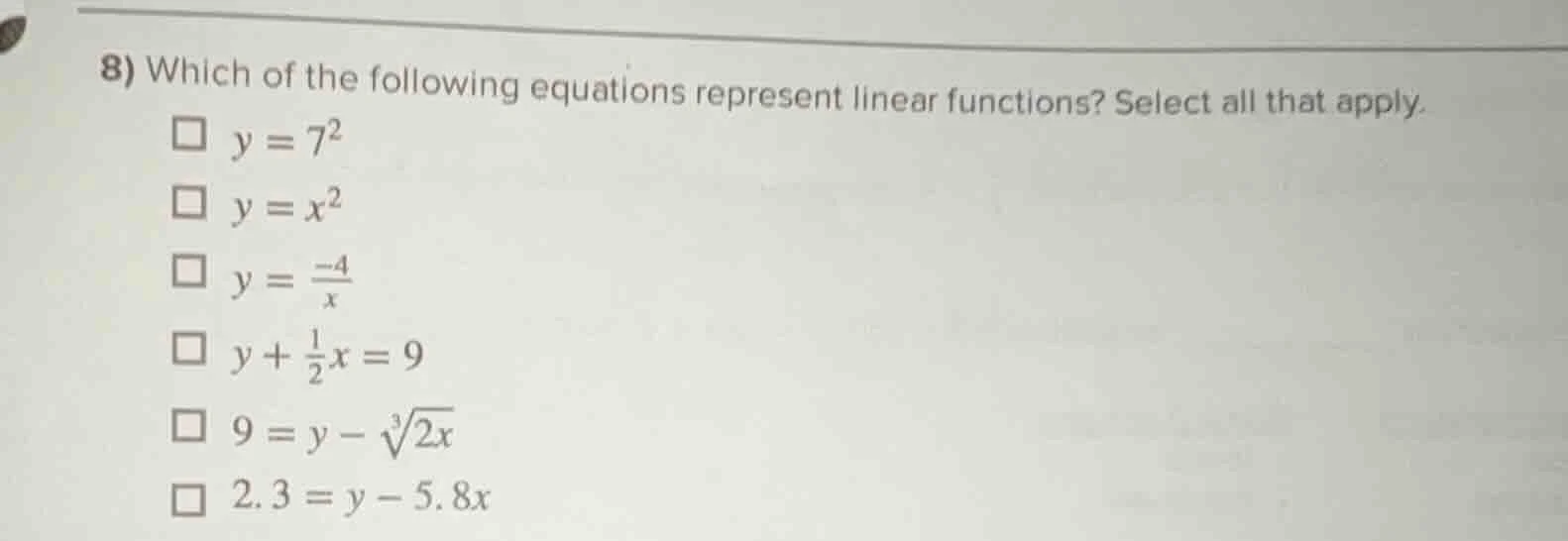
- which of the following equations represent linear functions? select all that apply.
□ $y = 7^2$
□ $y = x^2$
□ $y = \frac{-4}{x}$
□ $y + \frac{1}{2}x = 9$
□ $9 = y - \sqrt3{2x}$
□ $2.3 = y - 5.8x$
Step1: Recall linear function form
A linear function has the form \( y = mx + b \), where \( m \) and \( b \) are constants, and the exponent of \( x \) is 1.
Step2: Analyze \( y = 7^2 \)
Simplify \( 7^2 = 49 \), so \( y = 49 \). This is a horizontal line (constant function), which is a special case of linear function (slope \( m = 0 \)).
Step3: Analyze \( y = x^2 \)
The exponent of \( x \) is 2, so it's a quadratic function, not linear.
Step4: Analyze \( y = \frac{-4}{x} \)
This is a rational function (involves \( \frac{1}{x} \)), not linear.
Step5: Analyze \( y + \frac{1}{2}x = 9 \)
Rearrange to \( y = -\frac{1}{2}x + 9 \), which is in \( y = mx + b \) form ( \( m = -\frac{1}{2} \), \( b = 9 \) ), so linear.
Step6: Analyze \( 9 = y - \sqrt[3]{2x} \)
Rearrange to \( y = \sqrt[3]{2x} + 9 \). The term \( \sqrt[3]{2x} \) has a cube root, so it's not a linear function (exponent of \( x \) is \( \frac{1}{3} \), not 1).
Step7: Analyze \( 2.3 = y - 5.8x \)
Rearrange to \( y = 5.8x + 2.3 \), which is in \( y = mx + b \) form ( \( m = 5.8 \), \( b = 2.3 \) ), so linear.

Snap & solve any problem in the app
Get step-by-step solutions on Sovi AI
Photo-based solutions with guided steps
Explore more problems and detailed explanations
- \( y = 7^2 \) (since \( y = 49 \), a horizontal line, linear)
- \( y + \frac{1}{2}x = 9 \) (rearranges to linear form)
- \( 2.3 = y - 5.8x \) (rearranges to linear form)
So the boxes to select are:
\( \square \) \( y = 7^2 \) (checked), \( \square \) \( y + \frac{1}{2}x = 9 \) (checked), \( \square \) \( 2.3 = y - 5.8x \) (checked)