QUESTION IMAGE
Question
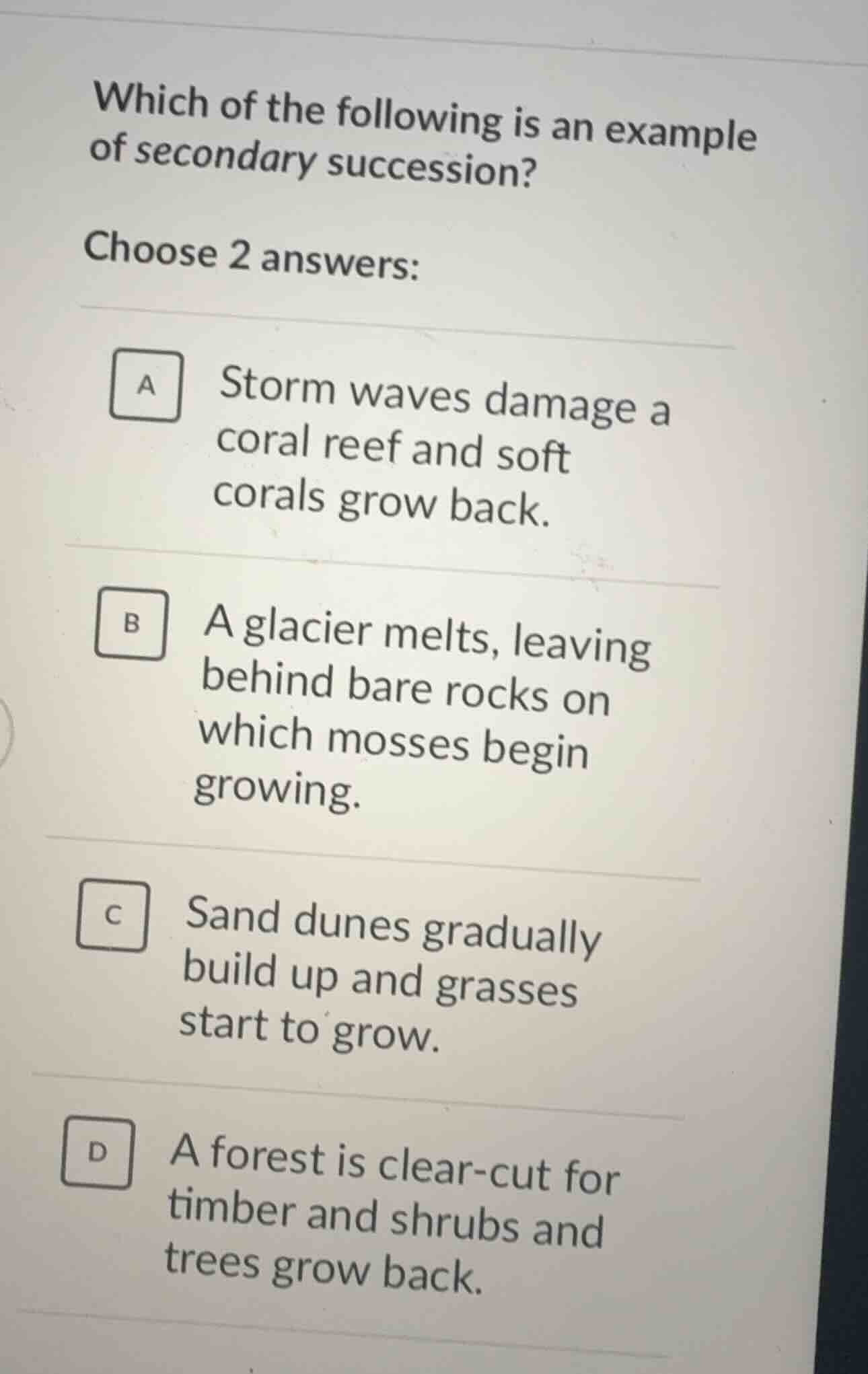
which of the following is an example of secondary succession? choose 2 answers: a storm waves damage a coral reef and soft corals grow back. b a glacier melts, leaving behind bare rocks on which mosses begin growing. c sand dunes gradually build up and grasses start to grow. d a forest is clear - cut for timber and shrubs and trees grow back.
To determine examples of secondary succession, we first recall that secondary succession occurs in an area where a disturbance has destroyed an existing community but left the soil intact (or with some organic matter).
- Option A: Storm waves damage a coral reef (a disturbance), and soft corals grow back. The reef ecosystem has a substrate (coral skeleton) and organic matter, so this is secondary succession.
- Option B: A glacier melting leaves bare rocks. This is primary succession because there is no soil or organic matter initially (bare rock is the starting point).
- Option C: Sand dunes building up and grasses growing. Sand dunes are a new, barren environment with little to no soil/organic matter initially, so this is primary succession.
- Option D: A forest is clear - cut (a disturbance), and shrubs/trees grow back. The soil is still intact after clear - cutting, so this is secondary succession.

Snap & solve any problem in the app
Get step-by-step solutions on Sovi AI
Photo-based solutions with guided steps
Explore more problems and detailed explanations
A. Storm waves damage a coral reef and soft corals grow back.
D. A forest is clear - cut for timber and shrubs and trees grow back.