QUESTION IMAGE
Question
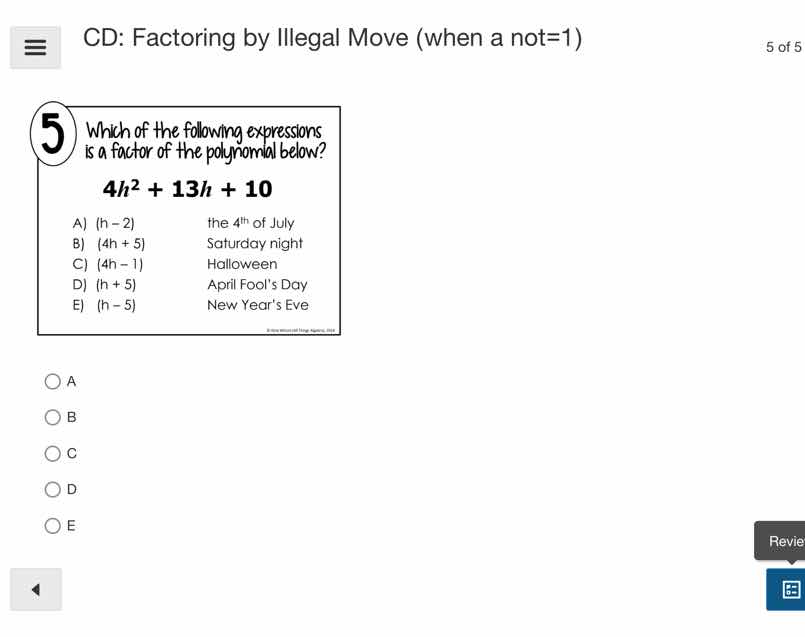
5 which of the following expressions is a factor of the polynomial below? $4h^2 + 13h + 10$ a) $(h - 2)$ the 4th of july b) $(4h + 5)$ saturday night c) $(4h - 1)$ halloween d) $(h + 5)$ april fool’s day e) $(h - 5)$ new year’s eve
Step1: Factor the quadratic polynomial
We have the quadratic polynomial \(4h^2 + 13h + 10\). We need to find two numbers that multiply to \(4\times10 = 40\) and add up to \(13\). The numbers are \(5\) and \(8\) since \(5\times8=40\) and \(5 + 8=13\).
So we can rewrite the middle term:
\(4h^2+5h + 8h + 10\)
Step2: Group and factor
Group the first two terms and the last two terms:
\((4h^2 + 5h)+(8h + 10)\)
Factor out the greatest common factor from each group:
\(h(4h + 5)+2(4h + 5)\)
Now we can factor out \((4h + 5)\) from both terms:
\((4h + 5)(h + 2)\) Wait, no, wait. Wait, let's check again. Wait, \(4h^2+13h + 10\). Let's use the formula for factoring \(ax^2+bx + c\). The roots are given by \(h=\frac{-b\pm\sqrt{b^2 - 4ac}}{2a}\). Here \(a = 4\), \(b=13\), \(c = 10\).
\(h=\frac{-13\pm\sqrt{13^2-4\times4\times10}}{2\times4}=\frac{-13\pm\sqrt{169 - 160}}{8}=\frac{-13\pm\sqrt{9}}{8}=\frac{-13\pm3}{8}\)
So the roots are \(h=\frac{-13 + 3}{8}=\frac{-10}{8}=\frac{-5}{4}\) and \(h=\frac{-13-3}{8}=\frac{-16}{8}=-2\)
So the factors are \((h + 2)\) and \((4h+5)\) (since if \(h=-\frac{5}{4}\), then \(4h + 5=0\))
Wait, let's check the factoring again. Let's try to factor \(4h^2+13h + 10\).
We can also use the method of splitting the middle term correctly. Let's find two numbers \(m\) and \(n\) such that \(m\times n=4\times10 = 40\) and \(m + n=13\). The numbers are \(5\) and \(8\) (since \(5\times8 = 40\) and \(5+8=13\)).
So \(4h^2+5h+8h + 10=h(4h + 5)+2(4h + 5)=(4h + 5)(h + 2)\). Wait, but in the options, option B is \((4h + 5)\), option A is \((h - 2)\), option D is \((h + 5)\), etc. Wait, maybe I made a mistake in the roots. Wait, let's expand \((4h + 5)(h + 2)=4h^2+8h+5h + 10=4h^2+13h + 10\). Yes, that's correct. So the factors are \((4h + 5)\) and \((h + 2)\). Looking at the options, option B is \((4h + 5)\), so that's a factor.

Snap & solve any problem in the app
Get step-by-step solutions on Sovi AI
Photo-based solutions with guided steps
Explore more problems and detailed explanations
B. \((4h + 5)\)