QUESTION IMAGE
Question
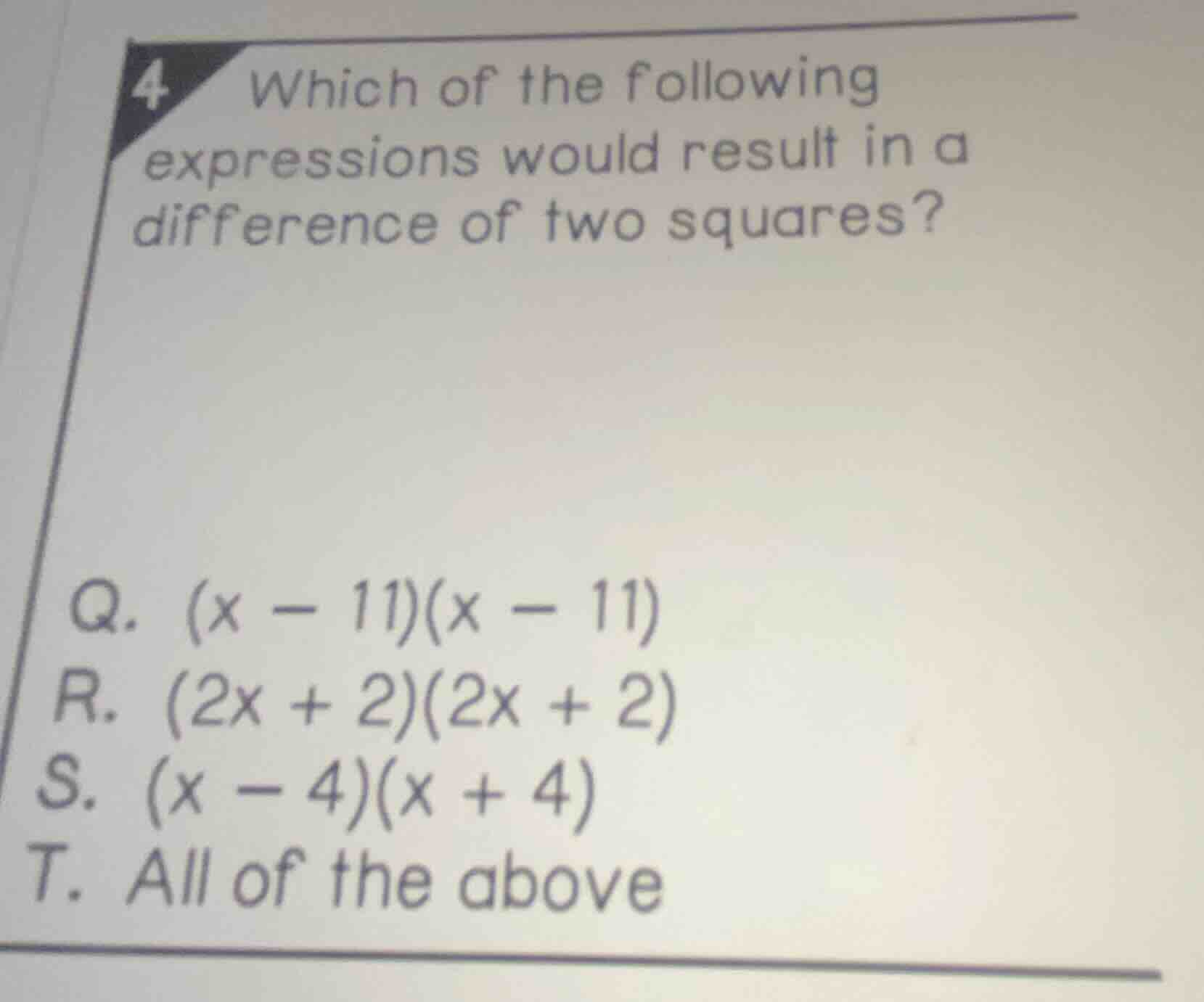
4 which of the following expressions would result in a difference of two squares? q. (x - 11)(x - 11) r. (2x + 2)(2x + 2) s. (x - 4)(x + 4) t. all of the above
Step1: Recall the formula for difference of two squares
The formula for the difference of two squares is \(a^2 - b^2=(a - b)(a + b)\). We need to check which of the given expressions matches this form.
Step2: Analyze Option Q
The expression is \((x - 11)(x - 11)=(x - 11)^2\). This is a perfect square, not a difference of two squares. The form is \((a - b)(a - b)=(a - b)^2=a^2-2ab + b^2\), which is a perfect square trinomial, not a difference of squares.
Step3: Analyze Option R
The expression is \((2x + 2)(2x + 2)=(2x + 2)^2\). This is also a perfect square, not a difference of two squares. The form is \((a + b)(a + b)=(a + b)^2=a^2+2ab + b^2\), a perfect square trinomial.
Step4: Analyze Option S
The expression is \((x - 4)(x + 4)\). Using the difference of two squares formula \(a^2 - b^2=(a - b)(a + b)\), here \(a = x\) and \(b = 4\). So \((x - 4)(x + 4)=x^2-4^2=x^2 - 16\), which is a difference of two squares.
Step5: Analyze Option T
Since options Q and R do not result in a difference of two squares, option T (All of the above) is incorrect.

Snap & solve any problem in the app
Get step-by-step solutions on Sovi AI
Photo-based solutions with guided steps
Explore more problems and detailed explanations
S. \((x - 4)(x + 4)\)