QUESTION IMAGE
Question
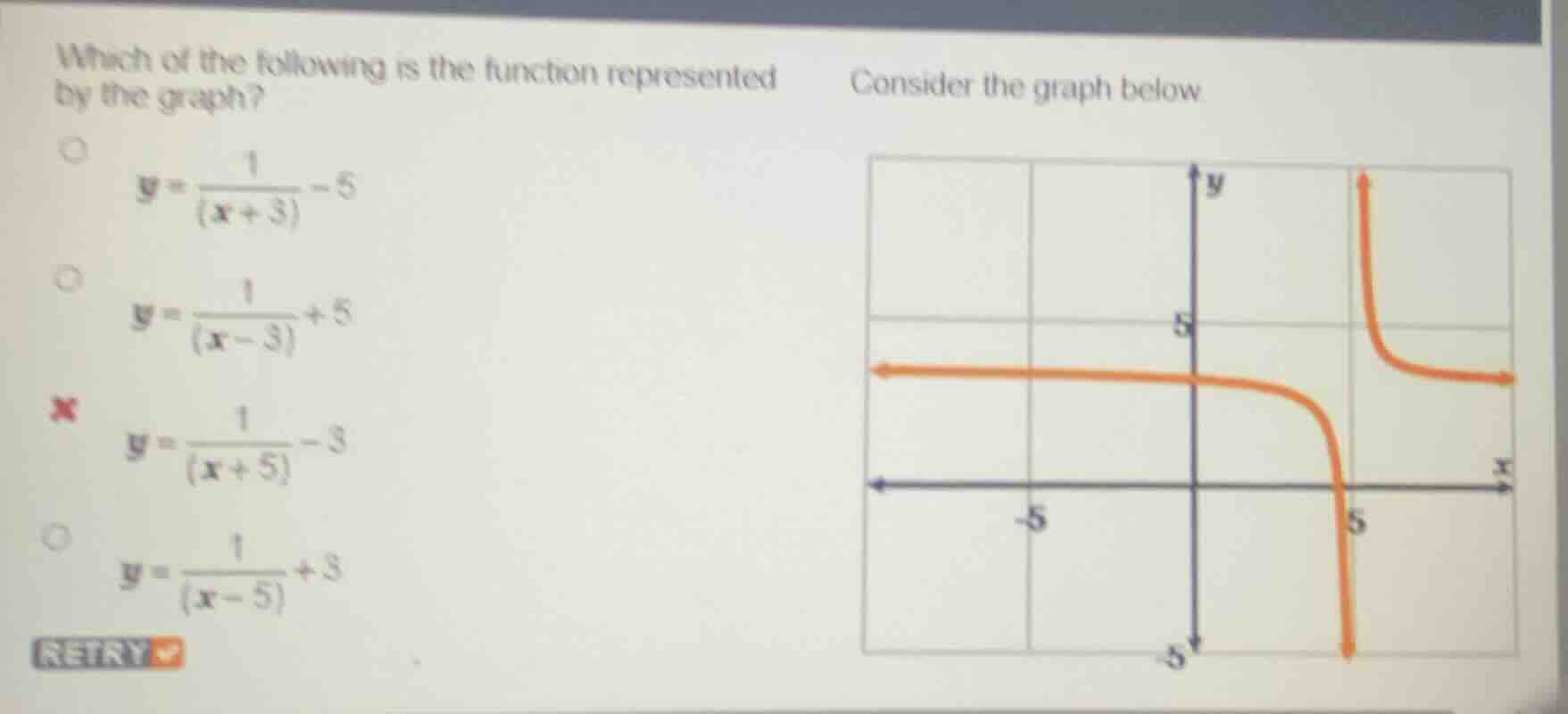
which of the following is the function represented by the graph? consider the graph below
\\( y = \frac{1}{(x + 3)} - 5 \\)
\\( y = \frac{1}{(x - 3)} + 5 \\)
\\( y = \frac{1}{(x + 5)} - 3 \\)
\\( y = \frac{1}{(x - 5)} + 3 \\)
Step1: Identify vertical asymptote
The vertical asymptote is $x=5$. For a rational function $y=\frac{1}{x-h}+k$, vertical asymptote is $x=h$, so $h=5$.
Step2: Identify horizontal asymptote
The horizontal asymptote is $y=3$. For the form $y=\frac{1}{x-h}+k$, horizontal asymptote is $y=k$, so $k=3$.
Step3: Substitute h,k into the form
Substitute $h=5$ and $k=3$ into $y=\frac{1}{x-h}+k$.
<Expression>
$y=\frac{1}{x-5}+3$
</Expression>

Snap & solve any problem in the app
Get step-by-step solutions on Sovi AI
Photo-based solutions with guided steps
Explore more problems and detailed explanations
$\boldsymbol{y=\frac{1}{x-5}+3}$ (the fourth option)