QUESTION IMAGE
Question
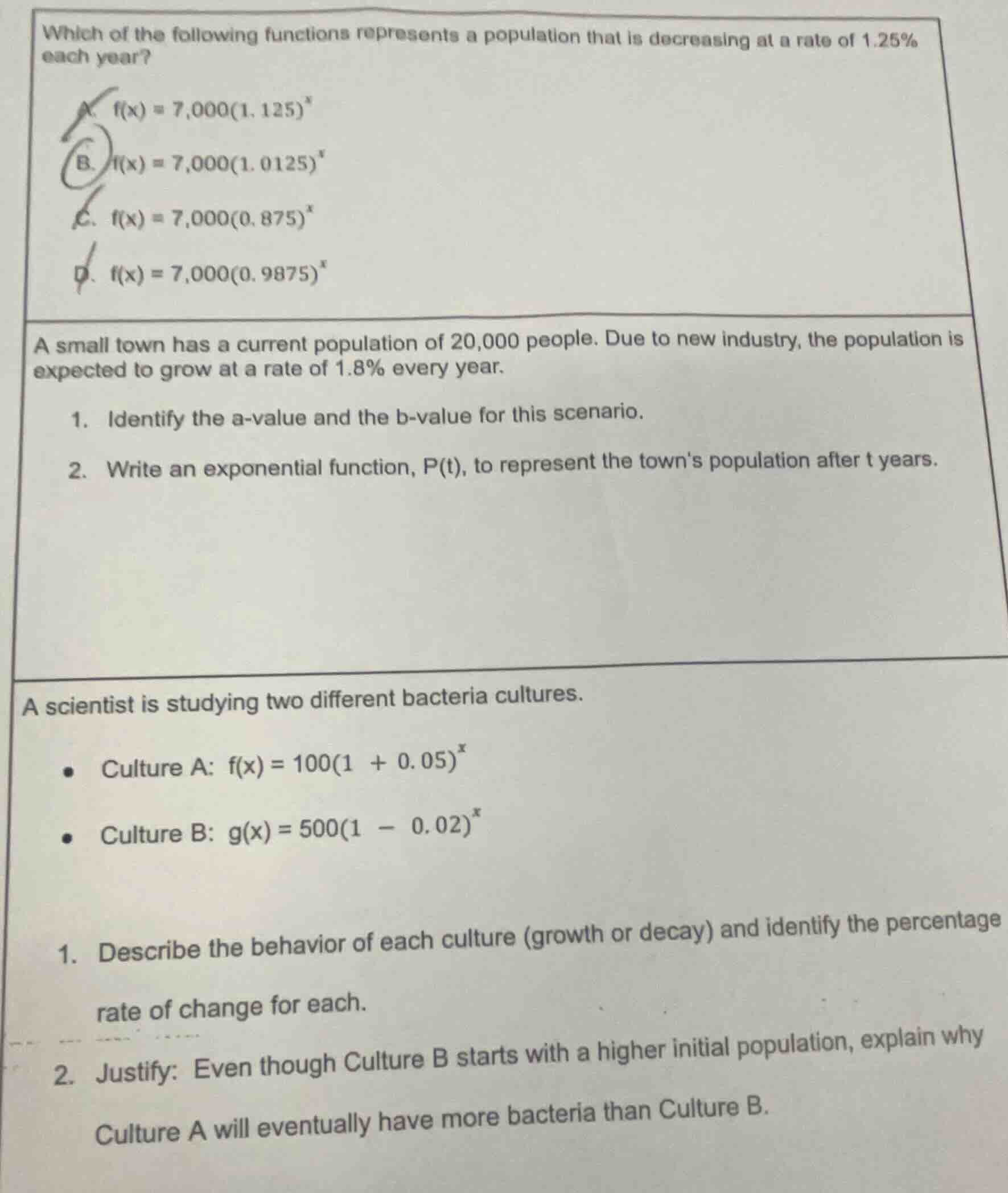
which of the following functions represents a population that is decreasing at a rate of 1.25% each year? a. $f(x) = 7,000(1.125)^x$ b. $f(x) = 7,000(1.0125)^x$ c. $f(x) = 7,000(0.875)^x$ d. $f(x) = 7,000(0.9875)^x$ a small town has a current population of 20,000 people. due to new industry, the population is expected to grow at a rate of 1.8% every year. 1. identify the a - value and the b - value for this scenario. 2. write an exponential function, $p(t)$, to represent the towns population after t years. a scientist is studying two different bacteria cultures. - culture a: $f(x)=100(1 + 0.05)^x$ - culture b: $g(x)=500(1 - 0.02)^x$ 1. describe the behavior of each culture (growth or decay) and identify the percentage rate of change for each. 2. justify: even though culture b starts with a higher initial population, explain why culture a will eventually have more bacteria than culture b.
First Question (Which function represents a population decreasing at 1.25% yearly?)
Step1: Recall exponential decay formula
The general form for exponential decay is \( f(x) = a(1 - r)^x \), where \( a \) is the initial amount, \( r \) is the rate of decrease (in decimal), and \( x \) is time. For a decrease of 1.25% (or \( r = 0.0125 \)), the base is \( 1 - 0.0125 = 0.9875 \).
Step2: Analyze each option
- Option A: \( 1.125>1 \), so it's growth (12.5% growth), not decay.
- Option B: \( 1.0125>1 \), growth (1.25% growth), not decay.
- Option C: \( 0.875 = 1 - 0.125 \), which would be 12.5% decay, not 1.25%.
- Option D: \( 0.9875 = 1 - 0.0125 \), which is 1.25% decay.
Step1: Recall exponential growth formula
The general form for exponential growth is \( P(t) = a(1 + r)^t \), where \( a \) is the initial population, \( r \) is the growth rate (in decimal), and \( t \) is time. The base \( b = 1 + r \).
Step2: Determine \( a \) and \( b \)
- Initial population \( a = 20,000 \) (current population).
- Growth rate \( r = 1.8\% = 0.018 \), so \( b = 1 + 0.018 = 1.018 \).
Step1: Use the exponential growth formula
Substitute \( a = 20,000 \) and \( b = 1.018 \) into \( P(t) = a \cdot b^t \).
Step2: Form the function
\( P(t) = 20,000(1.018)^t \)

Snap & solve any problem in the app
Get step-by-step solutions on Sovi AI
Photo-based solutions with guided steps
Explore more problems and detailed explanations
D. \( f(x) = 7,000(0.9875)^x \)