QUESTION IMAGE
Question
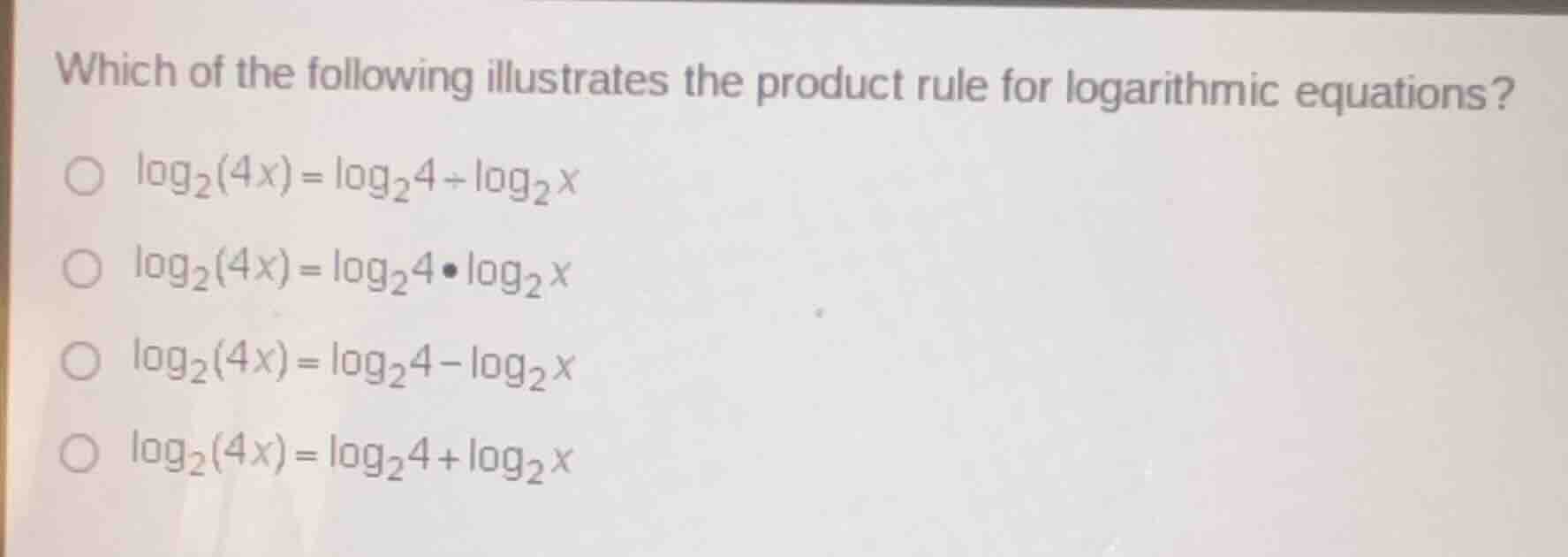
which of the following illustrates the product rule for logarithmic equations?
○ $\log_{2}(4x)=\log_{2}4\div\log_{2}x$
○ $\log_{2}(4x)=\log_{2}4\bullet\log_{2}x$
○ $\log_{2}(4x)=\log_{2}4-\log_{2}x$
○ $\log_{2}(4x)=\log_{2}4+\log_{2}x$
The product rule for logarithms states that for any positive real numbers \( a \), \( b \), and \( c \) (where \( c
eq 1 \)), \( \log_c(ab)=\log_c a+\log_c b \).
We need to apply this rule to \( \log_2(4x) \). Here, \( a = 4 \) and \( b=x \), and the base \( c = 2 \).
So, by the product rule of logarithms, \( \log_2(4x)=\log_2 4+\log_2 x \).
Now let's analyze each option:
- First option: Has a division sign, which is not part of the product rule.
- Second option: Has a multiplication sign, which is not part of the product rule.
- Third option: Has a subtraction sign, which is part of the quotient rule, not the product rule.
- Fourth option: Matches the product rule \( \log_c(ab)=\log_c a+\log_c b \) with \( c = 2 \), \( a = 4 \), and \( b=x \).

Snap & solve any problem in the app
Get step-by-step solutions on Sovi AI
Photo-based solutions with guided steps
Explore more problems and detailed explanations
D. \( \log_2(4x)=\log_24+\log_2x \) (assuming the options are labeled A, B, C, D in order, with the last one being D)