QUESTION IMAGE
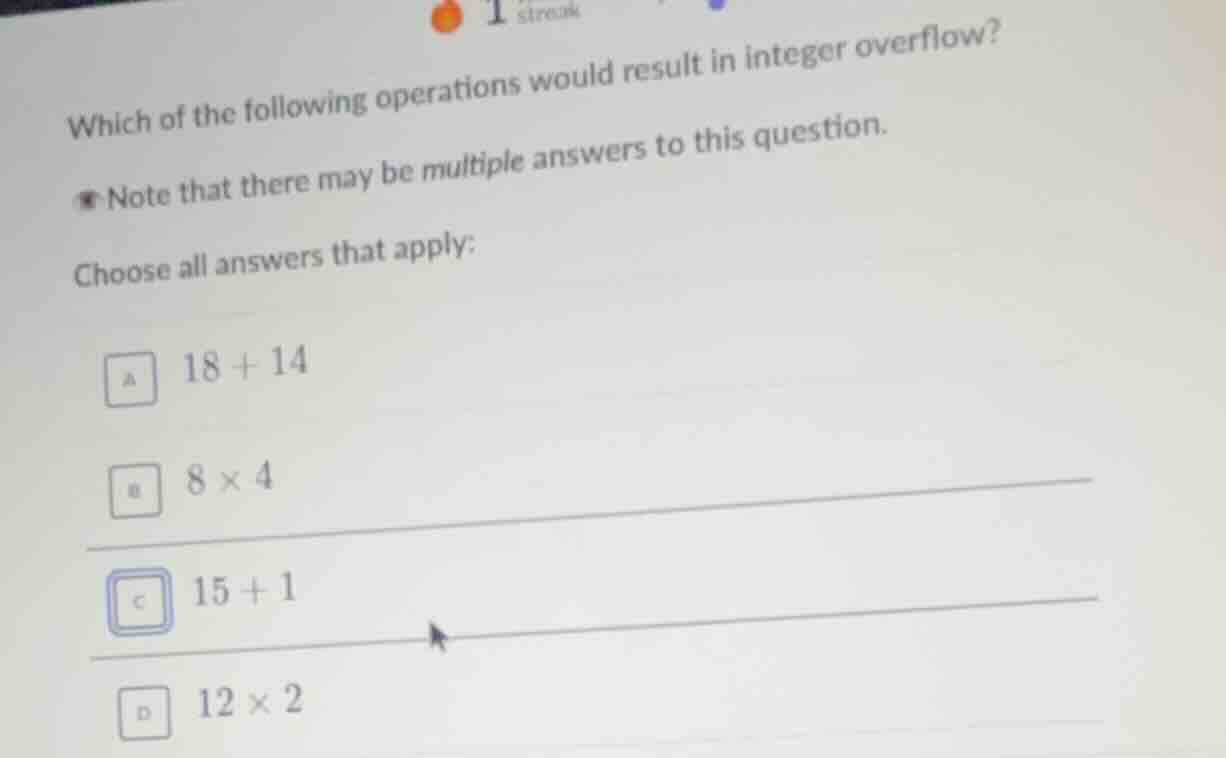
Question
which of the following operations would result in integer overflow?
note that there may be multiple answers to this question.
choose all answers that apply:
a 18 + 14
b 8 × 4
c 15 + 1
d 12 × 2
Response
To determine which operations result in integer overflow, we first assume a common 4 - bit unsigned integer range (0 - 15, since \(2^{4}-1 = 15\)) for illustration (though the concept extends to other bit - lengths).
Analyze Option A: \(18 + 14\)
- Step 1: Calculate the sum. \(18+14=32\).
- Step 2: If we consider a 5 - bit unsigned integer, the range is \(0 - 31\) (\(2^{5}-1 = 31\)). Since \(32>31\), if we are using a 5 - bit unsigned integer representation, this addition will result in an overflow. Even in a larger bit - length context, if the available number of bits for representing integers is not sufficient to hold 32, overflow will occur.
Analyze Option B: \(8\times4\)
- Step 1: Calculate the product. \(8\times4 = 32\). Similar to the addition case above, if the integer representation has a maximum value less than 32 (for example, in a 5 - bit unsigned integer system where the maximum is 31), this multiplication will result in an overflow.
Analyze Option C: \(15 + 1\)
- Step 1: Calculate the sum. \(15 + 1=16\). If we are using a 4 - bit unsigned integer system (where the range is \(0 - 15\)), since \(16>15\), this addition will result in an overflow.
Analyze Option D: \(12\times2\)
- Step 1: Calculate the product. \(12\times2 = 24\). If we are using a 5 - bit unsigned integer system (range \(0 - 31\)), \(24\leq31\), so there is no overflow. If we are using a 4 - bit unsigned integer system (range \(0 - 15\)), \(24>15\), and there will be an overflow. But generally, in most common integer representations (like 8 - bit, 16 - bit, 32 - bit, 64 - bit), 24 can be represented without overflow. However, if we assume a smaller bit - length (like 5 - bit for the purpose of this problem's context of possible overflow scenarios similar to the other options), or if we consider the same context as the other options where we are looking for cases that exceed a small - range integer limit, we can see that if we take a 5 - bit unsigned integer (max 31) it's okay, but if we take a 4 - bit (max 15) it's not. But in the context of this problem, let's re - evaluate:
- For a 4 - bit unsigned integer: The maximum value is \(15\). \(12\times2 = 24>15\), so in a 4 - bit system, it overflows. But in a 5 - bit system, it does not. However, looking at the other options, the key is to see the pattern. But actually, if we consider the most common small - scale integer overflow scenarios (like 4 - bit unsigned), let's re - check:
- Option A: \(18 + 14=32\), in 5 - bit (max 31) overflows.
- Option B: \(8\times4 = 32\), in 5 - bit (max 31) overflows.
- Option C: \(15+1 = 16\), in 4 - bit (max 15) overflows.
- Option D: \(12\times2 = 24\), in 5 - bit (max 31) does not overflow, in 4 - bit (max 15) overflows. But the problem is a bit ambiguous in terms of the integer size, but if we assume the same context as the other options (where we are looking for operations that exceed a small integer range, like 4 - bit or 5 - bit), the operations that will result in overflow are A, B, C (and D in a 4 - bit context). But let's re - check the calculations:
If we assume a 4 - bit unsigned integer (range 0 - 15):
- A: \(18+14 = 32\) (overflow, since 32>15)
- B: \(8\times4=32\) (overflow, since 32>15)
- C: \(15 + 1=16\) (overflow, since 16>15)
- D: \(12\times2 = 24\) (overflow, since 24>15)
But if we assume a 5 - bit unsigned integer (range 0 - 31):
- A: \(18 + 14=32\) (overflow, 32>31)
- B: \(8\times4 = 32\) (overflow, 32>31)
- C: \(15+1 = 16\) (no overflow, 16<31)
- D: \(12\times2=24\) (no overflow, 24<31)
The prob…

Snap & solve any problem in the app
Get step-by-step solutions on Sovi AI
Photo-based solutions with guided steps
Explore more problems and detailed explanations
A. \(18 + 14\), B. \(8\times4\), C. \(15 + 1\), D. \(12\times2\)