QUESTION IMAGE
Question
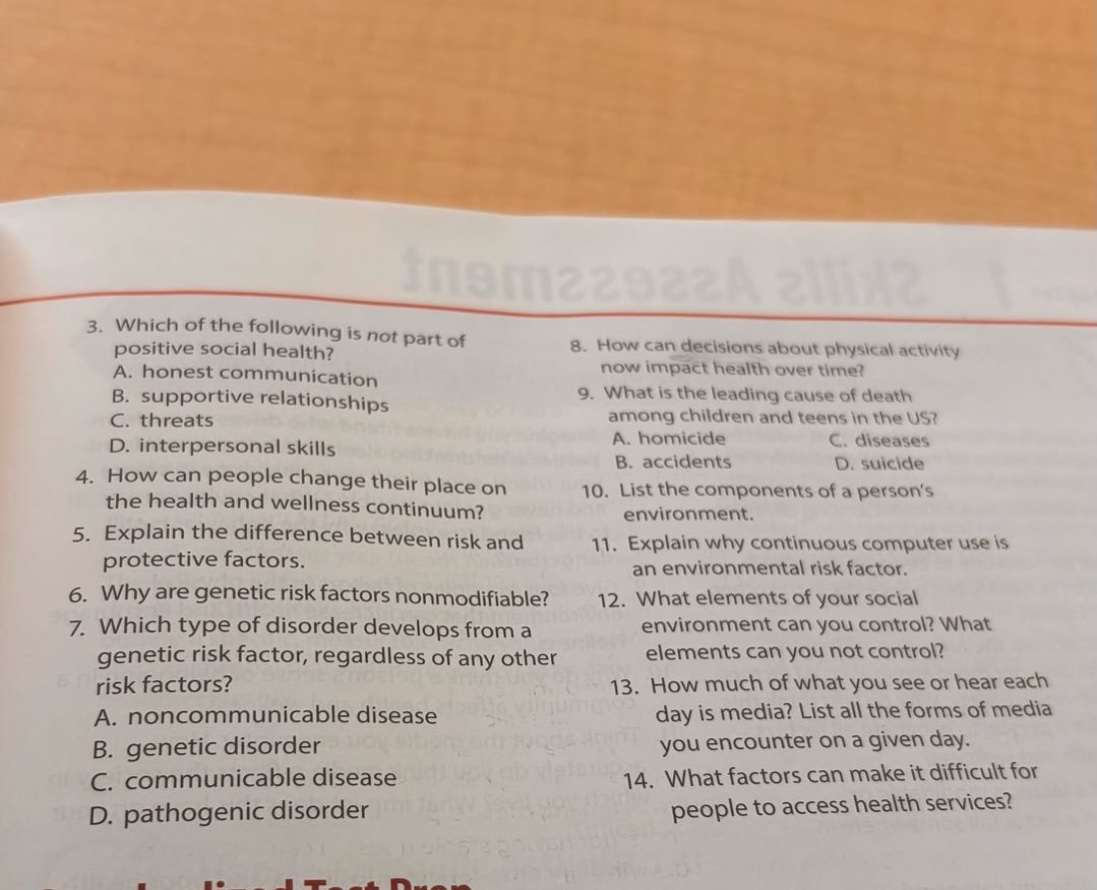
- which of the following is not part of positive social health? a. honest communication b. supportive relationships c. threats d. interpersonal skills 4. how can people change their place on the health and wellness continuum? 5. explain the difference between risk and protective factors. 6. why are genetic risk factors nonmodifiable? 7. which type of disorder develops from a genetic risk factor, regardless of any other risk factors? a. noncommunicable disease b. genetic disorder c. communicable disease d. pathogenic disorder 8. how can decisions about physical activity now impact health over time? 9. what is the leading cause of death among children and teens in the us? a. homicide c. diseases b. accidents d. suicide 10. list the components of a persons environment. 11. explain why continuous computer use is an environmental risk factor. 12. what elements of your social environment can you control? what elements can you not control? 13. how much of what you see or hear each day is media? list all the forms of media you encounter on a given day. 14. what factors can make it difficult for people to access health services?
Question 3
Positive social health involves healthy interactions. Honest communication (A), supportive relationships (B), and interpersonal skills (D) are positive. Threats (C) are negative and not part of positive social health.
A genetic disorder is caused by genetic risk factors and develops regardless of other factors. Noncommunicable diseases (A) may have other causes, communicable (C) are from pathogens, pathogenic (D) is not the term for this.
Among US children/teens, accidents (like unintentional injuries) are a leading cause of death. Homicide (A), diseases (C), and suicide (D) are not as leading as accidents for this group.

Snap & solve any problem in the app
Get step-by-step solutions on Sovi AI
Photo-based solutions with guided steps
Explore more problems and detailed explanations
C. threats