QUESTION IMAGE
Question
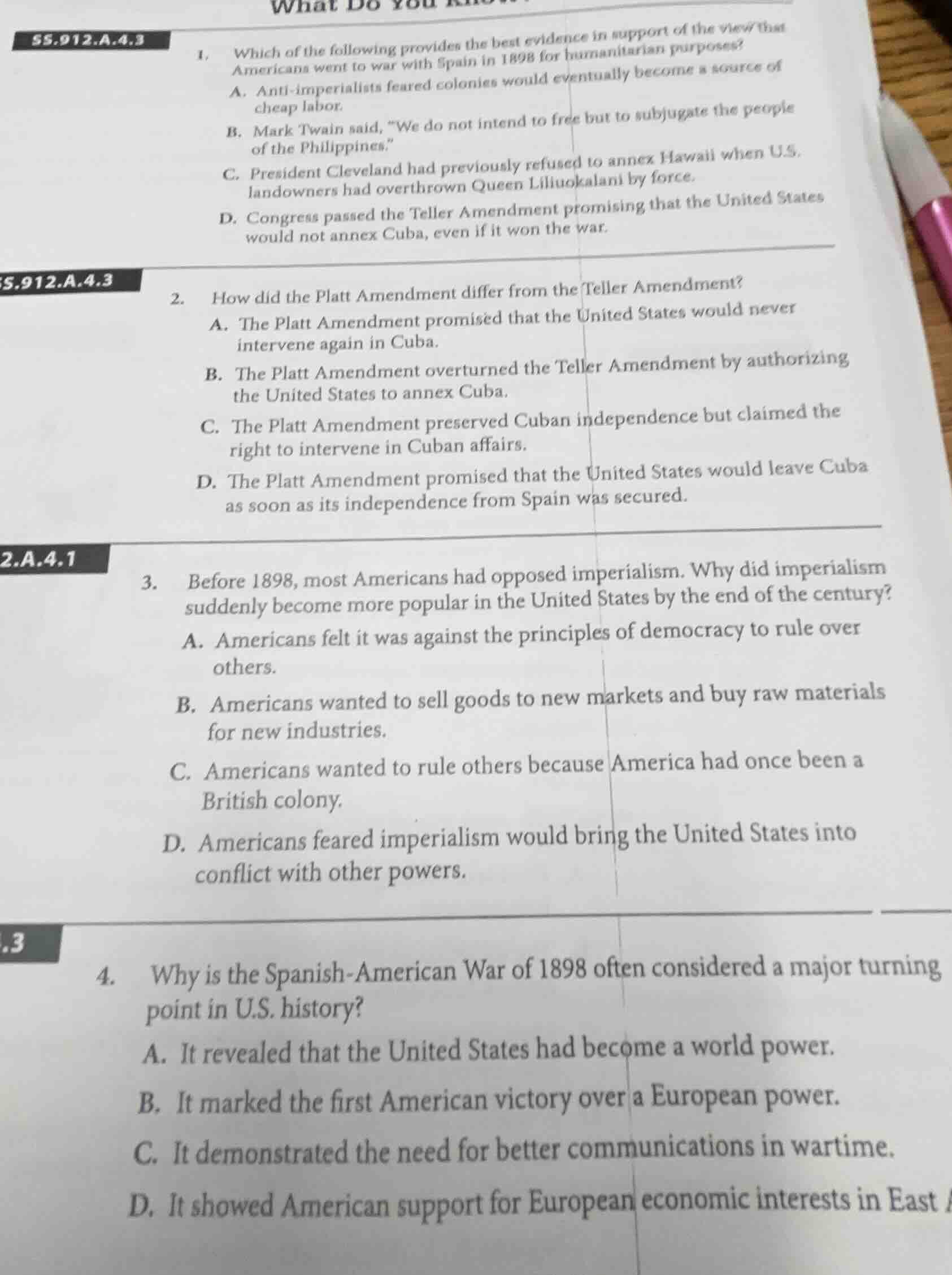
- which of the following provides the best evidence in support of the view that americans went to war with spain in 1898 for humanitarian purposes?
a. anti - imperialists feared colonies would eventually become a source of cheap labor.
b. mark twain said, \we do not intend to free but to subjugate the people of the philippines.\
c. president cleveland had previously refused to annex hawaii when u.s. landowners had overthrown queen liliuokalani by force.
d. congress passed the teller amendment promising that the united states would not annex cuba, even if it won the war.
- how did the platt amendment differ from the teller amendment?
a. the platt amendment promised that the united states would never intervene again in cuba.
b. the platt amendment overturned the teller amendment by authorizing the united states to annex cuba.
c. the platt amendment preserved cuban independence but claimed the right to intervene in cuban affairs.
d. the platt amendment promised that the united states would leave cuba as soon as its independence from spain was secured.
- before 1898, most americans had opposed imperialism. why did imperialism suddenly become more popular in the united states by the end of the century?
a. americans felt it was against the principles of democracy to rule over others.
b. americans wanted to sell goods to new markets and buy raw materials for new industries.
c. americans wanted to rule others because america had once been a british colony.
d. americans feared imperialism would bring the united states into conflict with other powers.
- why is the spanish - american war of 1898 often considered a major turning point in u.s. history?
a. it revealed that the united states had become a world power.
b. it marked the first american victory over a european power.
c. it demonstrated the need for better communications in wartime.
d. it showed american support for european economic interests in east
- For question 1: The Teller Amendment stated the U.S. would not annex Cuba, framing the war as a humanitarian effort to free Cuba rather than a land grab. Other options relate to anti-imperialism or prior annexation actions not tied to humanitarian war motives.
- For question 2: The Teller Amendment ruled out annexing Cuba, while the Platt Amendment let the U.S. intervene in Cuban affairs while keeping Cuba nominally independent. Options A, B, and D misstate the Platt Amendment's terms.
- For question 3: By the late 1800s, U.S. industrial growth created demand for new markets to sell goods and access to raw materials, driving support for imperialism. The other options reflect anti-imperial views or incorrect rationales.
- For question 4: The Spanish-American War led to the U.S. gaining overseas territories (Puerto Rico, Guam, Philippines) and asserting itself as a global power, marking a key shift in its role. Option B is incorrect (the U.S. defeated Britain in the Revolutionary War), and C/D are not the core turning point.

Snap & solve any problem in the app
Get step-by-step solutions on Sovi AI
Photo-based solutions with guided steps
Explore more problems and detailed explanations
- D. Congress passed the Teller Amendment promising that the United States would not annex Cuba, even if it won the war.
- C. The Platt Amendment preserved Cuban independence but claimed the right to intervene in Cuban affairs.
- B. Americans wanted to sell goods to new markets and buy raw materials for new industries.
- A. It revealed that the United States had become a world power.