QUESTION IMAGE
Question
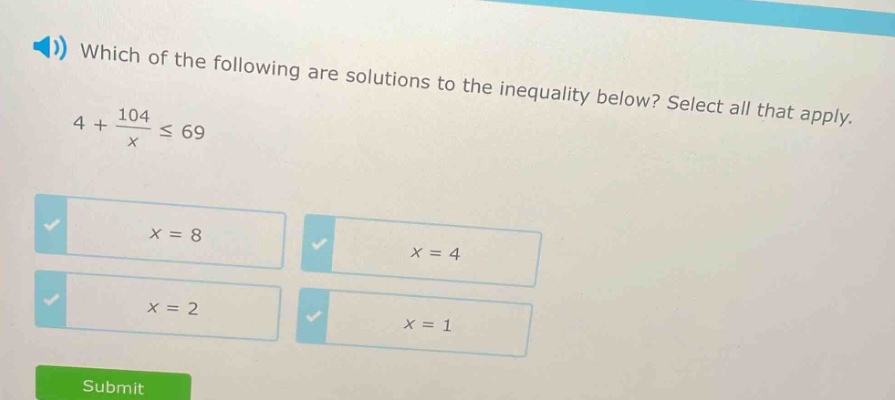
which of the following are solutions to the inequality below? select all that apply.
$4 + \frac{104}{x} \leq 69$
$x = 8$
$x = 4$
$x = 2$
$x = 1$
Step1: Solve the inequality \(4 + \frac{104}{x} \leq 69\)
Subtract 4 from both sides: \(\frac{104}{x} \leq 69 - 4\)
\(\frac{104}{x} \leq 65\)
Step2: Analyze the domain (x ≠ 0) and solve for x
Case 1: \(x > 0\)
Multiply both sides by x (since x > 0, inequality direction remains): \(104 \leq 65x\)
Divide both sides by 65: \(x \geq \frac{104}{65} = 1.6\)
Case 2: \(x < 0\)
Multiply both sides by x (since x < 0, inequality direction reverses): \(104 \geq 65x\)
Divide both sides by 65: \(x \leq \frac{104}{65} = 1.6\), but since \(x < 0\), this case gives \(x < 0\)
Now check the given values:
- \(x = 8\): \(8 \geq 1.6\) (satisfies \(x > 0\) case)
- \(x = 4\): \(4 \geq 1.6\) (satisfies \(x > 0\) case)
- \(x = 2\): \(2 \geq 1.6\) (satisfies \(x > 0\) case)
- \(x = 1\): \(1 < 1.6\) and \(1 > 0\), so does not satisfy \(x \geq 1.6\) (wait, earlier mistake? Wait let's recalculate the inequality with x=1: \(4 + \frac{104}{1}= 108\), and \(108 \leq 69\)? No, 108 > 69. Wait, maybe the initial check was wrong. Wait let's re - evaluate each value:
For \(x = 8\): \(4+\frac{104}{8}=4 + 13=17\leq69\) (True)
For \(x = 4\): \(4+\frac{104}{4}=4 + 26 = 30\leq69\) (True)
For \(x = 2\): \(4+\frac{104}{2}=4 + 52=56\leq69\) (True)
For \(x = 1\): \(4+\frac{104}{1}=108\leq69\) (False)
Wait, maybe there was a miscalculation in the inequality solving. Let's re - solve the inequality:
\(4+\frac{104}{x}\leq69\)
\(\frac{104}{x}\leq65\)
\(\frac{104}{x}-65\leq0\)
\(\frac{104 - 65x}{x}\leq0\)
Find critical points: \(x = 0\) and \(104-65x = 0\Rightarrow x=\frac{104}{65}=1.6\)
The sign chart of \(\frac{104 - 65x}{x}\):
- For \(x < 0\): numerator \(104-65x>0\) (since x is negative, - 65x is positive), denominator \(x < 0\), so \(\frac{104 - 65x}{x}<0\) (satisfies the inequality)
- For \(0 < x<1.6\): numerator \(104 - 65x>0\) (since \(x<1.6\Rightarrow65x < 104\)), denominator \(x>0\), so \(\frac{104 - 65x}{x}>0\) (does not satisfy)
- For \(x>1.6\): numerator \(104 - 65x<0\) (since \(x > 1.6\Rightarrow65x>104\)), denominator \(x>0\), so \(\frac{104 - 65x}{x}<0\) (satisfies)
Now check each value:
- \(x = 8\): \(x>1.6\), so \(\frac{104 - 65\times8}{8}=\frac{104 - 520}{8}=\frac{- 416}{8}=- 52\leq0\) (True)
- \(x = 4\): \(x>1.6\), \(\frac{104 - 65\times4}{4}=\frac{104 - 260}{4}=\frac{- 156}{4}=- 39\leq0\) (True)
- \(x = 2\): \(x>1.6\), \(\frac{104 - 65\times2}{2}=\frac{104 - 130}{2}=\frac{- 26}{2}=- 13\leq0\) (True)
- \(x = 1\): \(0 < x<1.6\), \(\frac{104 - 65\times1}{1}=\frac{39}{1}=39>0\) (False)
So the correct solutions among the given options are \(x = 8\), \(x = 4\), \(x = 2\) (since \(x = 1\) does not satisfy the inequality).

Snap & solve any problem in the app
Get step-by-step solutions on Sovi AI
Photo-based solutions with guided steps
Explore more problems and detailed explanations
The correct solutions are \(x = 8\), \(x = 4\), \(x = 2\) (i.e., the options with \(x = 8\), \(x = 4\), \(x = 2\) should be selected, and \(x = 1\) should not be selected).