QUESTION IMAGE
Question
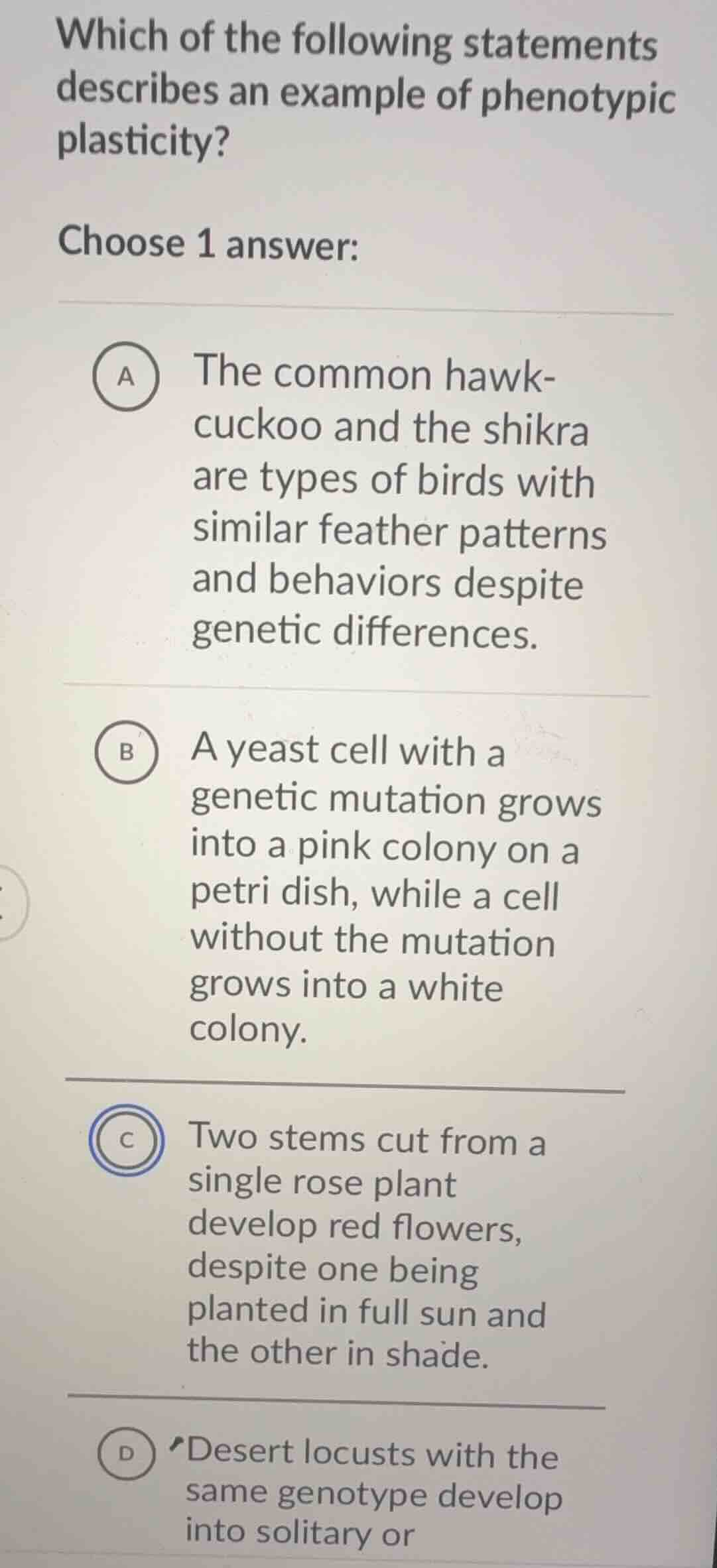
which of the following statements describes an example of phenotypic plasticity?
choose 1 answer:
a the common hawk-cuckoo and the shikra are types of birds with similar feather patterns and behaviors despite genetic differences.
b a yeast cell with a genetic mutation grows into a pink colony on a petri dish, while a cell without the mutation grows into a white colony.
c two stems cut from a single rose plant develop red flowers, despite one being planted in full sun and the other in shade.
d desert locusts with the same genotype develop into solitary or
Phenotypic plasticity is the ability of an organism with the same genotype to show different phenotypes in different environments. Let's analyze each option:
- Option A: Describes two different species (different genotypes) with similar phenotypes, which is mimicry, not phenotypic plasticity.
- Option B: Describes a genetic mutation (different genotypes) leading to different phenotypes, not plasticity (which requires the same genotype).
- Option C: Two stems from the same plant (same genotype) develop the same flower color (phenotype) in different environments. This shows stability of phenotype despite environmental change, not plasticity (which needs different phenotypes in different environments).
- Option D (assuming the full option is about desert locusts with the same genotype developing into solitary or gregarious forms based on environment): Desert locusts with the same genotype (from the same species) develop different phenotypes (solitary or gregarious) based on environmental conditions, which fits phenotypic plasticity. Since the original image might have a typo but from the context, D is the correct example of phenotypic plasticity (same genotype, different phenotypes due to environment). But wait, the user's option C is selected, but let's re - check. Wait, the user's option C: two stems from the same rose (same genotype) have the same flower color in sun and shade. So their phenotype is the same across environments. Phenotypic plasticity needs different phenotypes. So the correct option should be D (even if the text is cut, the key is same genotype, different phenotypes due to environment). But maybe the original question's D is "Desert locusts with the same genotype develop into solitary or gregarious forms depending on environmental conditions". So that's phenotypic plasticity. But in the given options, the only one that fits (if we assume D is as such) is D. But maybe there was a mistake in the user's selection. Wait, let's re - evaluate:
Phenotypic plasticity definition: the ability of an organism to change its phenotype in response to changes in the environment, with the same genotype.
Option A: different genotypes (different species), similar phenotypes: mimicry, not plasticity.
Option B: different genotypes (mutation vs no mutation), different phenotypes: genetic variation, not plasticity.
Option C: same genotype (same rose plant), same phenotype (red flowers) in different environments: no plasticity (plasticity would be different phenotypes).
Option D: same genotype (desert locusts), different phenotypes (solitary or gregarious) based on environment: this is phenotypic plasticity.
So the correct answer is D (assuming the full option is as described). But since the user's option D is cut, but from the context of the question, the correct answer should be the one with same genotype and different phenotypes due to environment. So the answer is D (if we assume the full option is about desert locusts with same genotype developing different phenotypes based on environment).

Snap & solve any problem in the app
Get step-by-step solutions on Sovi AI
Photo-based solutions with guided steps
Explore more problems and detailed explanations
D. Desert locusts with the same genotype develop into solitary or (gregarious forms depending on environmental conditions)