QUESTION IMAGE
Question
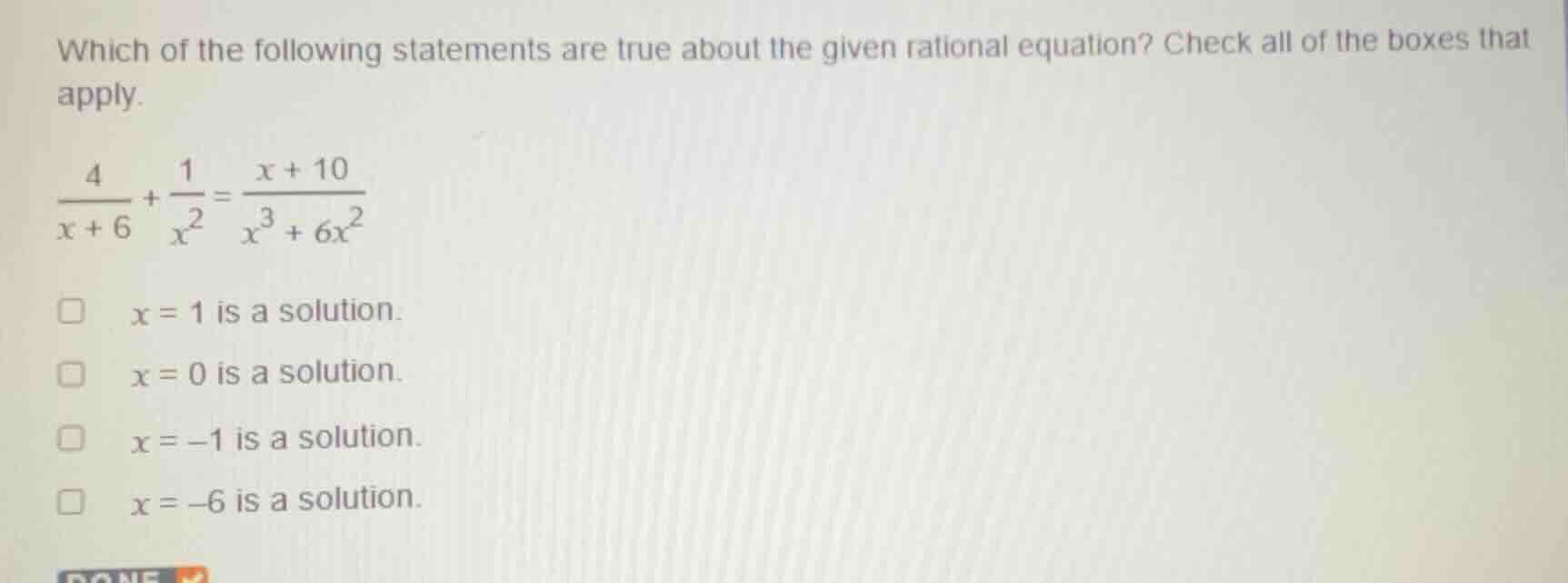
which of the following statements are true about the given rational equation? check all of the boxes that apply.\\(\frac{4}{x + 6}+\frac{1}{x^{2}}=\frac{x + 10}{x^{3}+6x^{2}}\\)\\(\square\\) \\(x = 1\\) is a solution.\\(\square\\) \\(x = 0\\) is a solution.\\(\square\\) \\(x=-1\\) is a solution.\\(\square\\) \\(x=-6\\) is a solution.
Step1: Find excluded values
First, identify values that make denominators zero:
Denominators: $x+6$, $x^2$, $x^3+6x^2 = x^2(x+6)$
Set denominators to 0:
$x+6=0 \implies x=-6$
$x^2=0 \implies x=0$
So $x=0$ and $x=-6$ are excluded (cannot be solutions).
Step2: Simplify the equation
Multiply all terms by $x^2(x+6)$ (the least common denominator) to eliminate fractions:
$$4 \cdot x^2 + 1 \cdot (x+6) = x+10$$
Step3: Expand and simplify
Expand left side, then combine like terms:
$4x^2 + x + 6 = x + 10$
Subtract $x$ from both sides:
$4x^2 + 6 = 10$
Subtract 10 from both sides:
$4x^2 - 4 = 0$
Divide by 4:
$x^2 - 1 = 0$
Step4: Solve for x
Factor and solve the quadratic:
$(x-1)(x+1)=0$
So $x=1$ or $x=-1$
Step5: Verify solutions
Check $x=1$ in original equation:
Left: $\frac{4}{1+6}+\frac{1}{1^2}=\frac{4}{7}+1=\frac{11}{7}$
Right: $\frac{1+10}{1^3+6(1)^2}=\frac{11}{7}$
Both sides equal, so valid.
Check $x=-1$ in original equation:
Left: $\frac{4}{-1+6}+\frac{1}{(-1)^2}=\frac{4}{5}+1=\frac{9}{5}$
Right: $\frac{-1+10}{(-1)^3+6(-1)^2}=\frac{9}{-1+6}=\frac{9}{5}$
Both sides equal, so valid.

Snap & solve any problem in the app
Get step-by-step solutions on Sovi AI
Photo-based solutions with guided steps
Explore more problems and detailed explanations
x = 1 is a solution.
x = -1 is a solution.