QUESTION IMAGE
Question
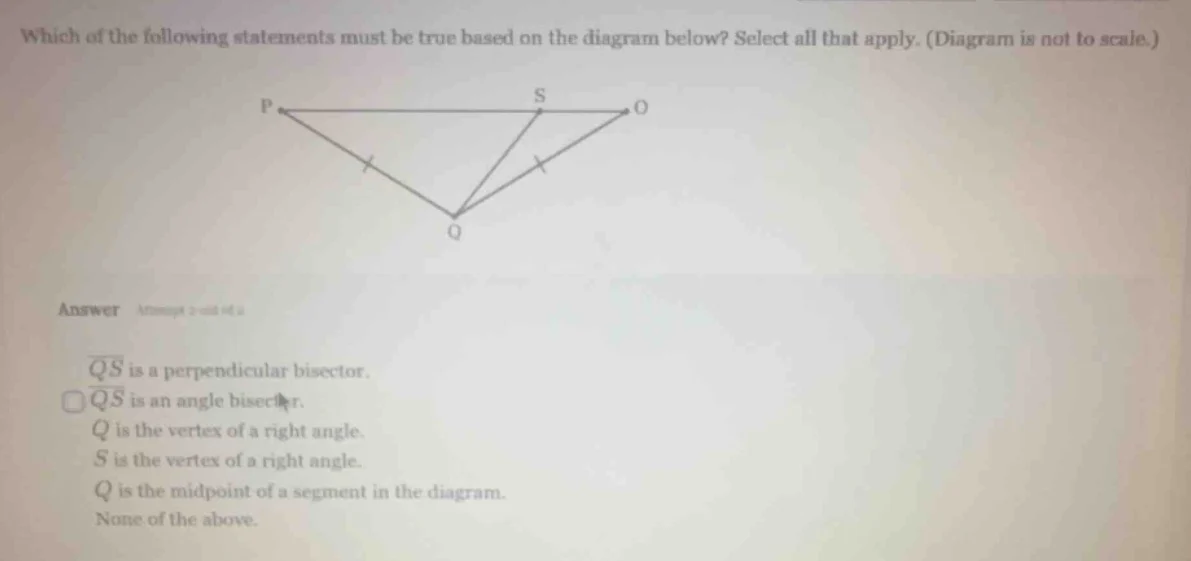
which of the following statements must be true based on the diagram below? select all that apply. (diagram is not to scale.)
answer
$overline{qs}$ is a perpendicular bisector.
$overline{qs}$ is an angle bisector.
$q$ is the vertex of a right angle.
$s$ is the vertex of a right angle.
$q$ is the midpoint of a segment in the diagram.
none of the above.
Brief Explanations
- A perpendicular bisector needs to be perpendicular and split a segment into two equal parts. We only know $\overline{PQ}=\overline{OQ}$, but there is no indication $\overline{QS}$ is perpendicular to $\overline{PO}$, so this is not necessarily true.
- An angle bisector splits an angle into two equal angles. In $\triangle PQO$, $\overline{PQ}=\overline{OQ}$, so it is isosceles with $PQ=OQ$. $\overline{QS}$ connects the apex $Q$ to a point $S$ on the base $\overline{PO}$. However, we do not know if $S$ is the midpoint of $\overline{PO}$, so we cannot confirm $\overline{QS}$ bisects $\angle PQO$.
- There is no right angle symbol or information proving $\angle PQO$ is a right angle, so this is not necessarily true.
- There is no right angle symbol or information proving $\angle PSQ$ or $\angle OSQ$ is a right angle, so this is not necessarily true.
- $Q$ is not on any segment in the diagram to be its midpoint; it is a vertex of a triangle, so this is false.
Since none of the first five statements must be true, the correct choice is the last option.

Snap & solve any problem in the app
Get step-by-step solutions on Sovi AI
Photo-based solutions with guided steps
Explore more problems and detailed explanations
None of the above.