QUESTION IMAGE
Question
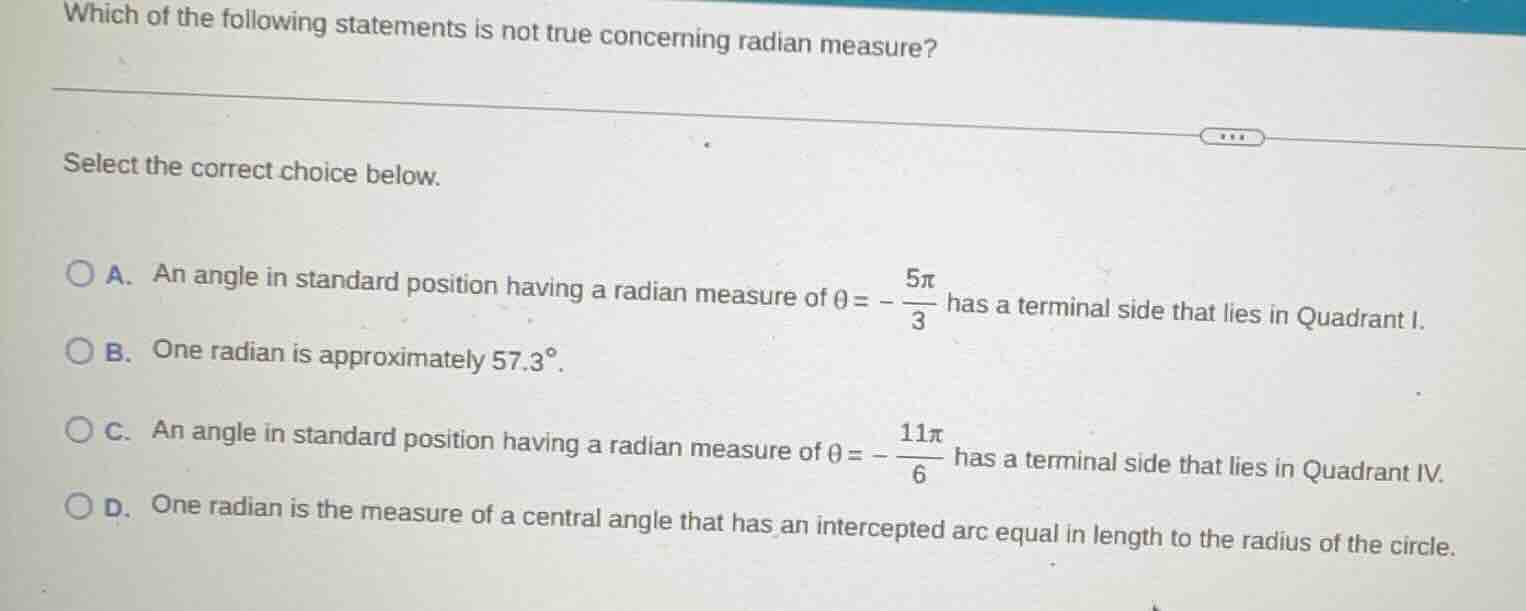
which of the following statements is not true concerning radian measure?
select the correct choice below.
a. an angle in standard position having a radian measure of \\(\theta = -\dfrac{5\pi}{3}\\) has a terminal side that lies in quadrant i.
b. one radian is approximately \\(57.3^\circ\\).
c. an angle in standard position having a radian measure of \\(\theta = -\dfrac{11\pi}{6}\\) has a terminal side that lies in quadrant iv.
d. one radian is the measure of a central angle that has an intercepted arc equal in length to the radius of the circle.
Step1: Analyze Option A
To find the quadrant of \(\theta = -\frac{5\pi}{3}\), we add \(2\pi\) (a full rotation) to get a coterminal angle: \(-\frac{5\pi}{3}+2\pi = -\frac{5\pi}{3}+\frac{6\pi}{3}=\frac{\pi}{3}\). \(\frac{\pi}{3}\) is in Quadrant I, so Option A is true.
Step2: Analyze Option B
We know that \(\pi\) radians \( = 180^\circ\), so 1 radian \(=\frac{180^\circ}{\pi}\approx\frac{180^\circ}{3.1416}\approx57.3^\circ\). So Option B is true.
Step3: Analyze Option C
To find the coterminal angle of \(\theta = -\frac{11\pi}{6}\), we add \(2\pi\) (or \(\frac{12\pi}{6}\)): \(-\frac{11\pi}{6}+\frac{12\pi}{6}=\frac{\pi}{6}\). \(\frac{\pi}{6}\) is in Quadrant I, not Quadrant IV. So we need to check the original angle's position. A negative angle rotates clockwise. \(-\frac{11\pi}{6}\) is equivalent to rotating clockwise \(\frac{11\pi}{6}\) radians. Since \(\frac{3\pi}{2}= \frac{9\pi}{6}\) and \(\frac{11\pi}{6}\) is more than \(\frac{9\pi}{6}\) (3π/2) and less than \(2\pi=\frac{12\pi}{6}\). So the terminal side of \(-\frac{11\pi}{6}\) lies in Quadrant I (because \(-\frac{11\pi}{6}+2\pi=\frac{\pi}{6}\) which is in Quadrant I). So the statement that it lies in Quadrant IV is false.
Step4: Analyze Option D
By definition, one radian is the measure of a central angle whose intercepted arc length is equal to the radius of the circle. So Option D is true.

Snap & solve any problem in the app
Get step-by-step solutions on Sovi AI
Photo-based solutions with guided steps
Explore more problems and detailed explanations
C. An angle in standard position having a radian measure of \(\theta = -\frac{11\pi}{6}\) has a terminal side that lies in Quadrant IV.