QUESTION IMAGE
Question
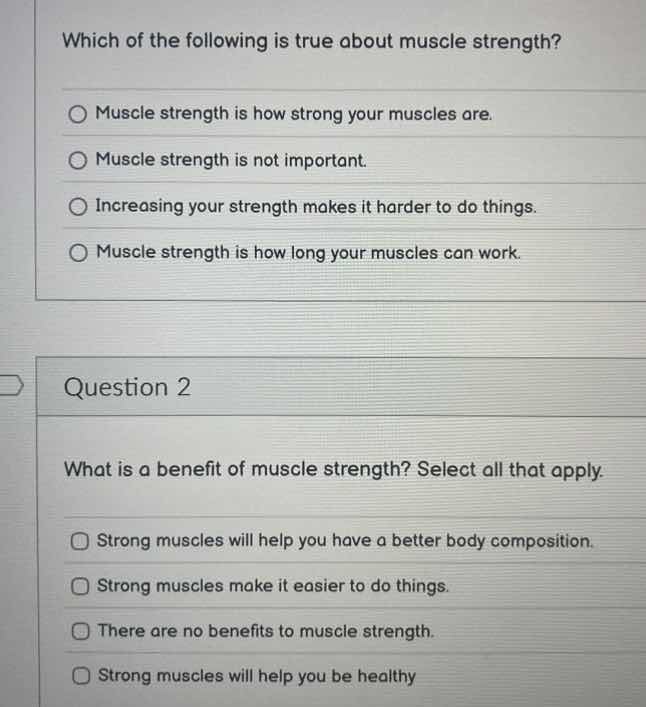
which of the following is true about muscle strength?
○ muscle strength is how strong your muscles are.
○ muscle strength is not important.
○ increasing your strength makes it harder to do things.
○ muscle strength is how long your muscles can work.
question 2
what is a benefit of muscle strength? select all that apply.
□ strong muscles will help you have a better body composition.
□ strong muscles make it easier to do things.
□ there are no benefits to muscle strength.
□ strong muscles will help you be healthy
Response
Question 1
Brief Explanations
- Analyze each option:
- "Muscle strength is how strong your muscles are." This is a basic and correct definition of muscle strength.
- "Muscle strength is not important." Muscle strength is important for daily activities, fitness, and health, so this is false.
- "Increasing your strength makes it harder to do things." Increasing strength typically makes tasks easier as muscles can exert more force, so this is false.
- "Muscle strength is how long your muscles can work." That describes muscle endurance, not strength, so this is false.
Brief Explanations
- Analyze each option:
- "Strong muscles will help you have a better body composition." Stronger muscles can contribute to a higher muscle - to - fat ratio, improving body composition, so this is a benefit.
- "Strong muscles make it easier to do things." With more strength, physical tasks like lifting, walking, etc., become easier, so this is a benefit.
- "There are no benefits to muscle strength." This is false as strength has multiple benefits like improved health, better performance in activities.
- "Strong muscles will help you be healthy." Strong muscles support joint health, metabolic rate, and overall physical function, contributing to health, so this is a benefit.

Snap & solve any problem in the app
Get step-by-step solutions on Sovi AI
Photo-based solutions with guided steps
Explore more problems and detailed explanations
A. Muscle strength is how strong your muscles are.