QUESTION IMAGE
Question
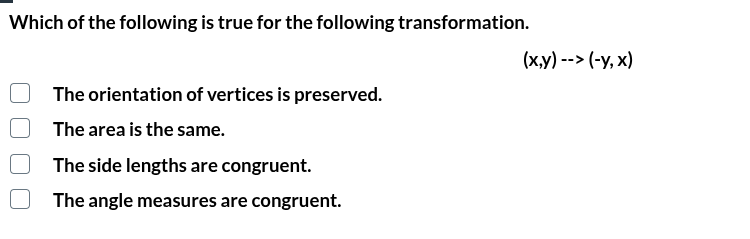
which of the following is true for the following transformation.
\\((x,y) --> (-y, x)\\)
- the orientation of vertices is preserved.
- the area is the same.
- the side lengths are congruent.
- the angle measures are congruent.
Brief Explanations
- First, analyze the transformation \((x,y)\to(-y,x)\). This is a 90 - degree counter - clockwise rotation about the origin.
- Orientation of vertices: A rotation changes the orientation of the vertices. For example, if we have a triangle with vertices in clock - wise order, after a 90 - degree counter - clockwise rotation, the order of the vertices will be counter - clockwise (or vice - versa), so the orientation of vertices is not preserved.
- Area: Rotations are rigid transformations. A rigid transformation is a transformation that preserves the shape and size of a figure. For a rigid transformation, the area of the figure remains the same. When we rotate a figure, the distances between points (which determine the area) do not change.
- Side lengths: Since rotation is a rigid transformation, the distance between any two points \((x_1,y_1)\) and \((x_2,y_2)\) in the original figure and their images \((-y_1,x_1)\) and \((-y_2,x_2)\) can be calculated using the distance formula \(d = \sqrt{(x_2 - x_1)^2+(y_2 - y_1)^2}\) for the original points and \(d'=\sqrt{(-y_2 + y_1)^2+(x_2 - x_1)^2}=\sqrt{(y_1 - y_2)^2+(x_2 - x_1)^2}=\sqrt{(x_2 - x_1)^2+(y_2 - y_1)^2}\) (because \((a - b)^2=(b - a)^2\)). So the side lengths are congruent.
- Angle measures: Rigid transformations also preserve angle measures. When we rotate a figure, the angles between the sides of the figure remain the same because the relative positions of the sides (in terms of their slopes and the way they are oriented with respect to each other) are preserved up to rotation, and the angle between two lines is determined by their slopes (or the vectors representing the sides), and rotation does not change the angle between two vectors. If we have two vectors \(\vec{v}=(x_2 - x_1,y_2 - y_1)\) and \(\vec{u}=(x_3 - x_1,y_3 - y_1)\) in the original figure, their images after rotation are \(\vec{v}'=(-(y_2 - y_1),x_2 - x_1)\) and \(\vec{u}'=(-(y_3 - y_1),x_3 - x_1)\). The dot product formula for the angle \(\theta\) between two vectors \(\vec{a}=(a_1,a_2)\) and \(\vec{b}=(b_1,b_2)\) is \(\cos\theta=\frac{\vec{a}\cdot\vec{b}}{\vert\vec{a}\vert\vert\vec{b}\vert}\). For the original vectors, \(\vec{v}\cdot\vec{u}=(x_2 - x_1)(x_3 - x_1)+(y_2 - y_1)(y_3 - y_1)\), and for the rotated vectors, \(\vec{v}'\cdot\vec{u}'=-(y_2 - y_1)(-(y_3 - y_1))+(x_2 - x_1)(x_3 - x_1)=(y_2 - y_1)(y_3 - y_1)+(x_2 - x_1)(x_3 - x_1)=\vec{v}\cdot\vec{u}\). Also, \(\vert\vec{v}'\vert=\vert\vec{v}\vert\) and \(\vert\vec{u}'\vert=\vert\vec{u}\vert\) as we saw from the distance formula. So \(\cos\theta'=\cos\theta\), which means the angle measures are congruent.

Snap & solve any problem in the app
Get step-by-step solutions on Sovi AI
Photo-based solutions with guided steps
Explore more problems and detailed explanations
- The area is the same.
- The side lengths are congruent.
- The angle measures are congruent.