QUESTION IMAGE
Question
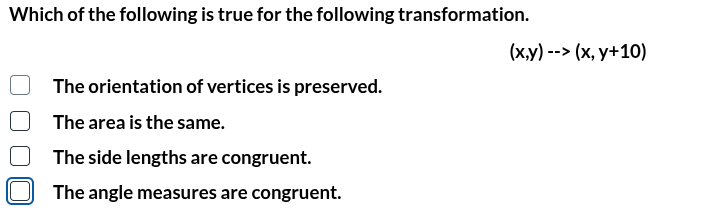
which of the following is true for the following transformation.
(x,y) --> (x, y+10)
the orientation of vertices is preserved.
the area is the same.
the side lengths are congruent.
the angle measures are congruent.
To determine the truth of each statement for the transformation \((x,y) \to (x, y + 10)\), we analyze the type of transformation:
Step 1: Identify the Transformation Type
The transformation \((x,y) \to (x, y + 10)\) is a vertical translation (shift) of the graph. A translation is a rigid transformation, which means it preserves the shape and size of the figure.
Step 2: Analyze Each Statement
- "The orientation of vertices is preserved."
Translations preserve the orientation of vertices because they do not involve rotation or reflection. So this statement is true.
- "The area is the same."
Rigid transformations (like translations) preserve the area of the figure. Since the shape and size remain unchanged, the area is the same. This statement is true.
- "The side lengths are congruent."
Rigid transformations preserve side lengths (they are congruent). This statement is true.
- "The angle measures are congruent."
Rigid transformations preserve angle measures (they are congruent). This statement is true.
Final Answer
All four statements are true:
- The orientation of vertices is preserved.
- The area is the same.
- The side lengths are congruent.
- The angle measures are congruent.
(If selecting all applicable options, mark all four checkboxes.)

Snap & solve any problem in the app
Get step-by-step solutions on Sovi AI
Photo-based solutions with guided steps
Explore more problems and detailed explanations
To determine the truth of each statement for the transformation \((x,y) \to (x, y + 10)\), we analyze the type of transformation:
Step 1: Identify the Transformation Type
The transformation \((x,y) \to (x, y + 10)\) is a vertical translation (shift) of the graph. A translation is a rigid transformation, which means it preserves the shape and size of the figure.
Step 2: Analyze Each Statement
- "The orientation of vertices is preserved."
Translations preserve the orientation of vertices because they do not involve rotation or reflection. So this statement is true.
- "The area is the same."
Rigid transformations (like translations) preserve the area of the figure. Since the shape and size remain unchanged, the area is the same. This statement is true.
- "The side lengths are congruent."
Rigid transformations preserve side lengths (they are congruent). This statement is true.
- "The angle measures are congruent."
Rigid transformations preserve angle measures (they are congruent). This statement is true.
Final Answer
All four statements are true:
- The orientation of vertices is preserved.
- The area is the same.
- The side lengths are congruent.
- The angle measures are congruent.
(If selecting all applicable options, mark all four checkboxes.)