QUESTION IMAGE
Question
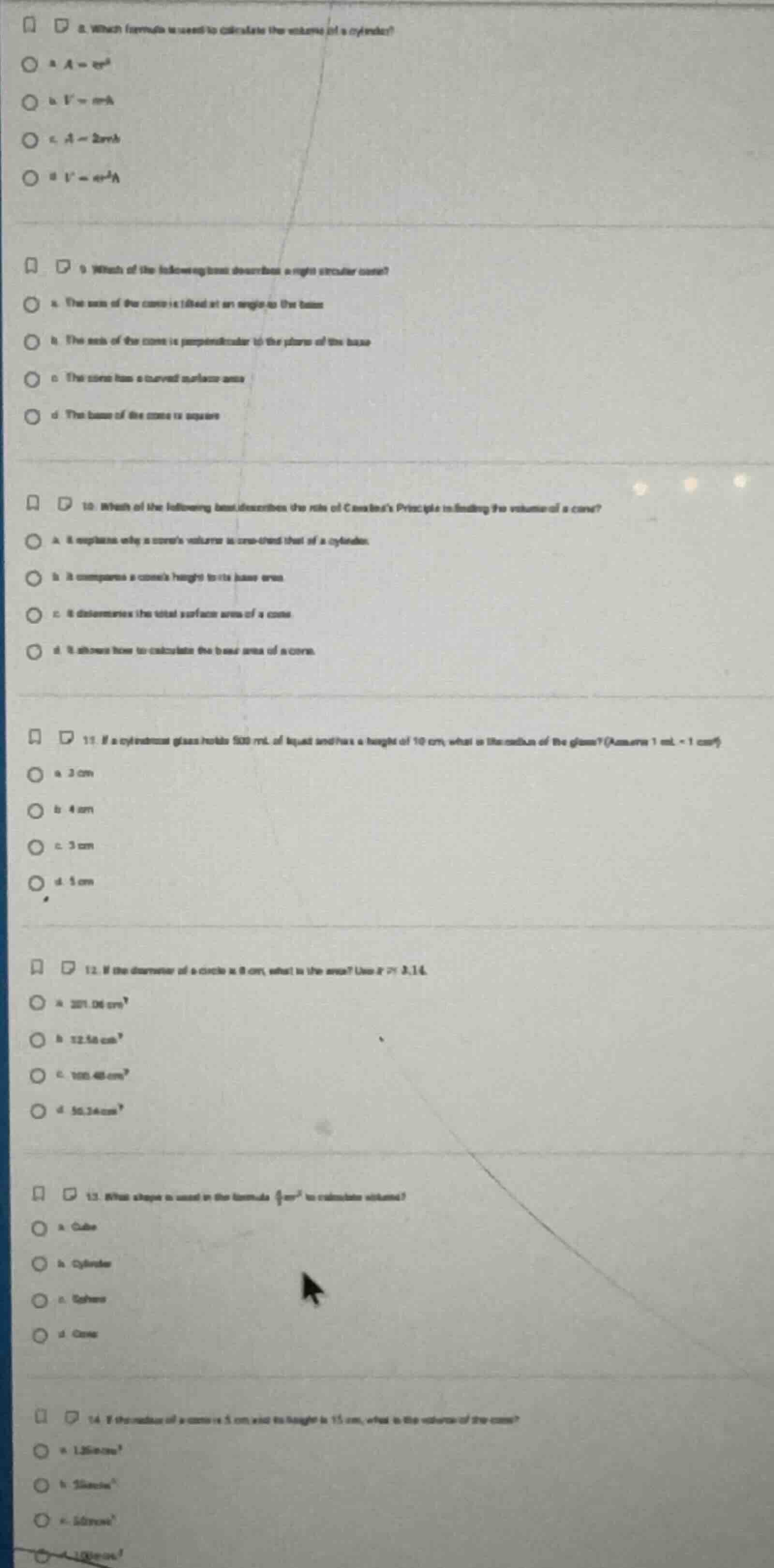
- which formula is used to calculate the volume of a cylinder?
a. $a = pi r^2$
b. $v = pi r^2 h$
c. $a = 2pi r h$
d. $v = pi r^2 a$
- which of the following best describes a right circular cone?
a. the axis of the cone is tilted at an angle to the base
b. the axis of the cone is perpendicular to the plane of the base
c. the cone has a curved surface area
d. the base of the cone is square
- which of the following best describes the role of cavalieri’s principle in finding the volume of a cone?
a. it explains why a cone’s volume is one - third that of a cylinder.
b. it compares a cone’s height to its base area.
c. it determines the total surface area of a cone.
d. it shows how to calculate the base area of a cone.
- if a cylindrical glass holds 500 ml of liquid and has a height of 10 cm, what is the radius of the glass? (assume 1 ml = 1 $cm^3$)
a. 2 cm
b. 4 cm
c. 3 cm
d. 5 cm
- if the diameter of a circle is 8 cm, what is the area? use $pi approx 3.14$.
a. 201.06 $cm^2$
b. 12.56 $cm^2$
c. 100.48 $cm^2$
d. 50.24 $cm^2$
- what shape is used in the formula $\frac{4}{3}pi r^3$ to calculate volume?
a. cube
b. cylinder
c. sphere
d. cone
- if the radius of a cone is 5 cm and its height is 15 cm, what is the volume of the cone?
Step1: Solve Q8 (Cylinder Volume Formula)
Identify the standard volume formula for a cylinder, which is $V = \pi r^2 h$ (matches option b, assuming typo in the image's $V=\pi r h$ is $V=\pi r^2 h$).
Step2: Solve Q9 (Right Circular Cone)
Recall the definition of a right circular cone: its axis is perpendicular to the base plane (option b).
Step3: Solve Q10 (Cavalieri's Principle)
Cavalieri's Principle compares volumes of solids with equal cross-sections; for cones, it shows the volume is $\frac{1}{3}$ of a cylinder's (option a).
Step4: Solve Q11 (Cylinder Radius Calculation)
Convert volume to $\text{cm}^3$: $500\ \text{mL}=500\ \text{cm}^3$. Use $V=\pi r^2 h$, solve for $r$:
$$r = \sqrt{\frac{V}{\pi h}} = \sqrt{\frac{500}{3.14 \times 10}} \approx \sqrt{15.92} \approx 4\ \text{cm}$$
(matches option b)
Step5: Solve Q12 (Circle Area Calculation)
Find radius: $r=\frac{d}{2}=\frac{8}{2}=4\ \text{cm}$. Use $A=\pi r^2$:
$$A=3.14 \times 4^2 = 3.14 \times 16 = 50.24\ \text{cm}^2$$
(matches option d)
Step6: Solve Q13 (Volume Formula Shape)
The formula $\frac{4}{3}\pi r^3$ is the standard volume formula for a sphere (option c).
Step7: Solve Q14 (Cone Volume Calculation)
Use cone volume formula $V=\frac{1}{3}\pi r^2 h$:
$$V=\frac{1}{3} \times 3.14 \times 5^2 \times 15 = \frac{1}{3} \times 3.14 \times 25 \times 15 = 392.5\ \text{cm}^3$$
(matches option b, assuming typo in image's $392.5$ is written as $392m$)

Snap & solve any problem in the app
Get step-by-step solutions on Sovi AI
Photo-based solutions with guided steps
Explore more problems and detailed explanations
- b. $V = \pi r^2 h$ (corrected from image typo)
- b. The axis of the cone is perpendicular to the plane of the base
- a. It explains why a cone's volume is one-third that of a cylinder
- b. 4 cm
- d. $50.24\ \text{cm}^2$
- c. Sphere
- b. $392.5\ \text{cm}^3$ (corrected from image typo)