QUESTION IMAGE
Question
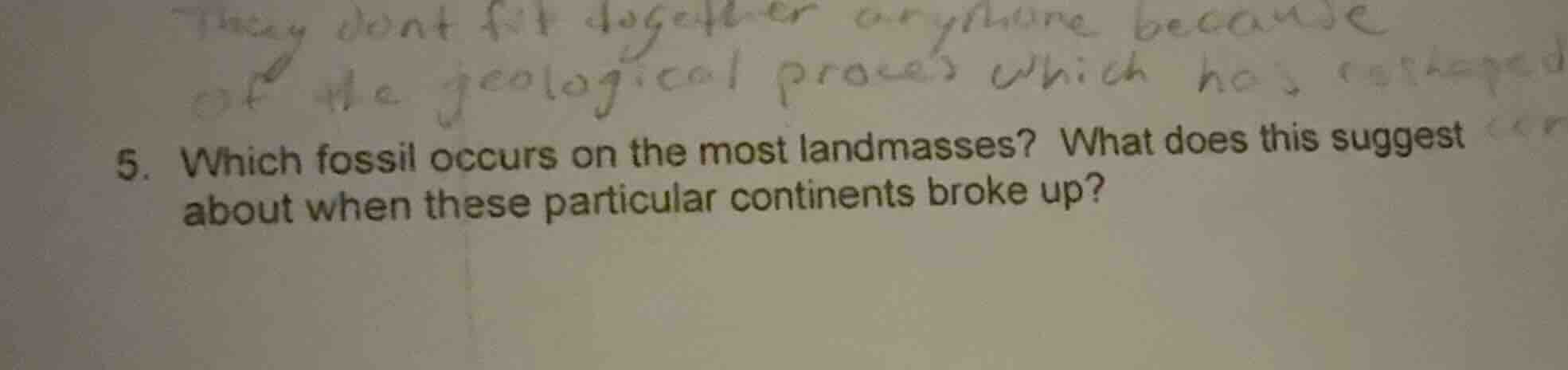
- which fossil occurs on the most landmasses? what does this suggest about when these particular continents broke up?
Brief Explanations
- The fossil that occurs on the most landmasses is often the Glossopteris fossil. Glossopteris was a seed - fern plant. Its fossils are found in South America, Africa, Antarctica, India, and Australia.
- This distribution suggests that these continents were once joined together in a supercontinent (like Gondwana). The fact that Glossopteris fossils are widespread across these now - separated landmasses implies that the continents broke up after the time when Glossopteris was alive (during the Permian period, approximately 299 - 252 million years ago). So the continents broke up after the existence of Glossopteris, as the plant could spread across the connected landmasses, and the subsequent continental drift separated the landmasses, preserving the fossils on each.

Snap & solve any problem in the app
Get step-by-step solutions on Sovi AI
Photo-based solutions with guided steps
Explore more problems and detailed explanations
The fossil that occurs on the most landmasses is the Glossopteris fossil. This suggests that the continents (that had Glossopteris - bearing rocks) broke up after the time when Glossopteris was alive (the Permian period), as the plant's wide distribution across these now - separated landmasses indicates they were once connected (as part of a supercontinent like Gondwana) and drifted apart later.