QUESTION IMAGE
Question
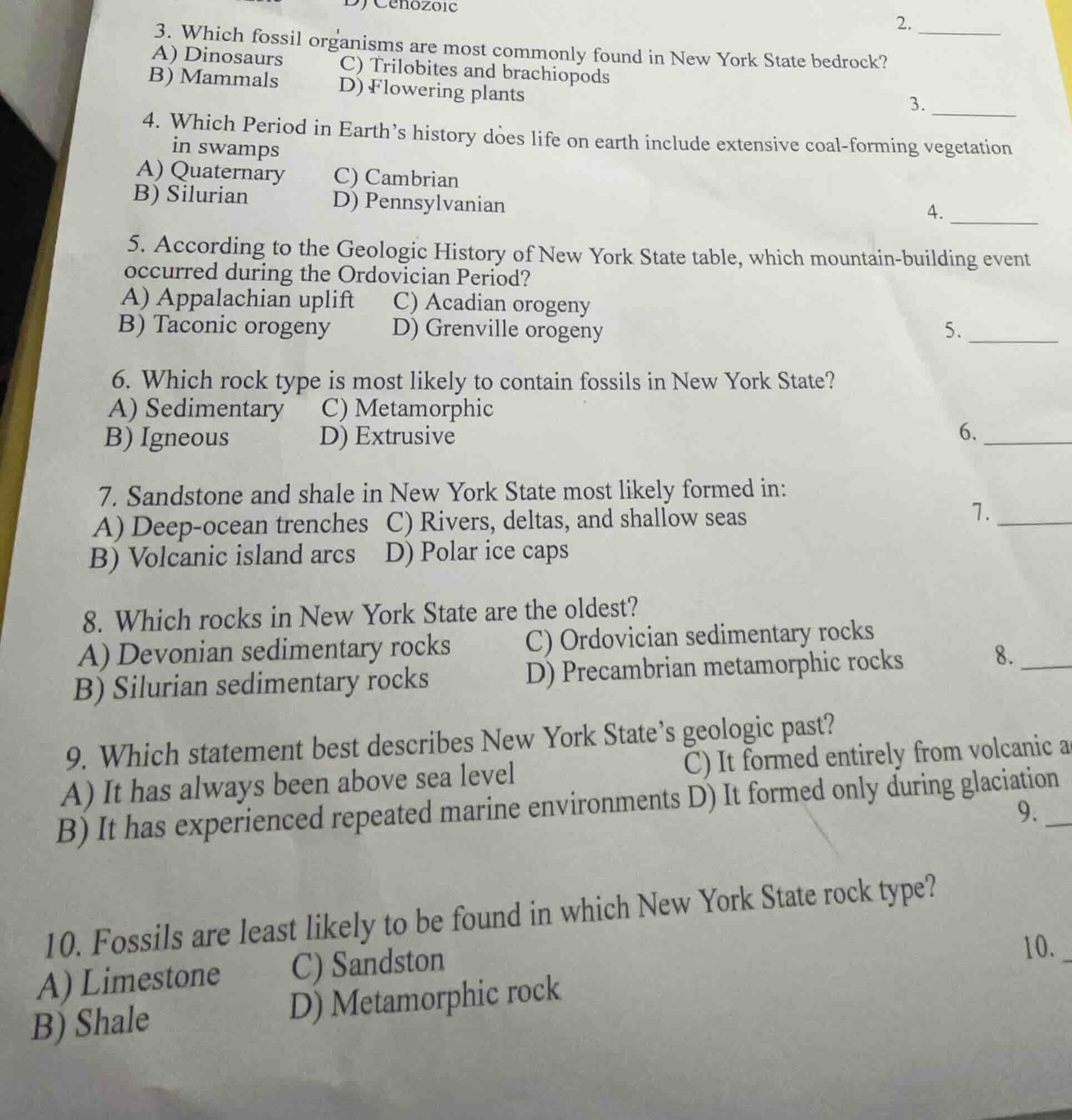
- which fossil organisms are most commonly found in new york state bedrock?
a) dinosaurs c) trilobites and brachiopods
b) mammals d) flowering plants
- which period in earth’s history does life on earth include extensive coal - forming vegetation in swamps
a) quaternary c) cambrian
b) silurian d) pennsylvanian
- according to the geologic history of new york state table, which mountain - building event occurred during the ordovician period?
a) appalachian uplift c) acadian orogeny
b) taconic orogeny d) grenville orogeny
- which rock type is most likely to contain fossils in new york state?
a) sedimentary c) metamorphic
b) igneous d) extrusive
- sandstone and shale in new york state most likely formed in:
a) deep - ocean trenches c) rivers, deltas, and shallow seas
b) volcanic island arcs d) polar ice caps
- which rocks in new york state are the oldest?
a) devonian sedimentary rocks c) ordovician sedimentary rocks
b) silurian sedimentary rocks d) precambrian metamorphic rocks
- which statement best describes new york state’s geologic past?
a) it has always been above sea level c) it formed entirely from volcanic a
b) it has experienced repeated marine environments d) it formed only during glaciation
- fossils are least likely to be found in which new york state rock type?
a) limestone c) sandston
b) shale d) metamorphic rock
- Trilobites and brachiopods are ancient marine organisms whose fossils are abundant in New York State's Paleozoic bedrock, which dominates the region's exposed rock layers.
- The Pennsylvanian Period is known as the "Age of Coal" due to extensive swamp vegetation that formed large coal deposits.
- The Taconic orogeny is the mountain-building event documented to have occurred during the Ordovician Period in New York State's geologic history.
- Sedimentary rocks form from deposited sediments, which often trap and preserve plant and animal remains as fossils; this is the primary rock type for fossil preservation.
- Sandstone forms from deposited sand particles, and shale from fine clay/silt, both of which accumulate in low-energy aquatic environments like rivers, deltas, and shallow seas, which were prevalent in New York's geologic past.
- The Precambrian is the earliest geologic eon, and its metamorphic rocks in New York State are the oldest, forming long before the Paleozoic sedimentary rocks listed.
- New York State's geologic record shows repeated cycles of being submerged under shallow seas and exposed, evidenced by alternating marine and terrestrial rock layers.
- Metamorphic rocks form under intense heat and pressure, which destroys any fossil remains that may have been present in the original rock material.

Snap & solve any problem in the app
Get step-by-step solutions on Sovi AI
Photo-based solutions with guided steps
Explore more problems and detailed explanations
- C) Trilobites and brachiopods
- D) Pennsylvanian
- B) Taconic orogeny
- A) Sedimentary
- C) Rivers, deltas, and shallow seas
- D) Precambrian metamorphic rocks
- B) It has experienced repeated marine environments
- D) Metamorphic rock