QUESTION IMAGE
Question
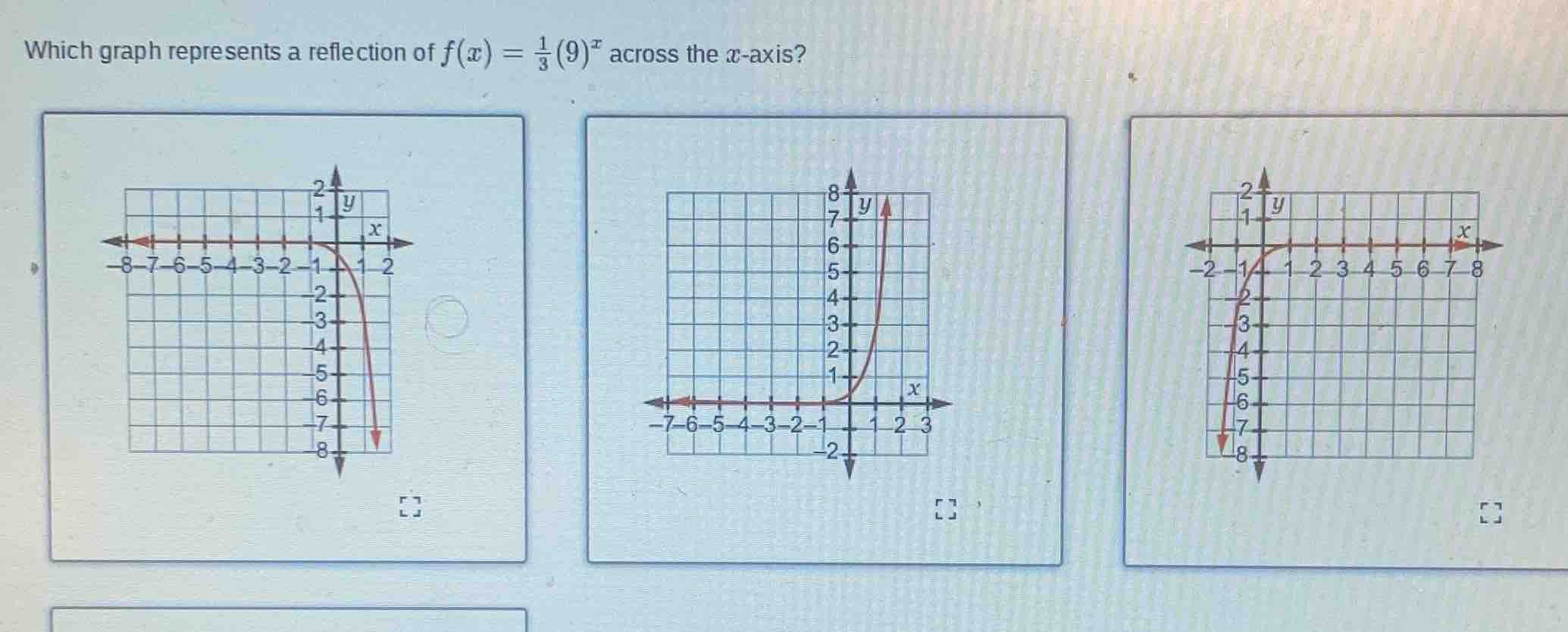
which graph represents a reflection of $f(x) = \frac{1}{3}(9)^x$ across the $x$-axis?
Step1: Recall reflection rule
To reflect a function \( f(x) \) across the \( x \)-axis, we use the transformation \( y=-f(x) \). So for \( f(x)=\frac{1}{3}(9)^{x} \), the reflected function is \( g(x)=-\frac{1}{3}(9)^{x} \).
Step2: Analyze original function
The original function \( f(x)=\frac{1}{3}(9)^{x} \) is an exponential growth function (since the base \( 9>1 \)) with a \( y \)-intercept at \( x = 0 \): \( f(0)=\frac{1}{3}(9)^{0}=\frac{1}{3}(1)=\frac{1}{3} \). It increases as \( x \) increases.
Step3: Analyze reflected function
The reflected function \( g(x)=-\frac{1}{3}(9)^{x} \) will be an exponential decay - like function (but actually a reflection of growth) with a \( y \)-intercept at \( x = 0 \): \( g(0)=-\frac{1}{3}(9)^{0}=-\frac{1}{3} \)? Wait, no, wait: Wait, \( f(0)=\frac{1}{3} \), so reflecting across \( x \)-axis, \( g(0)=-f(0)=-\frac{1}{3} \)? Wait, no, let's recalculate. Wait, \( 9^{0}=1 \), so \( f(0)=\frac{1}{3}\times1=\frac{1}{3} \). So the reflection across \( x \)-axis is \( g(x)=-f(x)=-\frac{1}{3}(9)^{x} \). So at \( x = 0 \), \( g(0)=-\frac{1}{3} \). As \( x \) increases, \( 9^{x} \) increases, so \( g(x) \) becomes more negative (since it's multiplied by - 1). As \( x \) decreases (goes to negative infinity), \( 9^{x}=\frac{1}{9^{\vert x\vert}} \) approaches 0, so \( g(x) \) approaches 0 from the negative side (since \( - \frac{1}{3}\times \) a small positive number is a small negative number).
Now let's analyze the graphs:
- The first graph: Let's check the \( y \)-intercept. At \( x = 0 \), the graph seems to pass near \( y=- 1 \)? Wait, no, let's look at the shape. The original function \( f(x)=\frac{1}{3}(9)^{x} \) has a \( y \)-intercept at \( \frac{1}{3}\approx0.333 \). The reflection should have a \( y \)-intercept at \( - \frac{1}{3}\approx - 0.333 \). Wait, maybe I made a mistake. Wait, no, let's re - evaluate the \( y \)-intercept of the original function. Wait, \( f(0)=\frac{1}{3}(9)^{0}=\frac{1}{3} \approx 0.333 \). So the reflection across \( x \)-axis will have a \( y \)-intercept at \( - 0.333 \). Now, let's look at the first graph: The curve is decreasing (as \( x \) increases, \( y \) decreases) and approaches 0 as \( x\to-\infty \) (from below the \( x \)-axis? Wait, no, the first graph: when \( x = 0 \), the curve is at \( y\approx - 1 \)? Wait, maybe my initial analysis of the \( y \)-intercept is wrong. Wait, let's check the original function again. Wait, \( f(x)=\frac{1}{3}(9)^{x} \). When \( x = 0 \), \( y=\frac{1}{3}\approx0.333 \). So the reflection is \( y =-\frac{1}{3}(9)^{x} \), so at \( x = 0 \), \( y =-\frac{1}{3}\approx - 0.333 \). Now, let's look at the first graph: The curve at \( x = 0 \) is near \( y=-1 \)? Wait, maybe the graphs are drawn with different scales. Alternatively, let's think about the behavior. The original function \( f(x)=\frac{1}{3}(9)^{x} \) is increasing, so the reflection should be decreasing (since it's a reflection across \( x \)-axis). The first graph: as \( x \) increases (from - 8 to 2), the curve is decreasing (going down as \( x \) moves to the right), which matches the behavior of \( g(x)=-\frac{1}{3}(9)^{x} \) (since as \( x \) increases, \( 9^{x} \) increases, so \( - \frac{1}{3}(9)^{x} \) decreases). The second graph is increasing, which is the original function (not the reflection). The third graph: let's see, at \( x = 0 \), it's at \( y = 0 \) or \( y=-1 \)? No, the third graph seems to have a \( y \)-intercept at \( y=-2 \) or so, and it's increasing as \( x \) decreases, which is not the case for the reflection.
Wait, maybe…

Snap & solve any problem in the app
Get step-by-step solutions on Sovi AI
Photo-based solutions with guided steps
Explore more problems and detailed explanations
The first graph (the one with the curve starting near \( x = 0 \), \( y\approx - 1 \) and decreasing as \( x \) increases, approaching the \( x \)-axis as \( x\to-\infty \))