QUESTION IMAGE
Question
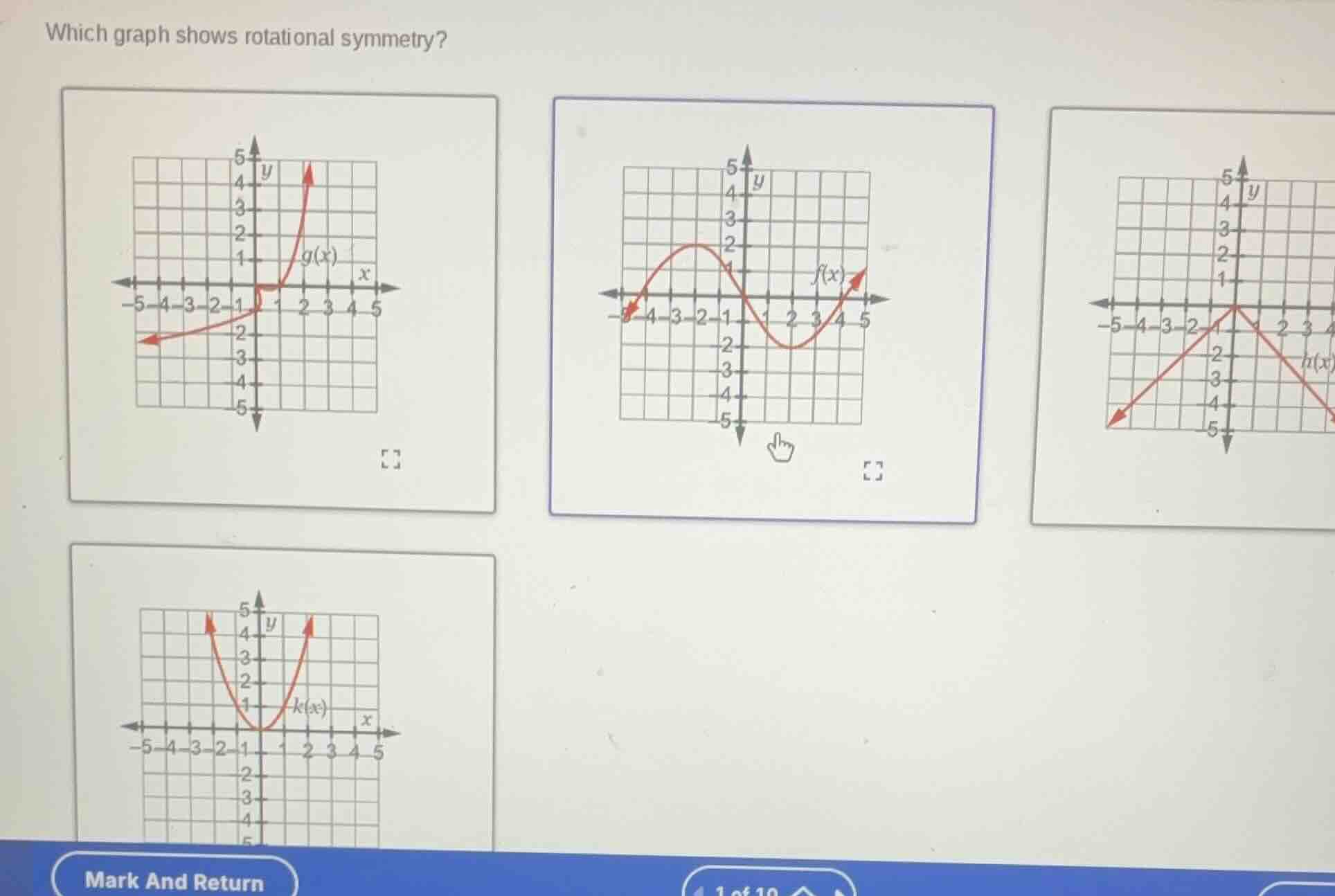
which graph shows rotational symmetry?
Brief Explanations
To determine which graph shows rotational symmetry, we recall that a graph has rotational symmetry about the origin if rotating it \(180^\circ\) around the origin maps the graph onto itself. Let's analyze each graph:
- Graph of \(g(x)\): This appears to be an exponential - like function. If we rotate it \(180^\circ\) about the origin, the shape will not map onto itself. For example, the part in the first quadrant and the part in the third quadrant do not have a \(180^\circ\) rotational relationship.
- Graph of \(f(x)\): This is a sinusoidal - like (or a polynomial with odd - degree behavior) graph. If we rotate it \(180^\circ\) about the origin, the graph will map onto itself. For any point \((x,y)\) on the graph, the point \((-x,-y)\) should also be on the graph. Looking at the graph, the left - hand side and the right - hand side have a \(180^\circ\) rotational symmetry about the origin.
- Graph of \(h(x)\): This is a V - shaped graph (absolute - value - like). It has reflection symmetry about the \(y\) - axis, but if we rotate it \(180^\circ\) about the origin, the graph will not map onto itself. For example, the point \((1, - 1)\) (if we consider the slope) and the point \((-1,1)\) do not satisfy the \(180^\circ\) rotation property.
- Graph of \(k(x)\): This is a parabola opening upwards with vertex at the origin. It has reflection symmetry about the \(y\) - axis, but a \(180^\circ\) rotation about the origin will not map it onto itself (a parabola \(y = ax^{2}\) rotated \(180^\circ\) about the origin gives \(y=-ax^{2}\), which is a different parabola unless \(a = 0\), which it is not here).

Snap & solve any problem in the app
Get step-by-step solutions on Sovi AI
Photo-based solutions with guided steps
Explore more problems and detailed explanations
The graph of \(f(x)\) (the second graph in the top row) shows rotational symmetry.