QUESTION IMAGE
Question
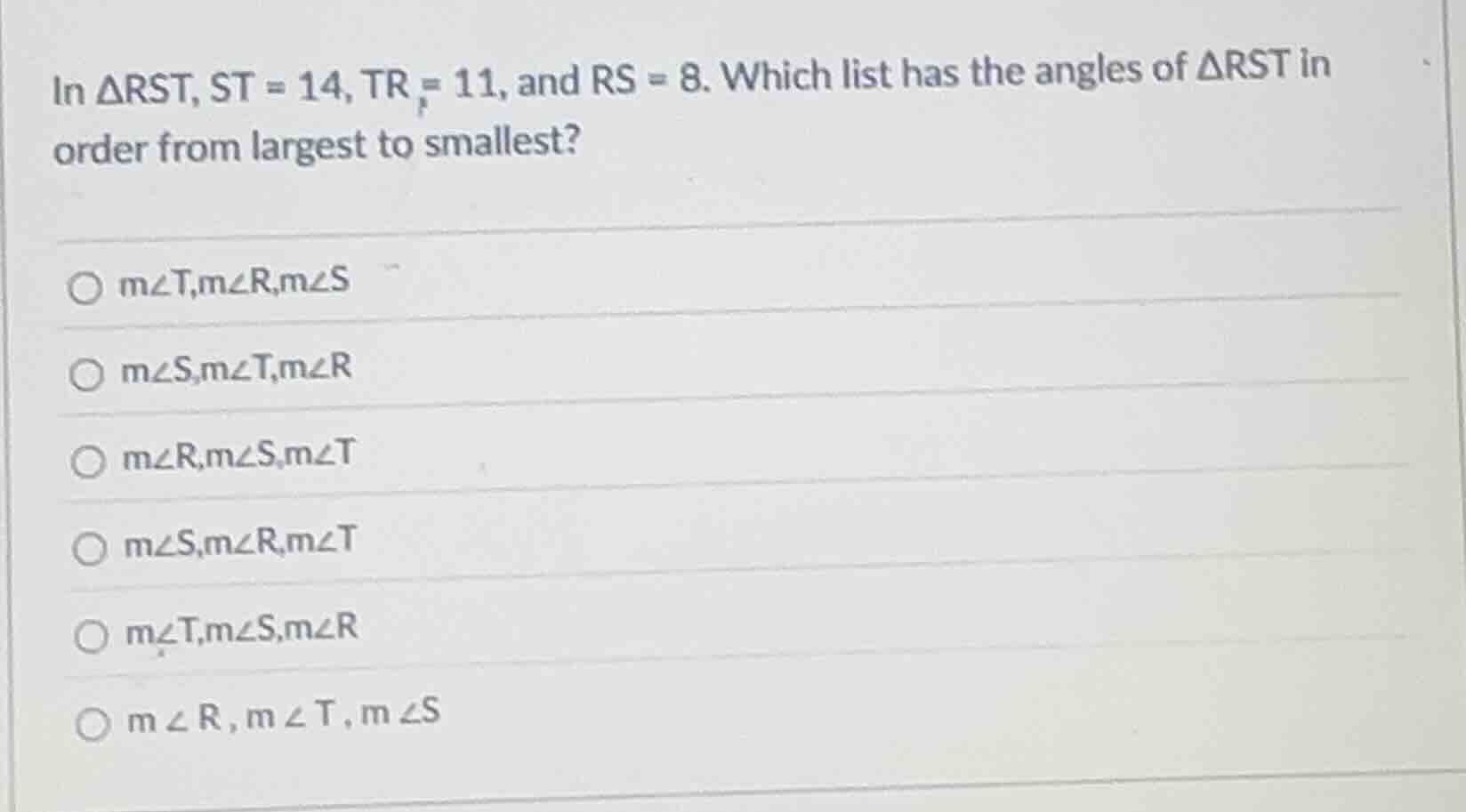
in $\triangle rst$, $st = 14$, $tr = 11$, and $rs = 8$. which list has the angles of $\triangle rst$ in order from largest to smallest?\
\bigcirc $m\angle t, m\angle r, m\angle s$\
\bigcirc $m\angle s, m\angle t, m\angle r$\
\bigcirc $m\angle r, m\angle s, m\angle t$\
\bigcirc $m\angle s, m\angle r, m\angle t$\
\bigcirc $m\angle t, m\angle s, m\angle r$\
\bigcirc $m\angle r, m\angle t, m\angle s$
Step1: Recall the triangle angle - side relationship
In a triangle, the larger the side opposite an angle, the larger the angle. So we need to first identify the sides opposite each angle in $\triangle RST$.
Let's label the triangle: In $\triangle RST$, the sides are:
- $ST = 14$, the angle opposite to $ST$ is $\angle R$ (because in $\triangle RST$, side $ST$ is opposite vertex $R$).
- $TR=11$, the angle opposite to $TR$ is $\angle S$ (side $TR$ is opposite vertex $S$).
- $RS = 8$, the angle opposite to $RS$ is $\angle T$ (side $RS$ is opposite vertex $T$).
Step2: Compare the lengths of the sides
We have the side lengths: $ST = 14$, $TR = 11$, $RS=8$. So, $ST>TR > RS$.
Step3: Relate side lengths to angle measures
Since the larger side is opposite the larger angle, the angle opposite the largest side ($ST$) is the largest angle, the angle opposite the second - largest side ($TR$) is the second - largest angle, and the angle opposite the smallest side ($RS$) is the smallest angle.
- The side opposite $\angle R$ is $ST = 14$ (the largest side), so $\angle R$ is the largest angle.
- The side opposite $\angle S$ is $TR=11$ (the second - largest side), so $\angle S$ is the second - largest angle.
- The side opposite $\angle T$ is $RS = 8$ (the smallest side), so $\angle T$ is the smallest angle.
So the order of angles from largest to smallest is $m\angle R,m\angle S,m\angle T$.

Snap & solve any problem in the app
Get step-by-step solutions on Sovi AI
Photo-based solutions with guided steps
Explore more problems and detailed explanations
$\boldsymbol{m\angle R,m\angle S,m\angle T}$ (corresponding to the option "m∠R,m∠S,m∠T")