QUESTION IMAGE
Question
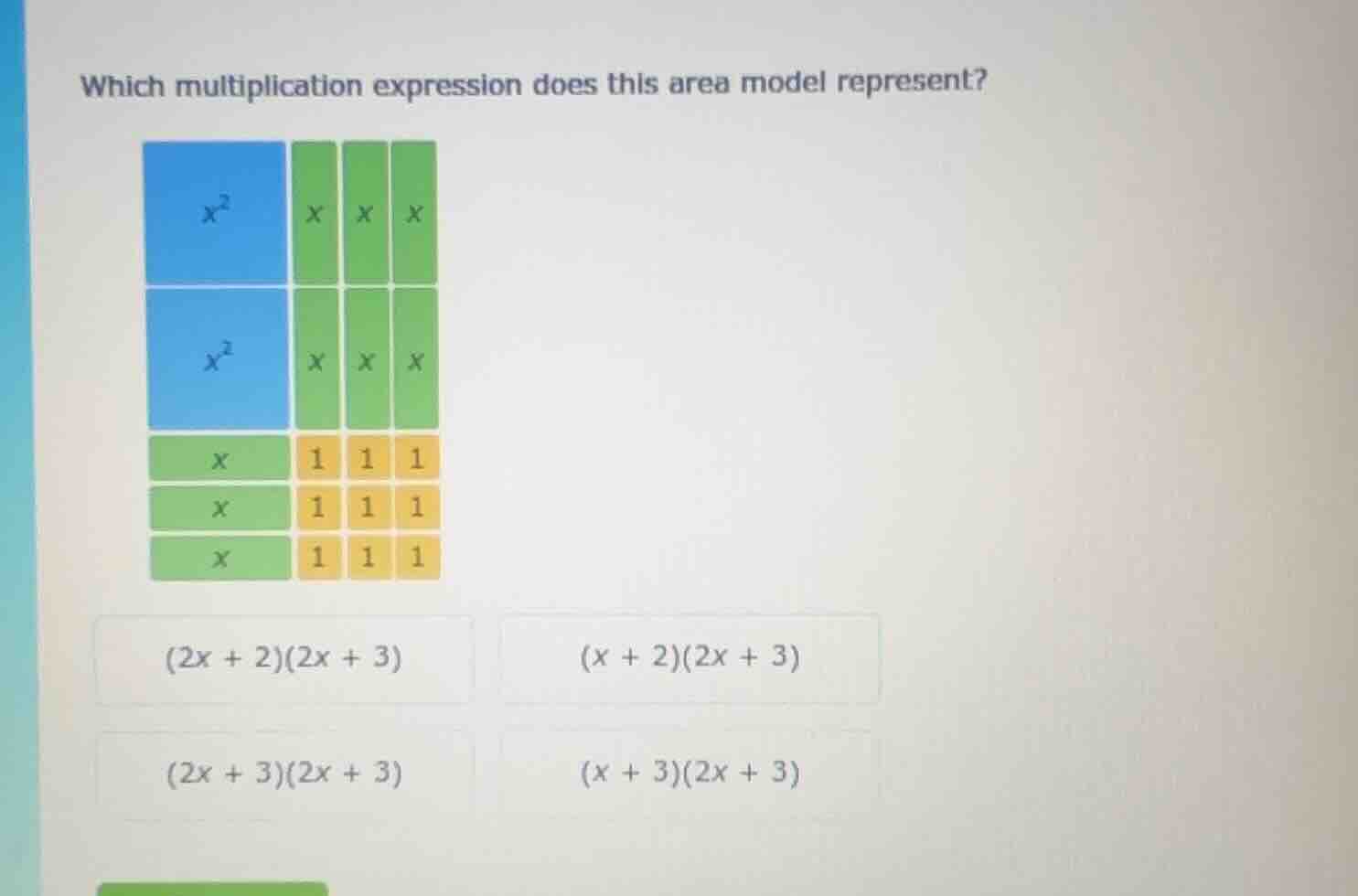
which multiplication expression does this area model represent?
(2x + 2)(2x + 3) (x + 2)(2x + 3)
(2x + 3)(2x + 3) (x + 3)(2x + 3)
Step1: Analyze the length of the rectangle (horizontal side)
Looking at the area model, the horizontal side has terms: \(x^2\) (two of them, so \(2x^2\) when combined? Wait, no, let's count the number of \(x\) and constant terms. Wait, actually, let's look at the columns. The first part (blue and green \(x\)s) and the second part (green \(x\)s and yellow 1s). Wait, maybe better to count the number of \(x\) terms and constant terms in each dimension.
Wait, the vertical dimension (height) and horizontal dimension (width). Let's look at the vertical stacks:
First, the blue \(x^2\)s: there are 2 rows of \(x^2\), then 3 rows of \(x\). Wait, no, let's count the number of \(x\) terms in each dimension.
Wait, the horizontal direction (width) has: from the blue \(x^2\)s, there are 2 \(x^2\)s (so that's \(2x\) in terms of the length? Wait, no, maybe the length is composed of \(x + x + 1 + 1 + 1\)? No, let's look at the area model as a rectangle with length and width.
Wait, the area model can be divided into two parts for the length and two parts for the width? Wait, no, let's count the number of \(x\) terms and constant terms in each side.
Looking at the vertical direction (height):
- The top two rows have \(x^2\) and \(x\) terms. Wait, the first two rows (blue \(x^2\) and green \(x\)): each row has 1 \(x^2\) and 3 \(x\)s? No, the blue \(x^2\) is a square, then three \(x\)s (green) in the first row. Second row same: \(x^2\) and three \(x\)s. Then the next three rows: each has an \(x\) (green) and three 1s (yellow).
Wait, maybe the length (horizontal) is \(2x + 3\)? Wait, no, let's count the number of \(x\) terms and constant terms in the length and width.
Wait, the width (horizontal) has:
- Number of \(x\) terms: Let's see, the first part (left) has \(x^2\) (two of them, so that's \(2x\) when considering the length? Wait, no, maybe the length is \(x + x + 3\)? No, let's think of the area model as a rectangle with length \( (2x + 3) \) and width \( (x + 3) \)? No, wait, let's count the number of \(x\) terms and constant terms in each dimension.
Wait, the vertical dimension (height) has:
- The first two rows: each has \(x^2\) (so that's \(2x\) in terms of the height? Wait, no, \(x^2\) is a square with side \(x\), so two \(x^2\)s stacked vertically would be height \(2x\)? Wait, maybe the height is \(2x + 3\)? No, let's look at the answer choices.
Wait, the answer choices are:
- \( (2x + 2)(2x + 3) \)
- \( (x + 2)(2x + 3) \)
- \( (2x + 3)(2x + 3) \)
- \( (x + 3)(2x + 3) \)
Wait, let's calculate the area of the model. Let's count the number of \(x^2\), \(x\), and constant terms.
- \(x^2\) terms: 2 (blue squares)
- \(x\) terms: Let's see, the green \(x\)s: first two rows have 3 \(x\)s each, so \(2 \times 3 = 6\) \(x\)s. Then the next three rows have 1 \(x\) each, so \(3 \times 1 = 3\) \(x\)s. Total \(x\) terms: \(6 + 3 = 9\) \(x\)s? Wait, no, that can't be. Wait, maybe I'm miscounting.
Wait, the area model is a rectangle. Let's find the length and width by looking at the number of \(x\) terms and constant terms in each side.
Looking at the horizontal direction (width):
- The first part (left) has \(x^2\) (two of them, so that's \(2x\) in length? Wait, no, \(x^2\) is a square with side \(x\), so two \(x^2\)s side by side would be length \(2x\)? Wait, no, \(x^2\) is area, but in the area model, the length is composed of \(x\) terms and constant terms.
Wait, maybe the length (horizontal) is \( (x + x + 1 + 1 + 1) \)? No, that's \(2x + 3\). Wait, the width (vertical) is \( (x + x + 1 + 1 + 1) \)? No, let's look at the answe…

Snap & solve any problem in the app
Get step-by-step solutions on Sovi AI
Photo-based solutions with guided steps
Explore more problems and detailed explanations
\((x + 3)(2x + 3)\)