QUESTION IMAGE
Question
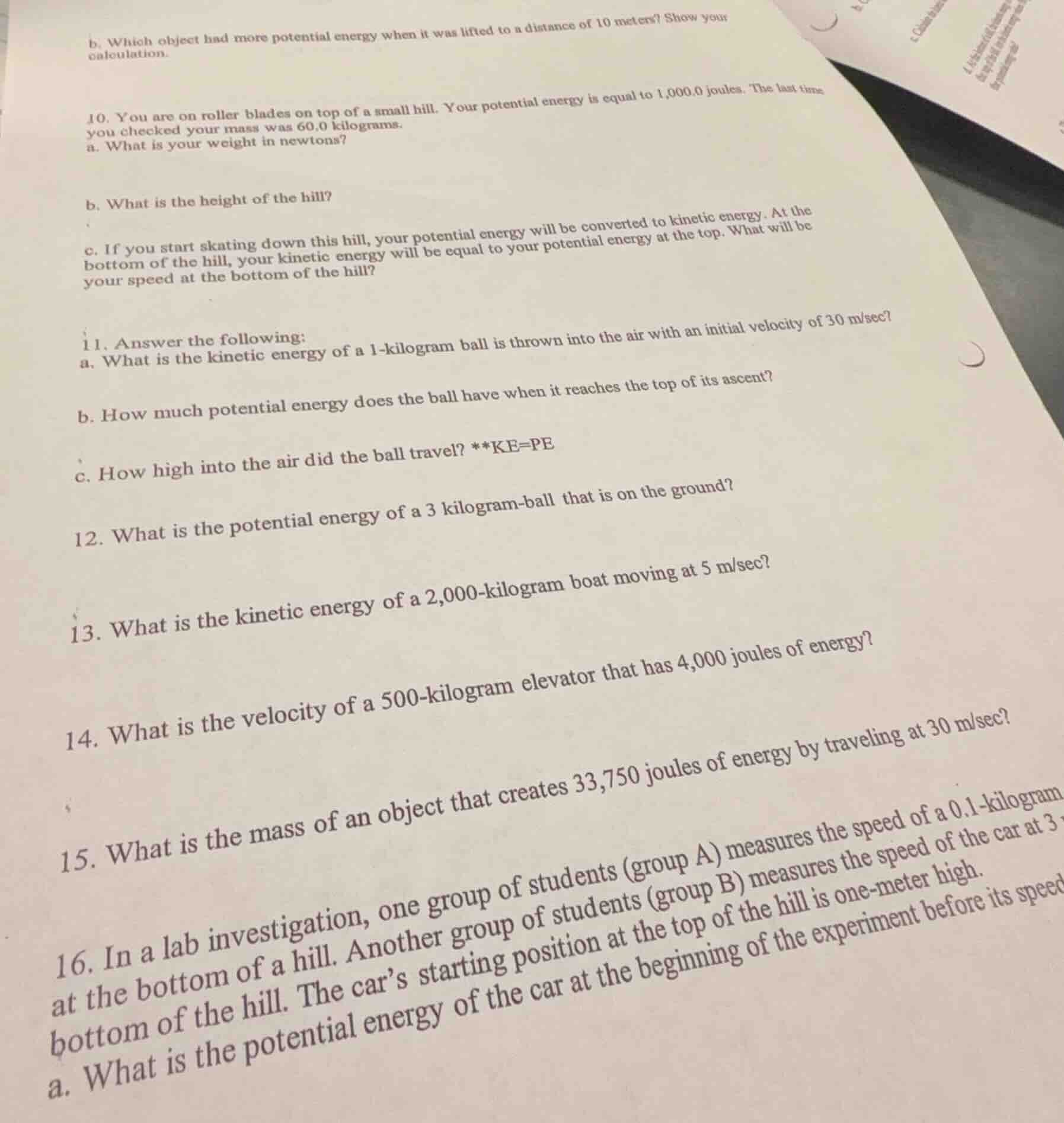
b. which object had more potential energy when it was lifted to a distance of 10 meters? show your calculation.
- you are on roller blades on top of a small hill. your potential energy is equal to 1,000.0 joules. the last time you checked your mass was 60.0 kilograms.
a. what is your weight in newtons?
b. what is the height of the hill?
c. if you start skating down this hill, your potential energy will be converted to kinetic energy. at the bottom of the hill, your kinetic energy will be equal to your potential energy at the top. what will be your speed at the bottom of the hill?
- answer the following:
a. what is the kinetic energy of a 1-kilogram ball is thrown into the air with an initial velocity of 30 m/sec?
b. how much potential energy does the ball have when it reaches the top of its ascent?
c. how high into the air did the ball travel? **ke=pe
- what is the potential energy of a 3 kilogram-ball that is on the ground?
- what is the kinetic energy of a 2,000-kilogram boat moving at 5 m/sec?
- what is the velocity of a 500-kilogram elevator that has 4,000 joules of energy?
- what is the mass of an object that creates 33,750 joules of energy by traveling at 30 m/sec?
- in a lab investigation, one group of students (group a) measures the speed of a 0.1-kilogram at the bottom of a hill. another group of students (group b) measures the speed of the car at 3 bottom of the hill. the cars starting position at the top of the hill is one-meter high.
a. what is the potential energy of the car at the beginning of the experiment before its speed
Step1: Calculate weight (Q10a)
Weight formula: $W = m \times g$, where $g=9.8\ \text{m/s}^2$
$W = 60.0\ \text{kg} \times 9.8\ \text{m/s}^2 = 588\ \text{N}$
Step2: Find hill height (Q10b)
Rearrange $PE = mgh$ to $h = \frac{PE}{mg}$
$h = \frac{1000.0\ \text{J}}{60.0\ \text{kg} \times 9.8\ \text{m/s}^2} \approx 1.70\ \text{m}$
Step3: Calculate speed at hill bottom (Q10c)
Set $KE=PE$, use $KE=\frac{1}{2}mv^2$, solve for $v$:
$v = \sqrt{\frac{2PE}{m}} = \sqrt{\frac{2 \times 1000.0\ \text{J}}{60.0\ \text{kg}}} \approx 5.77\ \text{m/s}$
Step4: Calculate ball's kinetic energy (Q11a)
Use $KE=\frac{1}{2}mv^2$
$KE = \frac{1}{2} \times 1\ \text{kg} \times (30\ \text{m/s})^2 = 450\ \text{J}$
Step5: Find top potential energy (Q11b)
By energy conservation, $PE_{top}=KE_{initial}$
$PE_{top} = 450\ \text{J}$
Step6: Calculate ball's max height (Q11c)
Rearrange $PE=mgh$ to $h=\frac{PE}{mg}$
$h = \frac{450\ \text{J}}{1\ \text{kg} \times 9.8\ \text{m/s}^2} \approx 45.9\ \text{m}$
Step7: Ground potential energy (Q12)
Height $h=0$, so $PE=mgh=0$
$PE = 3\ \text{kg} \times 9.8\ \text{m/s}^2 \times 0\ \text{m} = 0\ \text{J}$
Step8: Calculate boat's kinetic energy (Q13)
Use $KE=\frac{1}{2}mv^2$
$KE = \frac{1}{2} \times 2000\ \text{kg} \times (5\ \text{m/s})^2 = 25000\ \text{J}$
Step9: Find elevator velocity (Q14)
Rearrange $KE=\frac{1}{2}mv^2$ to $v=\sqrt{\frac{2KE}{m}}$
$v = \sqrt{\frac{2 \times 4000\ \text{J}}{500\ \text{kg}}} = 4\ \text{m/s}$
Step10: Calculate object mass (Q15)
Rearrange $KE=\frac{1}{2}mv^2$ to $m=\frac{2KE}{v^2}$
$m = \frac{2 \times 33750\ \text{J}}{(30\ \text{m/s})^2} = 75\ \text{kg}$
Step11: Find car's initial PE (Q16a)
Use $PE=mgh$, $m=0.1\ \text{kg}$, $h=1\ \text{m}$
$PE = 0.1\ \text{kg} \times 9.8\ \text{m/s}^2 \times 1\ \text{m} = 0.98\ \text{J}$

Snap & solve any problem in the app
Get step-by-step solutions on Sovi AI
Photo-based solutions with guided steps
Explore more problems and detailed explanations
10a. $588\ \text{newtons}$
10b. $\approx 1.70\ \text{meters}$
10c. $\approx 5.77\ \text{m/s}$
11a. $450\ \text{joules}$
11b. $450\ \text{joules}$
11c. $\approx 45.9\ \text{meters}$
- $0\ \text{joules}$
- $25000\ \text{joules}$
- $4\ \text{m/s}$
- $75\ \text{kilograms}$
16a. $0.98\ \text{joules}$