QUESTION IMAGE
Question
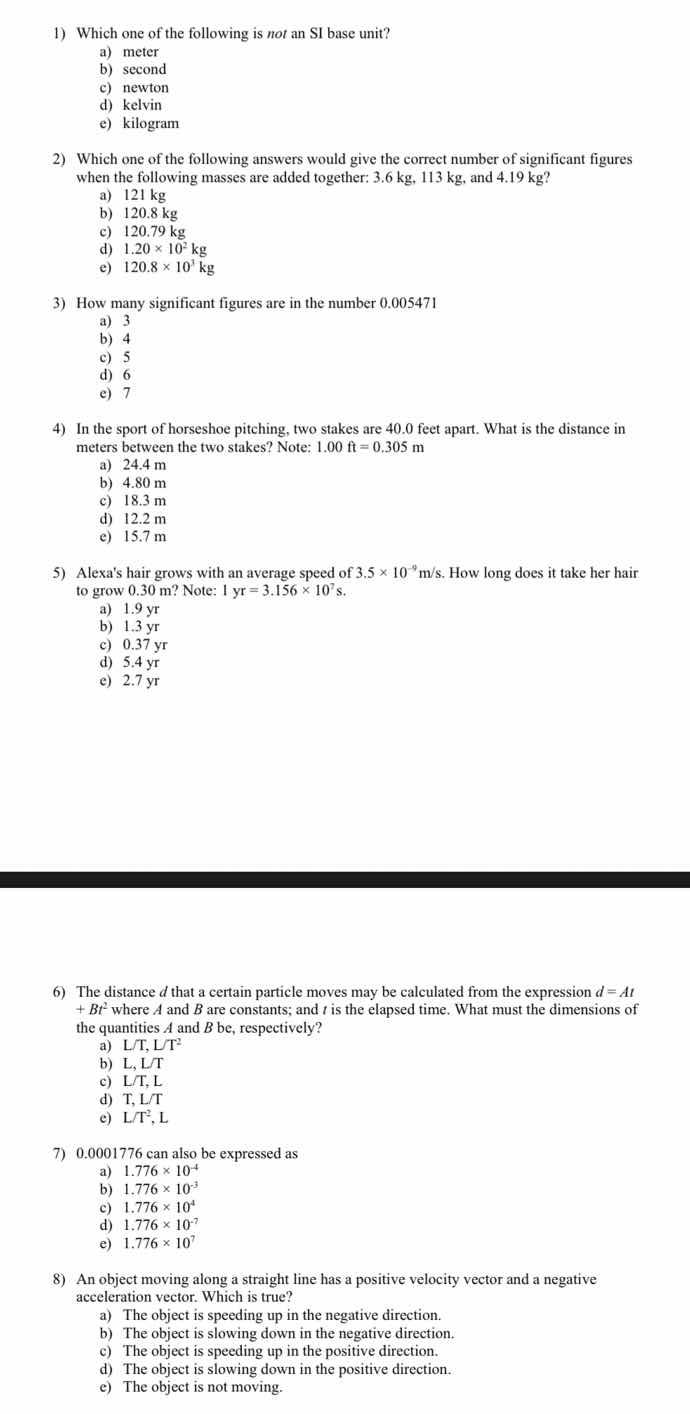
- which one of the following is not an si base unit?
a) meter
b) second
c) newton
d) kelvin
e) kilogram
- which one of the following answers would give the correct number of significant figures when the following masses are added together: 3.6 kg, 113 kg, and 4.19 kg?
a) 121 kg
b) 120.8 kg
c) 120.79 kg
d) $1.20 \times 10^{2}$ kg
e) $120.8 \times 10^{3}$ kg
- how many significant figures are in the number 0.005471
a) 3
b) 4
c) 5
d) 6
e) 7
- in the sport of horseshoe pitching, two stakes are 40.0 feet apart. what is the distance in meters between the two stakes? note: $1.00\\ \text{ft} = 0.305\\ \text{m}$
a) 24.4 m
b) 4.80 m
c) 18.3 m
d) 12.2 m
e) 15.7 m
- alexas hair grows with an average speed of $3.5 \times 10^{-9}$ m/s. how long does it take her hair to grow 0.30 m? note: $1\\ \text{yr}=3.156 \times 10^{7}$ s.
a) 1.9 yr
b) 1.3 yr
c) 0.37 yr
d) 5.4 yr
e) 2.7 yr
- the distance $d$ that a certain particle moves may be calculated from the expression $d = at + bt^{2}$ where $a$ and $b$ are constants; and $t$ is the elapsed time. what must the dimensions of the quantities $a$ and $b$ be, respectively?
a) $l/t, l/t^{2}$
b) $l, l/t$
c) $l/t, l$
d) $t, l/t$
e) $l/t^{2}, l$
- 0.0001776 can also be expressed as
a) $1.776 \times 10^{-4}$
b) $1.776 \times 10^{-3}$
c) $1.776 \times 10^{4}$
d) $1.776 \times 10^{-7}$
e) $1.776 \times 10^{7}$
- an object moving along a straight line has a positive velocity vector and a negative acceleration vector. which is true?
a) the object is speeding up in the negative direction.
b) the object is slowing down in the negative direction.
c) the object is speeding up in the positive direction.
d) the object is slowing down in the positive direction.
e) the object is not moving.
Step1: Identify SI base units
SI base units include meter, second, kelvin, kilogram. Newton is a derived unit ($1\ \text{N}=1\ \text{kg·m/s}^2$).
Step2: Calculate sum + sig figs
Add masses: $3.6 + 113 + 4.19 = 120.79\ \text{kg}$. Round to least decimal places (113 has 0 decimals) → $121\ \text{kg}$.
Step3: Count significant figures
For 0.005471, leading zeros are not significant. Significant digits: 5,4,7,1 → 4 total.
Step4: Convert feet to meters
Use conversion: $40.0\ \text{ft} \times 0.305\ \text{m/ft} = 12.2\ \text{m}$.
Step5: Calculate growth time
First find time in seconds: $t = \frac{d}{v} = \frac{0.30\ \text{m}}{3.5 \times 10^{-9}\ \text{m/s}} \approx 8.571 \times 10^7\ \text{s}$. Convert to years: $\frac{8.571 \times 10^7\ \text{s}}{3.156 \times 10^7\ \text{s/yr}} \approx 2.7\ \text{yr}$.
Step6: Dimensional analysis for distance
$d$ has dimension $L$. $At$ must have $L$ → $A = \frac{L}{T}$. $Bt^2$ must have $L$ → $B = \frac{L}{T^2}$.
Step7: Convert to scientific notation
0.0001776: move decimal 4 places right → $1.776 \times 10^{-4}$.
Step8: Relate velocity/acceleration signs
Positive velocity = moving in positive direction. Negative acceleration = acceleration opposite to velocity → object slows down in positive direction.

Snap & solve any problem in the app
Get step-by-step solutions on Sovi AI
Photo-based solutions with guided steps
Explore more problems and detailed explanations
- c) newton
- a) 121 kg
- b) 4
- d) 12.2 m
- e) 2.7 yr
- a) $L/T, L/T^2$
- a) $1.776 \times 10^{-4}$
- d) The object is slowing down in the positive direction.