QUESTION IMAGE
Question
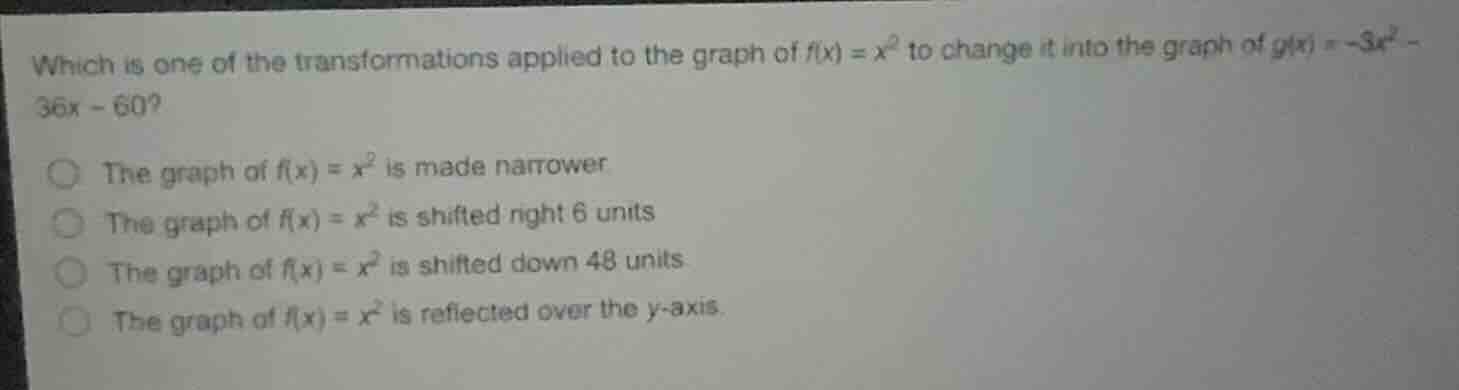
which is one of the transformations applied to the graph of $f(x) = x^2$ to change it into the graph of $g(x) = -3x^2 - 36x - 60$?
- the graph of $f(x) = x^2$ is made narrower
- the graph of $f(x) = x^2$ is shifted right 6 units
- the graph of $f(x) = x^2$ is shifted down 48 units
- the graph of $f(x) = x^2$ is reflected over the $y$-axis
Step1: Rewrite \( g(x) \) in vertex form
First, we complete the square for \( g(x) = -3x^2 - 36x - 60 \).
Factor out -3 from the first two terms: \( g(x) = -3(x^2 + 12x) - 60 \)
To complete the square inside the parentheses, take half of 12 (which is 6), square it (which is 36), and add and subtract it inside the parentheses:
\( g(x) = -3(x^2 + 12x + 36 - 36) - 60 \)
\( g(x) = -3((x + 6)^2 - 36) - 60 \)
Distribute the -3: \( g(x) = -3(x + 6)^2 + 108 - 60 \)
Simplify: \( g(x) = -3(x + 6)^2 + 48 \)
Step2: Analyze transformations from \( f(x) = x^2 \)
- For vertical stretch/compression: The coefficient of \( (x + 6)^2 \) is -3. The absolute value is 3, which is greater than 1, so the graph is vertically stretched (made narrower) compared to \( f(x) = x^2 \) (which has a coefficient of 1).
- For horizontal shift: The form is \( (x + 6) \), which means a shift left 6 units (since it's \( x - (-6) \)), not right 6 units.
- For vertical shift: The constant term is 48, but since the vertex form is \( -3(x + 6)^2 + 48 \), the vertical shift from \( f(x) = x^2 \) (which has vertex at (0,0)) to \( g(x) \) (which has vertex at (-6, 48)) is up 48 units, not down.
- For reflection over y-axis: The function \( g(x) \) has \( (x + 6) \), not \( (-x + 6) \) or similar, so there's no reflection over the y-axis.

Snap & solve any problem in the app
Get step-by-step solutions on Sovi AI
Photo-based solutions with guided steps
Explore more problems and detailed explanations
The graph of \( f(x) = x^2 \) is made narrower