QUESTION IMAGE
Question
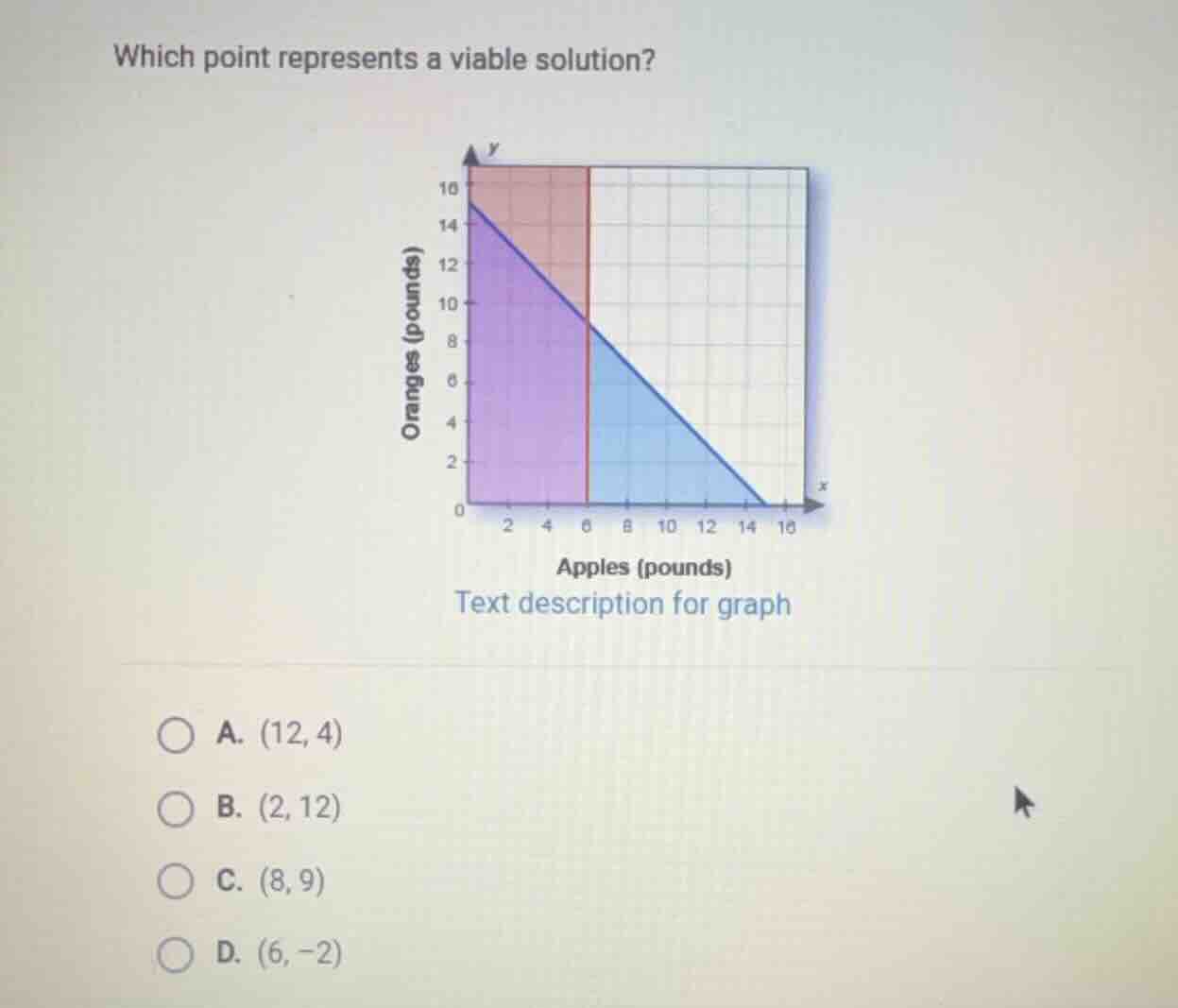
which point represents a viable solution? graph with x-axis: apples (pounds), y-axis: oranges (pounds), and a line, colored regions. text description for graph a. (12, 4) b. (2, 12) c. (8, 9) d. (6, -2)
Step1: Analyze constraints from graph
The graph has x (Apples) and y (Oranges) as non - negative (since they represent pounds, can't be negative). Also, the feasible region is where \(x\geq0\), \(y\geq0\) and within the area bounded by the line. Let's check each option:
- Option A: \((12,4)\)
- Check if it's in feasible region. From the graph, the line equation (let's assume the line is \(y = -x + 16\) as when \(x = 0\), \(y = 16\) and when \(y = 0\), \(x = 16\) (maybe a typo in graph, but checking the feasible region). For \((12,4)\), substitute into \(y\leq -x + 16\): \(4\leq - 12+16=4\), so \(y = 4\) satisfies \(y\leq -x + 16\). Also, x and y are non - negative. But wait, let's check the graph's feasible region. Wait, the graph's x - axis goes up to 16? Wait, the original graph's x - axis label has 16? Wait, the user's graph: x - axis is Apples (pounds) with 0,2,4,6,8,10,12,14,16? Wait, the point (12,4): let's see the feasible region. Wait, maybe the feasible region is the area where \(x\) and \(y\) are non - negative and \(x + y\leq16\) (since when \(x = 0\), \(y = 16\) and when \(y = 0\), \(x = 16\)). But let's check other options.
- Option B: \((2,12)\)
- Substitute into \(y\leq -x + 16\): \(12\leq - 2+16 = 14\), which is true. Also, x = 2, y = 12 are non - negative. But let's check the graph's feasible region. Wait, the graph has different colored regions. Wait, maybe the feasible region is where \(x\leq6\) (from the red line at x = 6)? Wait, no, the graph's x - axis: the red line is at x = 6? Wait, the user's graph: the purple region is from x = 0 to x = 6, red from x = 6 to x = 8? Wait, no, the text description is not clear, but let's check the y - value. Oranges can't be negative, so option D: \((6,-2)\) is invalid as \(y=-2<0\). Option C: \((8,9)\): \(y = 9\), \(x = 8\). Substitute into \(y\leq -x + 16\): \(9\leq - 8 + 16=8\)? No, \(9>8\), so it's above the line, not in feasible region. Option B: \((2,12)\): \(x = 2\), \(y = 12\). Substitute into \(y\leq -x + 16\): \(12\leq - 2+16 = 14\), which is true. Also, x and y are non - negative. Wait, but maybe the feasible region is where \(x\leq6\)? Wait, the graph's purple region is up to x = 6, red up to x = 8? Wait, the user's graph: the x - axis has 0,2,4,6,8,10,12,14,16? Wait, maybe the correct feasible region is where \(x\) and \(y\) are non - negative and \(x + y\leq16\) and also \(x\leq6\)? No, that doesn't make sense. Wait, let's re - evaluate.
- Wait, the key is that in a real - world context (pounds of apples and oranges), both x (apples) and y (oranges) must be non - negative. So option D is out (\(y=-2\)). Option C: \(y = 9\), \(x = 8\). Let's assume the line is \(y=-x + 16\) (since when \(x = 0\), \(y = 16\) and when \(y = 0\), \(x = 16\)). For \((8,9)\): \(8 + 9=17>16\), so it's above the line, not in the feasible region (since the feasible region is below the line \(x + y=16\)). For option B: \((2,12)\): \(2 + 12 = 14\leq16\), and x = 2, y = 12 are non - negative. For option A: \((12,4)\): \(12 + 4=16\), which is on the line. But wait, maybe the feasible region is where \(x\leq6\)? No, the x - axis goes to 16. Wait, maybe the graph's feasible region is the area where \(x\) is between 0 and 16, \(y\) between 0 and 16, and \(x + y\leq16\). But also, maybe the graph has a vertical line at x = 6? Wait, the user's graph: the purple region is from x = 0 to x = 6, red from x = 6 to x = 8? No, the original graph's x - axis labels: 0,2,4,6,8,10,12,14,16? Wait, the point (2,12): x = 2 (which is in the purple region, maybe the feasible region is x from 0 to 6? Wait,…

Snap & solve any problem in the app
Get step-by-step solutions on Sovi AI
Photo-based solutions with guided steps
Explore more problems and detailed explanations
B. (2, 12)