QUESTION IMAGE
Question
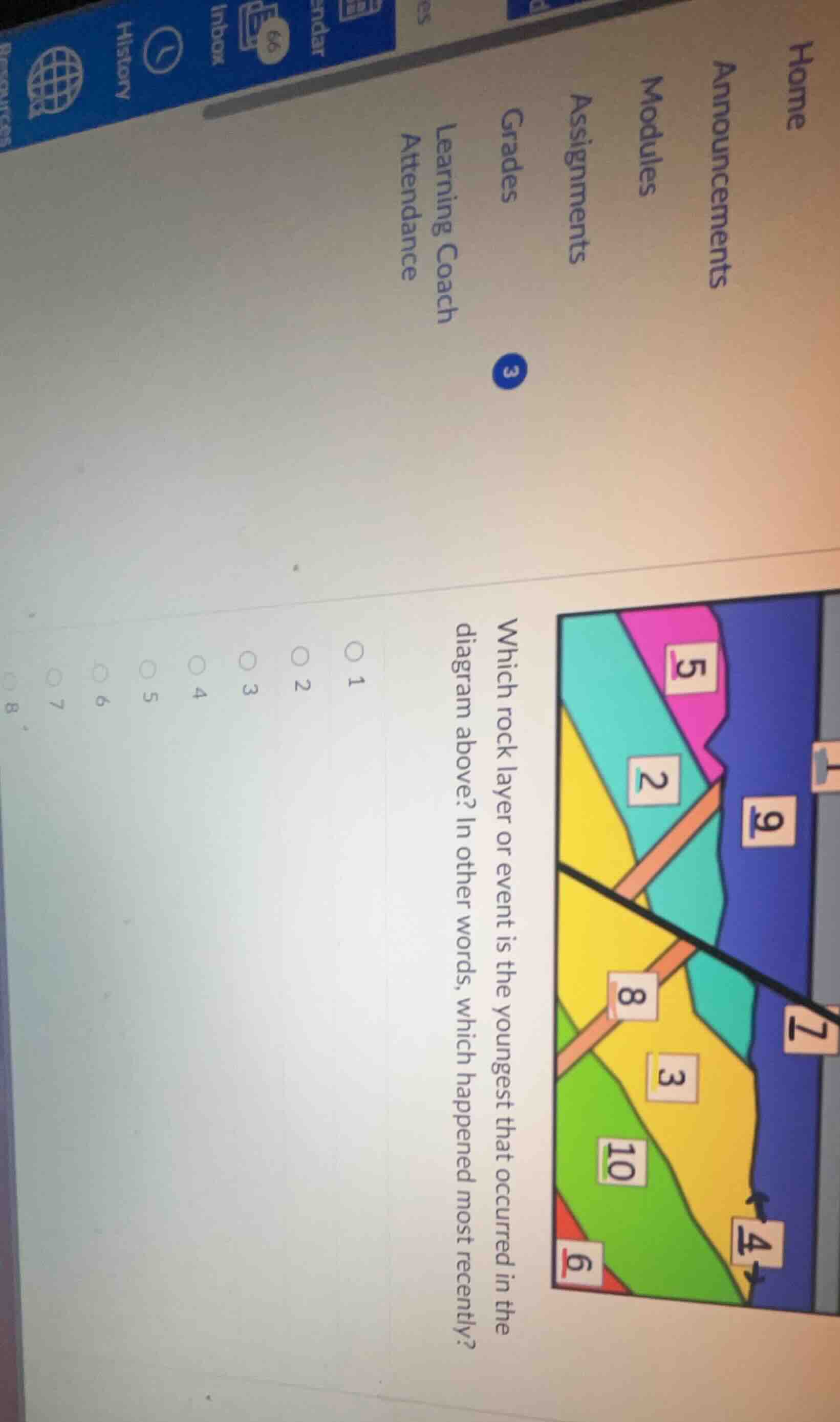
which rock layer or event is the youngest that occurred in the diagram above? in other words, which happened most recently?
1
2
3
4
5
6
7
8
Response
To determine the youngest rock layer or event, we use the principle of cross - cutting relationships (a younger feature cuts through older ones) and superposition (in undisturbed layers, younger layers are on top).
Step 1: Analyze the layers and events
- Rock layers are formed over time, with younger layers generally on top of older ones in undisturbed sequences. For events like faults or intrusions (the colored lines here), the event that cuts through other layers is younger than the layers it cuts.
- Let's look at the diagram. The black line (let's assume it's a fault or a dike) cuts through many layers. Also, layer 5 is on top of some other layers. But among the numbered features, layer 7 (the black line - type feature) cuts through layers 1, 4, 9 and the other colored layers. Wait, no, let's re - evaluate. Wait, the red - numbered 6 is at the bottom? No, wait, the principle of superposition: in a sequence of sedimentary rocks, the oldest is at the bottom and the youngest at the top, unless disturbed. But here we have cross - cutting events. The event (or layer) that cuts through the most recent layers (or other events) is the youngest. Wait, looking at the options (1 - 8, and 6,7,10). Wait, the layer 7 (the black line) cuts through layer 9, 4, 1 and the colored layers. But layer 5 is on top of layer 2. Wait, maybe I made a mistake. Wait, the key is that a cross - cutting feature is younger than the features it cuts. So if we have a fault (black line, 7) that cuts through layers 1, 4, 9 and the other layers (2,3,5,8,10,6), then 7 is younger than those. But also, layer 5 is on top of layer 2. But among the options, the youngest should be the one that happened last. Wait, maybe the answer is 7? Wait, no, let's check again. Wait, the problem is about relative dating. The youngest event is the one that occurred most recently. So, for example, if we have layers: first 6,10,3,8,2,5 were deposited (in order from bottom to top, assuming 6 is bottom, then 10,3,8,2,5). Then there was an intrusion or fault (the orange line, 8? No, 8 is a layer? Wait, no, the orange line is a cross - cutting feature. Wait, the black line is 7, orange is 8? Wait, maybe I misread. Wait, the numbers: 6 is red at the bottom, 10 is green, 3 is yellow, 8 is orange (cross - cutting), 2 is cyan, 5 is pink, 4 is beige, 9 is blue, 1 is gray, and 7 is black (cross - cutting). So the cross - cutting feature 7 (black line) cuts through 9,4,1 and the colored layers (2,3,5,8,10,6). So 7 is younger than all the layers it cuts. Also, layer 5 is on top of layer 2, so 5 is younger than 2. But 7 cuts through 5? Wait, no, 7 is a black line that goes from the right - hand side, cutting through 9,4, and then into the yellow (3), green (10), etc. Wait, maybe the youngest is 7? But the options are 1 - 8, 6,7,10. Wait, the question is which rock layer or event is the youngest. So among the numbered options (the radio buttons are 1 - 8, and then 6,7,8? Wait, the radio buttons are 1,2,3,4,5,6,7,8. Wait, maybe the answer is 7? Wait, no, let's think again. The principle of cross - cutting relationships: a geologic feature that cuts through another is younger than the feature it cuts. So if feature X cuts through feature Y, X is younger than Y. So, for example, if we have a fault (7) that cuts through layers 1,4,9 and layers 2,3,5,8,10,6, then 7 is younger than all of those. So 7 is the youngest.

Snap & solve any problem in the app
Get step-by-step solutions on Sovi AI
Photo-based solutions with guided steps
Explore more problems and detailed explanations
7 (assuming the black line is 7 and it's the cross - cutting feature that is youngest among the options)