QUESTION IMAGE
Question
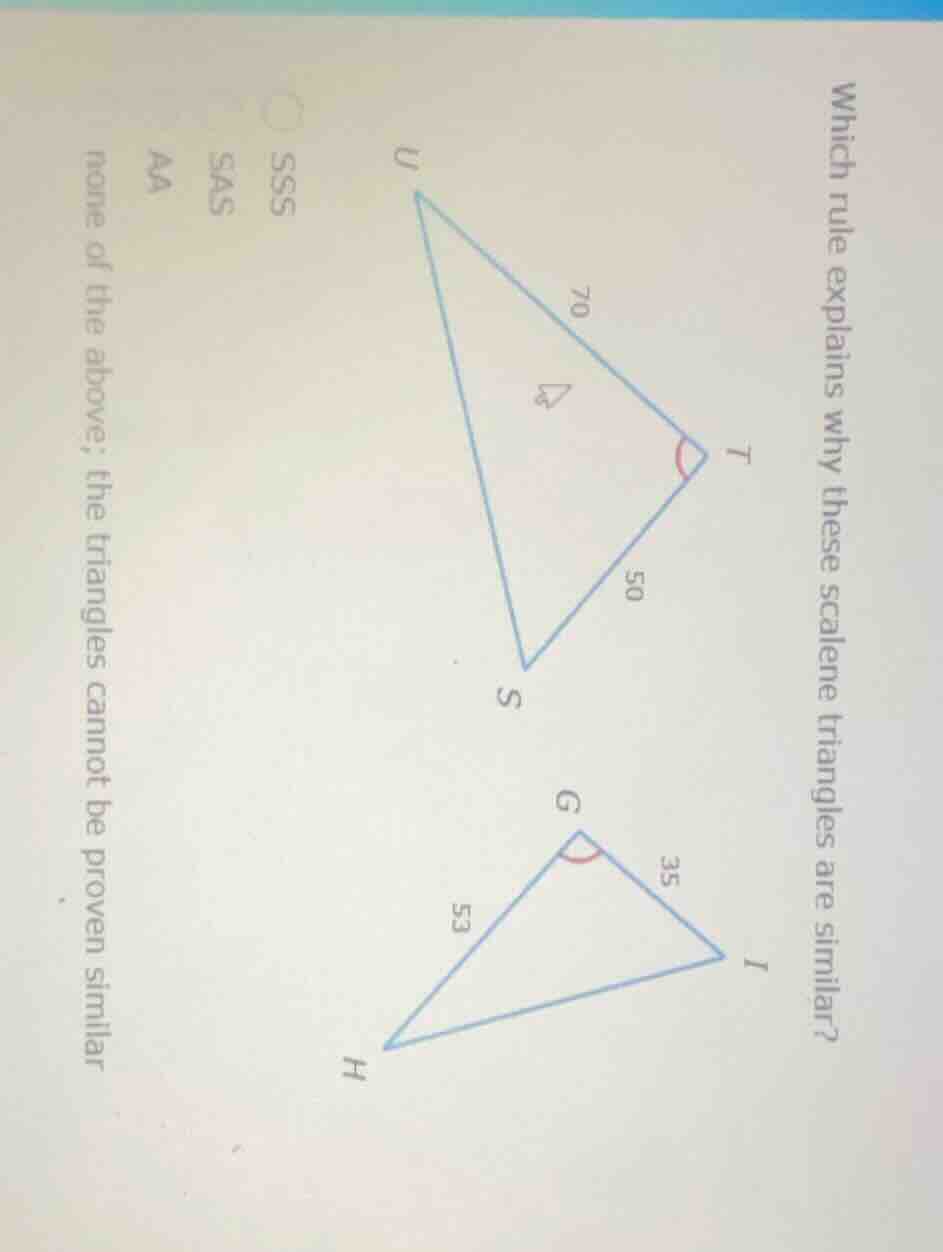
which rule explains why these scalene triangles are similar? sss sas aa none of the above; the triangles cannot be proven similar
To determine if the triangles are similar, we check the ratios of corresponding sides and the included angles.
Step 1: Check the ratios of sides
For triangle \( TUS \) and triangle \( IGH \), let's find the ratios of the sides. The sides given are \( TU = 70 \), \( TS = 50 \), \( IG = 35 \). Let's see the ratio of \( TU \) to \( IG \): \( \frac{TU}{IG} = \frac{70}{35} = 2 \). Now check the ratio of \( TS \) to the other side (but we don't have a corresponding side with a clear ratio that would satisfy SAS or SSS. Also, the included angles: in triangle \( TUS \), the angle at \( T \) is marked, and in triangle \( IGH \), the angle at \( G \) is marked. But the sides around the angles: for SAS, we need two sides in proportion and the included angle equal. The ratio of \( TU/IG = 2 \), but what about the other side? \( TS = 50 \), and if we check the other side in the second triangle, we don't have a side that is \( 50/2 = 25 \), instead we have 53. Also, the angles: we don't have information about two angles being equal (AA) since we only have one angle marked in each, and they don't seem to be equal (the markings are different? Wait, no, the red arcs: but the sides around them: in triangle \( T \), the sides are 70 and 50, in triangle \( G \), the sides are 35 and... not 25. So the ratios of the sides around the angles: \( TU/IG = 2 \), but \( TS \) (50) and the other side (let's say if we consider the angle at \( T \) and angle at \( G \), the sides around \( T \) are 70 and 50, around \( G \) are 35 and 53. The ratio \( 70/35 = 2 \), but \( 50/53
eq 2 \), so SAS doesn't hold. SSS: we don't have all three sides. AA: we only have one angle marked, not two. So the triangles cannot be proven similar by any of the given rules.

Snap & solve any problem in the app
Get step-by-step solutions on Sovi AI
Photo-based solutions with guided steps
Explore more problems and detailed explanations
none of the above; the triangles cannot be proven similar