QUESTION IMAGE
Question
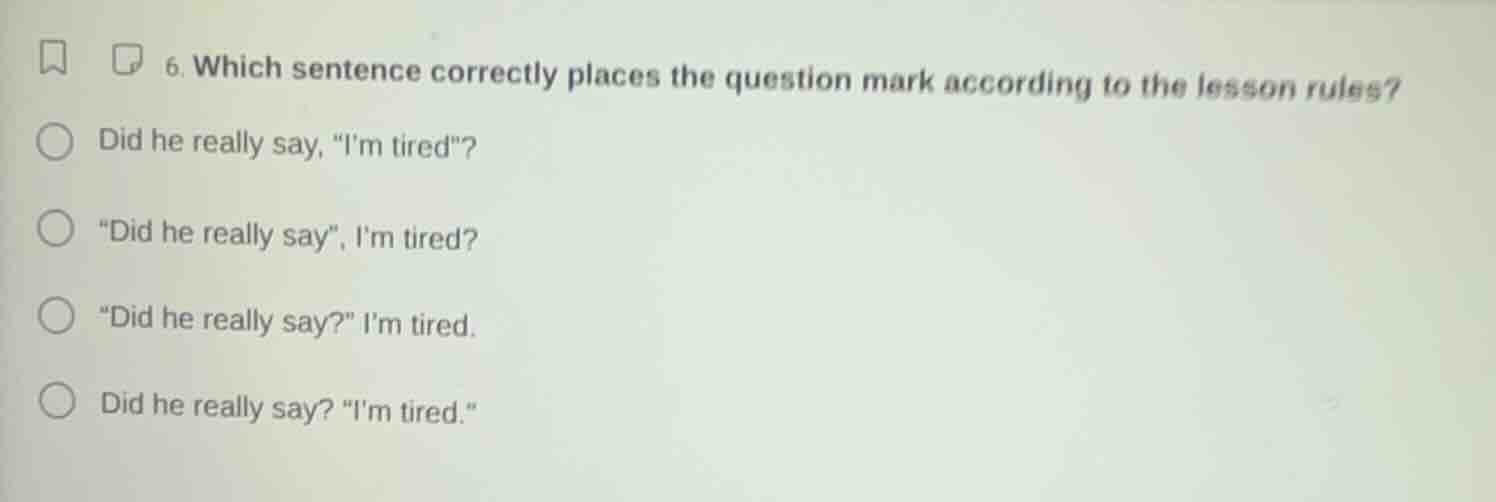
- which sentence correctly places the question mark according to the lesson rules? did he really say, \im tired\? \did he really say\, im tired? \did he really say?\ im tired. did he really say? \im tired.\
Brief Explanations
To determine the correct placement of the question mark, we analyze each option:
- Option 1: "Did he really say, "I'm tired"?" – The main sentence is a question asking if he said "I'm tired", so the question mark is placed at the end of the entire sentence, outside the quoted speech (since the quoted speech is a statement, not a question). This follows punctuation rules for direct speech in questions.
- Option 2: "Did he really say", I'm tired? – The comma and placement of the quote are incorrect; the quoted part should be properly enclosed, and the structure is flawed.
- Option 3: "Did he really say?" I'm tired. – This implies the quoted part is a question, but the main sentence structure is wrong as "I'm tired" is a statement, not related to the question in this way.
- Option 4: Did he really say? "I'm tired." – The question mark is placed incorrectly, splitting the main question in a wrong way.

Snap & solve any problem in the app
Get step-by-step solutions on Sovi AI
Photo-based solutions with guided steps
Explore more problems and detailed explanations
A. Did he really say, "I'm tired"?