QUESTION IMAGE
Question
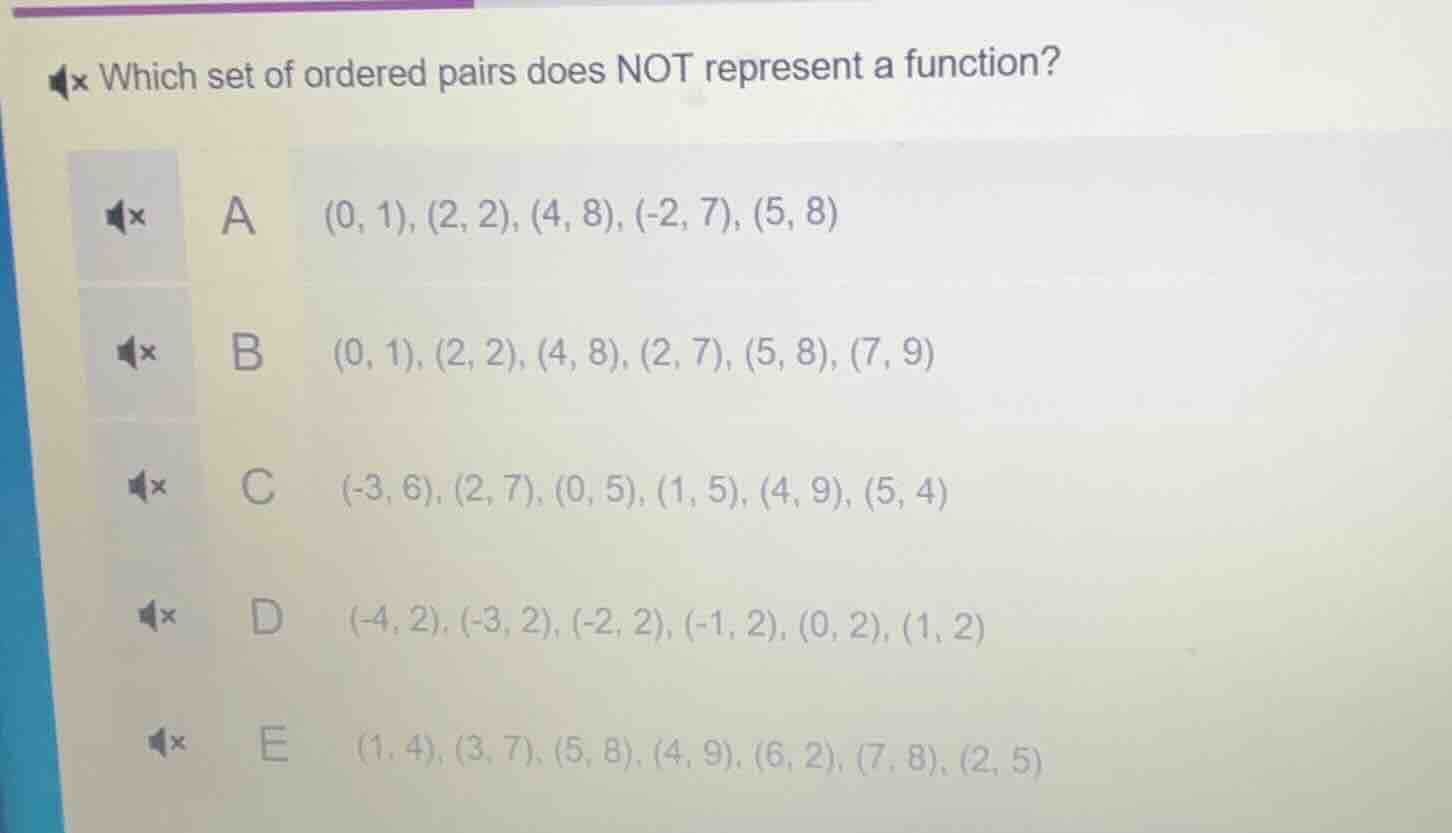
which set of ordered pairs does not represent a function? a (0, 1), (2, 2), (4, 8), (-2, 7), (5, 8) b (0, 1), (2, 2), (4, 8), (2, 7), (5, 8), (7, 9) c (-3, 6), (2, 7), (0, 5), (1, 5), (4, 9), (5, 4) d (-4, 2), (-3, 2), (-2, 2), (-1, 2), (0, 2), (1, 2) e (1, 4), (3, 7), (5, 8), (4, 9), (6, 2), (7, 8), (2, 5)
Step1: Recall the definition of a function
A function is a relation where each input (x - value) has exactly one output (y - value). So, we need to check each set of ordered pairs to see if any x - value is repeated with different y - values.
Step2: Analyze Option A
For the set \((0, 1),(2, 2),(4, 8),(-2, 7),(5, 8)\), the x - values are \(0,2,4, - 2,5\). Each x - value appears only once. So, this is a function.
Step3: Analyze Option B
For the set \((0, 1),(2, 2),(4, 8),(2, 7),(5, 8),(7, 9)\), the x - value \(2\) appears twice, with \(y\) - values \(2\) and \(7\) (\((2,2)\) and \((2,7)\)). Since the input \(x = 2\) has more than one output, this relation is not a function.
Step4: Analyze Option C
For the set \((-3, 6),(2, 7),(0, 5),(1, 5),(4, 9),(5, 4)\), the x - values are \(-3,2,0,1,4,5\). Each x - value appears only once (note that \(y\) - values can repeat, like \(x = 0\) and \(x = 1\) both have \(y=5\), which is allowed in a function). So, this is a function.
Step5: Analyze Option D
For the set \((-4, 2),(-3, 2),(-2, 2),(-1, 2),(0, 2),(1, 2)\), the x - values are \(-4,-3,-2,-1,0,1\). Each x - value appears only once (all have the same \(y\) - value, which is allowed in a function). So, this is a function.
Step6: Analyze Option E
For the set \((1, 4),(3, 7),(5, 8),(4, 9),(6, 2),(7, 8),(2, 5)\), the x - values are \(1,3,5,4,6,7,2\). Each x - value appears only once. So, this is a function.

Snap & solve any problem in the app
Get step-by-step solutions on Sovi AI
Photo-based solutions with guided steps
Explore more problems and detailed explanations
B. \((0, 1),(2, 2),(4, 8),(2, 7),(5, 8),(7, 9)\)