QUESTION IMAGE
Question
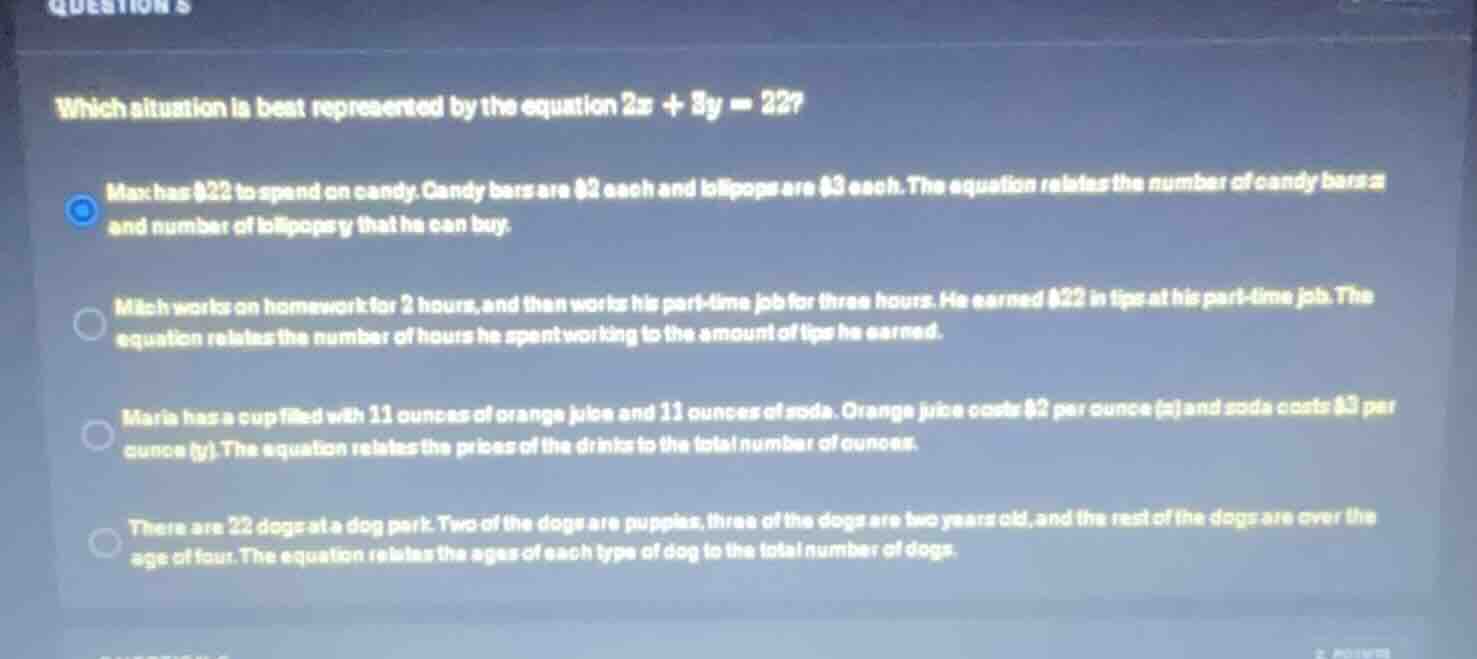
which situation is best represented by the equation (2x + 3y = 22)?
max has $22 to spend on candy. candy bars are $2 each and lollipops are $3 each. the equation relates the number of candy bars (x) and number of lollipops (y) that he can buy.
mitch works on homework for 2 hours, and then works his part - time job for three hours. he earned $22 in tips at his part - time job. the equation relates the number of hours he spent working to the amount of tips he earned.
maria has a cup filled with 11 ounces of orange juice and 11 ounces of soda. orange juice costs $2 per ounce ((x)) and soda costs $3 per ounce ((y)). the equation relates the prices of the drinks to the total number of ounces.
there are 22 dogs at a dog park. two of the dogs are puppies, three of the dogs are two years old, and the rest of the dogs are over the age of four. the equation relates the ages of each type of dog to the total number of dogs.
We analyze each option to match the equation $2x + 3y = 22$:
- For the first option: $x$ = number of $2 candy bars, $y$ = number of $3 lollipops. Total cost is $2x + 3y$, which equals the $22 budget. This matches the equation exactly.
- For the second option: The scenario links hours worked to tips, which does not fit the structure of $2x + 3y = 22$.
- For the third option: The total ounces are fixed at 22, and the cost equation would be unrelated to the given form.
- For the fourth option: The count of dogs would use a sum of counts, not a linear equation with coefficients 2 and 3 for age groups.

Snap & solve any problem in the app
Get step-by-step solutions on Sovi AI
Photo-based solutions with guided steps
Explore more problems and detailed explanations
A. Max has $22 to spend on candy. Candy bars are $2 each and lollipops are $3 each. The equation relates the number of candy bars x and number of lollipops y that he can buy.