QUESTION IMAGE
Question
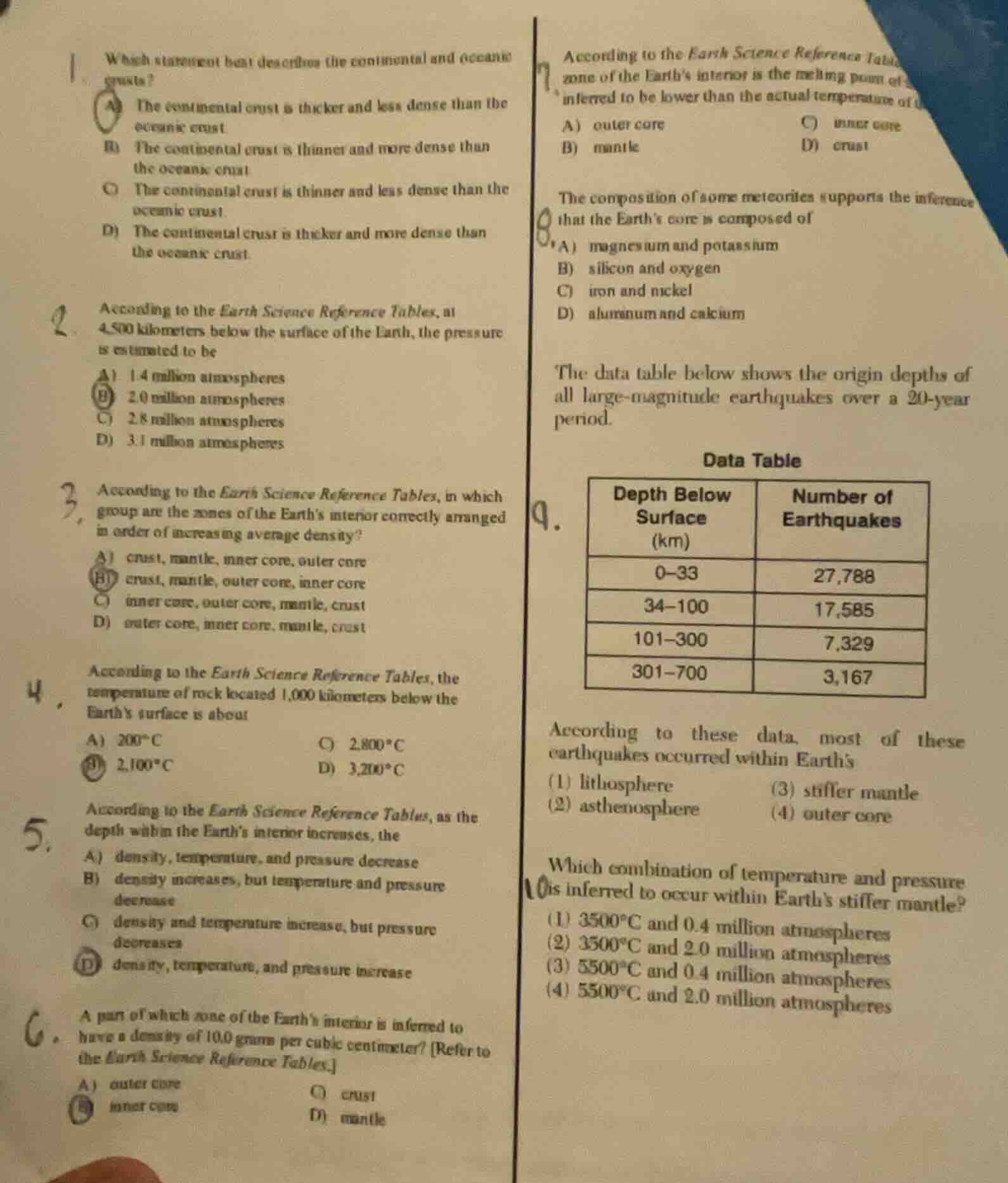
- which statement best describes the continental and oceanic crusts?
a) the continental crust is thicker and less dense than the oceanic crust
b) the continental crust is thinner and more dense than the oceanic crust
c) the continental crust is thinner and less dense than the oceanic crust
d) the continental crust is thicker and more dense than the oceanic crust
- according to the earth science reference tables, at 4,500 kilometers below the surface of the earth, the pressure is estimated to be
a) 1.4 million atmospheres
b) 2.0 million atmospheres
c) 2.8 million atmospheres
d) 3.1 million atmospheres
- according to the earth science reference tables, in which group are the zones of the earth’s interior correctly arranged in order of increasing average density?
a) crust, mantle, inner core, outer core
b) crust, mantle, outer core, inner core
c) inner core, outer core, mantle, crust
d) outer core, inner core, mantle, crust
- according to the earth science reference tables, the temperature of rock located 1,000 kilometers below the earth’s surface is about
a) 200°c
b) 2,100°c
c) 2,800°c
d) 3,200°c
- according to the earth science reference tables, as the depth within the earth’s interior increases, the
a) density, temperature, and pressure decrease
b) density increases, but temperature and pressure decrease
c) density and temperature increase, but pressure decreases
d) density, temperature, and pressure increase
- a part of which zone of the earth’s interior is inferred to have a density of 10.0 grams per cubic centimeter? refer to the earth science reference tables.
a) outer core
b) inner core
c) crust
d) mantle
- according to the earth science reference table, zone of the earth’s interior is the melting point of inferred to be lower than the actual temperature of
a) outer core
b) mantle
c) inner core
d) crust
- the composition of some meteorites supports the inference that the earth’s core is composed of
a) magnesium and potassium
b) silicon and oxygen
c) iron and nickel
d) aluminum and calcium
- the data table below shows the origin depths of all large - magnitude earthquakes over a 20 - year period.
data table
| depth below surface (km) | number of earthquakes |
|---|---|
| 34 - 100 | 17,585 |
| 101 - 300 | 7,329 |
| 301 - 700 | 3,167 |
according to these data, most of these earthquakes occurred within earth’s
(1) lithosphere (3) stiffer mantle
(2) asthenosphere (4) outer core
- which combination of temperature and pressure is inferred to occur within earth’s stiffer mantle?
(1) 3500°c and 0.4 million atmospheres
(2) 3500°c and 2.0 million atmospheres
(3) 5500°c and 0.4 million atmospheres
(4) 5500°c and 2.0 million atmospheres
- Continental crust averages ~30-50 km thick (less dense, felsic), oceanic crust is ~5-10 km thick (more dense, mafic).
- Earth Science Reference Tables show pressure at 4500 km (inner core boundary) is ~2.0 million atmospheres.
- Earth layers by increasing density: crust (~2.7-3.0 g/cm³), mantle (~3.3-5.7 g/cm³), outer core (~9.9-12.2 g/cm³), inner core (~12.6-13.0 g/cm³).
- At 1000 km depth (upper mantle), the reference table lists a temperature of ~2100°C.
- As depth in Earth increases, overlying material increases pressure, which raises density and temperature of materials.
- Inner core has a density range of 12.6-13.0 g/cm³, outer core 9.9-12.2 g/cm³; this density matches the core, specifically inner core.
- The mantle's melting point is inferred to be lower than its actual temperature, allowing it to flow slowly (plasticity).
- Meteorite composition (iron-nickel chondrites) matches the inferred composition of Earth's core, as these represent primitive solar system material.
- The lithosphere includes the crust and upper mantle, extending to ~100 km depth. 27,788 + 17,585 = 45,373 earthquakes occur in the 0-100 km range, which is the vast majority of total earthquakes.
- The stiffer mantle (upper mantle below asthenosphere) has a pressure of ~0.4-1.0 million atmospheres and temperature of ~1000-3500°C, matching this combination.

Snap & solve any problem in the app
Get step-by-step solutions on Sovi AI
Photo-based solutions with guided steps
Explore more problems and detailed explanations
- A) The continental crust is thicker and less dense than the oceanic crust
- B) 2.0 million atmospheres
- B) crust, mantle, outer core, inner core
- B) 2,100°C
- D) density, temperature, and pressure increase
- B) inner core
- B) mantle
- C) iron and nickel
- (1) lithosphere
- (1) 3500°C and 0.4 million atmospheres