QUESTION IMAGE
Question
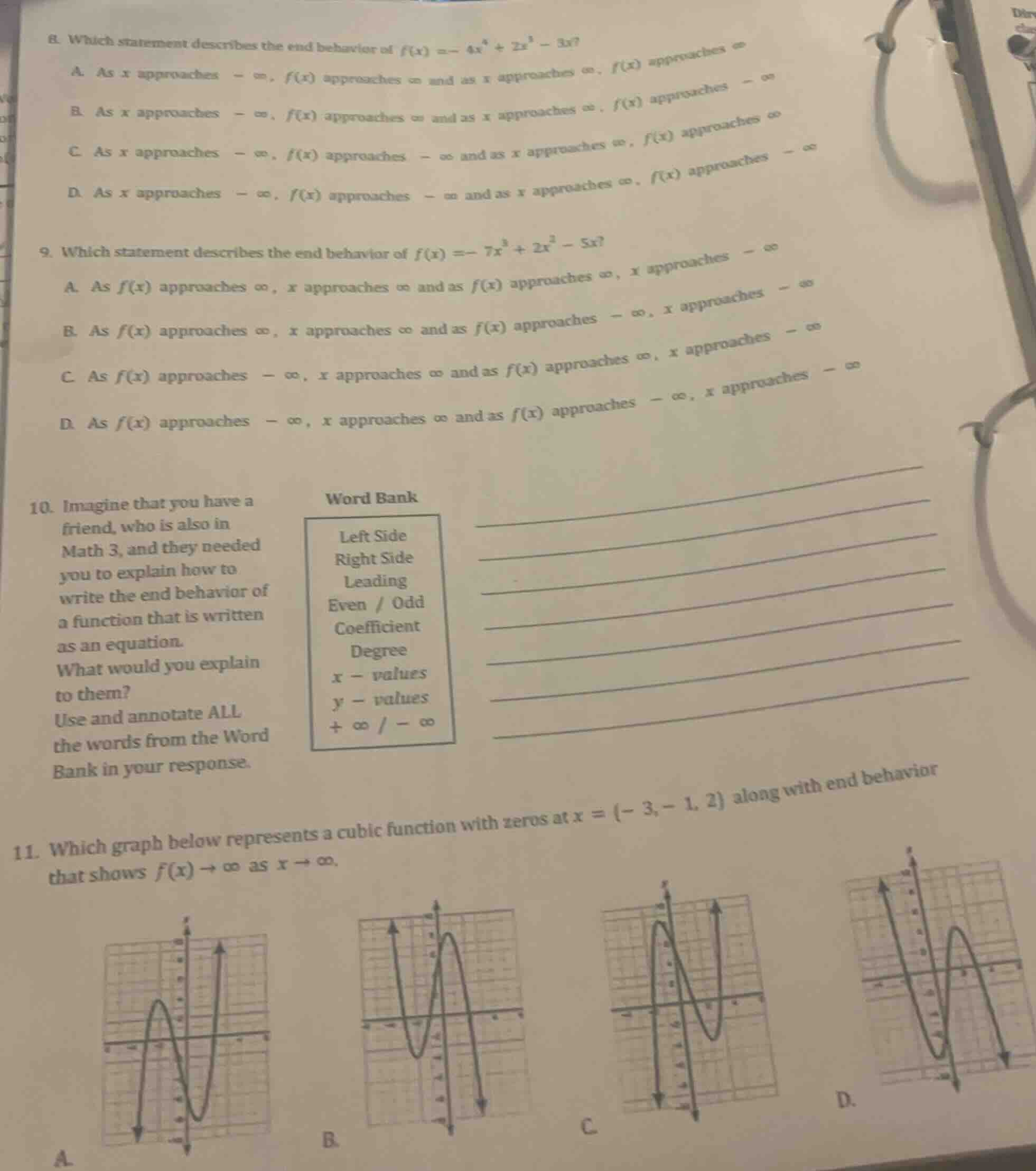
- which statement describes the end behavior of $f(x) = -4x^4 + 2x^3 - 3x$?
a. as $x$ approaches $-\infty$, $f(x)$ approaches $\infty$ and as $x$ approaches $\infty$, $f(x)$ approaches $\infty$
b. as $x$ approaches $-\infty$, $f(x)$ approaches $\infty$ and as $x$ approaches $\infty$, $f(x)$ approaches $-\infty$
c. as $x$ approaches $-\infty$, $f(x)$ approaches $-\infty$ and as $x$ approaches $\infty$, $f(x)$ approaches $\infty$
d. as $x$ approaches $-\infty$, $f(x)$ approaches $-\infty$ and as $x$ approaches $\infty$, $f(x)$ approaches $-\infty$
- which statement describes the end behavior of $f(x) = -7x^3 + 2x^2 - 5x$?
a. as $f(x)$ approaches $\infty$, $x$ approaches $\infty$ and as $f(x)$ approaches $\infty$, $x$ approaches $-\infty$
b. as $f(x)$ approaches $\infty$, $x$ approaches $\infty$ and as $f(x)$ approaches $-\infty$, $x$ approaches $-\infty$
c. as $f(x)$ approaches $-\infty$, $x$ approaches $\infty$ and as $f(x)$ approaches $\infty$, $x$ approaches $-\infty$
d. as $f(x)$ approaches $-\infty$, $x$ approaches $\infty$ and as $f(x)$ approaches $-\infty$, $x$ approaches $-\infty$
- imagine that you have a friend, who is also in math 3, and they needed you to explain how to write the end behavior of a function that is written as an equation.
what would you explain to them?
use and annotate all the words from the word bank in your response.
word bank
left side
right side
leading
even / odd
coefficient
degree
$x-$values
$y-$values
$+\infty / -\infty$
- which graph below represents a cubic function with zeros at $x = \\{-3, -1, 2\\}$ along with end behavior that shows $f(x) \to \infty$ as $x \to \infty$.
Step1: Identify degree and leading coefficient (Q8)
For $f(x) = -4x^4 + 2x^3 - 3x$, degree $n=4$ (even), leading coefficient $-4$ (negative).
Step2: Determine end behavior (Q8)
Even degree, negative leading coefficient: as $x\to-\infty$, $f(x)\to-\infty$; as $x\to\infty$, $f(x)\to-\infty$.
Step3: Identify degree and leading coefficient (Q9)
For $f(x) = -7x^3 + 2x^2 - 5x$, degree $n=3$ (odd), leading coefficient $-7$ (negative).
Step4: Determine end behavior (Q9)
Odd degree, negative leading coefficient: as $x\to\infty$, $f(x)\to-\infty$; as $x\to-\infty$, $f(x)\to\infty$. Rewrite in terms of $f(x)$ trends: as $f(x)\to\infty$, $x\to-\infty$; as $f(x)\to-\infty$, $x\to\infty$.
Step5: Explain end behavior steps (Q10)
- First, find the Leading Coefficient (the number multiplied by the highest power of $x$) and the Degree (the highest exponent of $x$, check if it is Even / Odd).
- To analyze the Left Side end behavior, look at $x$-values approaching $-\infty$:
- If degree is even and leading coefficient positive: $y$-values ($f(x)$) approach $+\infty$; if leading coefficient negative: $y$-values approach $-\infty$.
- If degree is odd and leading coefficient positive: $y$-values approach $-\infty$; if leading coefficient negative: $y$-values approach $+\infty$.
- To analyze the Right Side end behavior, look at $x$-values approaching $+\infty$:
- If degree is even and leading coefficient positive: $y$-values approach $+\infty$; if leading coefficient negative: $y$-values approach $-\infty$.
- If degree is odd and leading coefficient positive: $y$-values approach $+\infty$; if leading coefficient negative: $y$-values approach $-\infty$.
- Summarize by stating how $y$-values change as $x$-values go to $+\infty / -\infty$.
Step6: Analyze cubic function (Q11)
Cubic function (degree 3, odd), zeros at $x=-3,-1,2$, and $f(x)\to\infty$ as $x\to\infty$ (so leading coefficient positive). For odd degree positive leading coefficient: $f(x)\to-\infty$ as $x\to-\infty$. The graph crosses the x-axis at $x=-3,-1,2$, goes down as $x\to-\infty$ and up as $x\to\infty$.

Snap & solve any problem in the app
Get step-by-step solutions on Sovi AI
Photo-based solutions with guided steps
Explore more problems and detailed explanations
- D. As x approaches $-\infty$, $f(x)$ approaches $-\infty$ and as x approaches $\infty$, $f(x)$ approaches $-\infty$
- C. As $f(x)$ approaches $-\infty$, x approaches $\infty$ and as $f(x)$ approaches $\infty$, x approaches $-\infty$
- 1. Start by identifying the Leading Coefficient (the number in front of the highest-powered $x$ term) and the Degree (the highest exponent of $x$, note if it is Even / Odd).
- For the Left Side of the graph, observe what happens to $y$-values ($f(x)$) when $x$-values approach $-\infty$:
- If the degree is even and leading coefficient is positive, $y$-values approach $+\infty$; if negative, $y$-values approach $-\infty$.
- If the degree is odd and leading coefficient is positive, $y$-values approach $-\infty$; if negative, $y$-values approach $+\infty$.
- For the Right Side of the graph, observe what happens to $y$-values ($f(x)$) when $x$-values approach $+\infty$:
- If the degree is even and leading coefficient is positive, $y$-values approach $+\infty$; if negative, $y$-values approach $-\infty$.
- If the degree is odd and leading coefficient is positive, $y$-values approach $+\infty$; if negative, $y$-values approach $-\infty$.
- Finally, state the end behavior clearly by linking $x$-values moving toward $+\infty / -\infty$ to the corresponding $y$-value trends.
- A. (Graph that crosses x-axis at -3, -1, 2, goes down as $x\to-\infty$ and up as $x\to\infty$)