QUESTION IMAGE
Question
which statement is true about the given information?
options:
- ( bd = \frac{1}{2}bc )
- ( bc = \frac{1}{2}be )
- ( overline{bd} cong overline{ce} )
- ( overline{bc} cong overline{bd} )
Step1: Analyze the number line segments
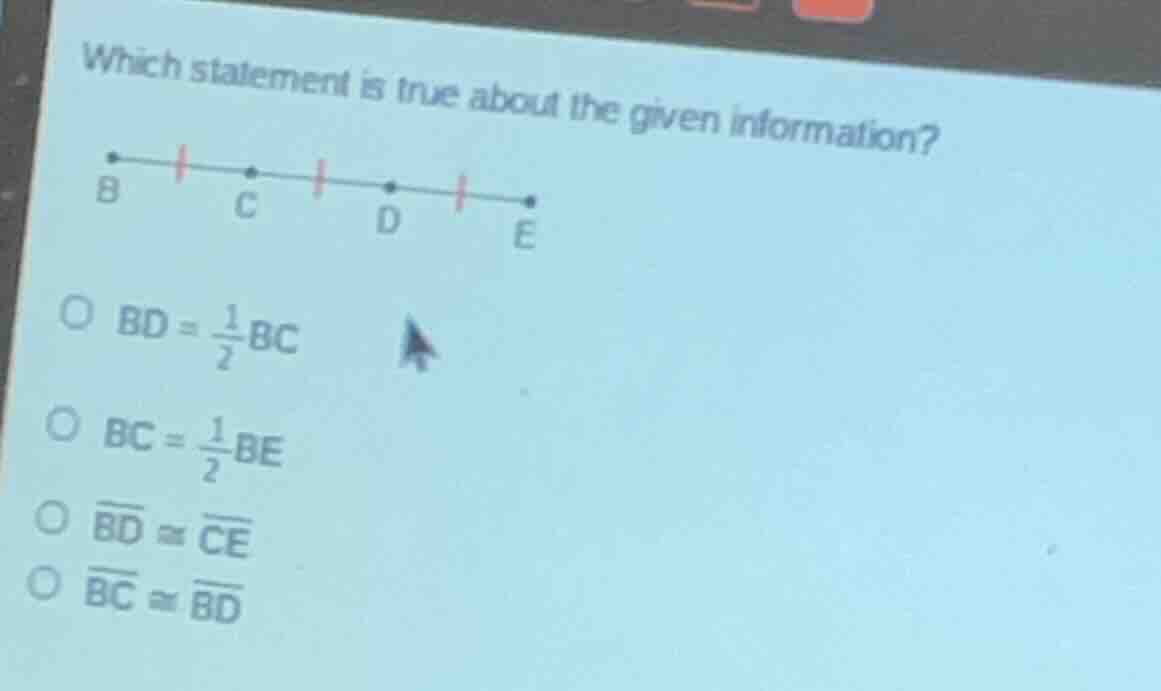
From the number line, the tick marks indicate that \( BC = CD = DE \). Let's denote the length of each segment (e.g., \( BC \)) as \( x \). Then \( BD = BC + CD = x + x = 2x \), \( BE=BC + CD + DE=x + x + x = 3x \), and \( CE=CD + DE=x + x = 2x \).
Step2: Evaluate each option
- For \( BD=\frac{1}{2}BC \): \( BD = 2x \), \( BC=x \), so \( 2x
eq\frac{1}{2}x \). False.
- For \( BC=\frac{1}{2}BE \): \( BC = x \), \( BE = 3x \), so \( x
eq\frac{1}{2}(3x)=\frac{3}{2}x \). False.
- For \( \overline{BD}\cong\overline{CE} \): \( BD = 2x \), \( CE = 2x \), so their lengths are equal, meaning the segments are congruent. True.
- For \( \overline{BC}\cong\overline{BD} \): \( BC = x \), \( BD = 2x \), so \( x
eq2x \). False.

Snap & solve any problem in the app
Get step-by-step solutions on Sovi AI
Photo-based solutions with guided steps
Explore more problems and detailed explanations
\( \overline{BD} \cong \overline{CE} \) (the third option)