QUESTION IMAGE
Question
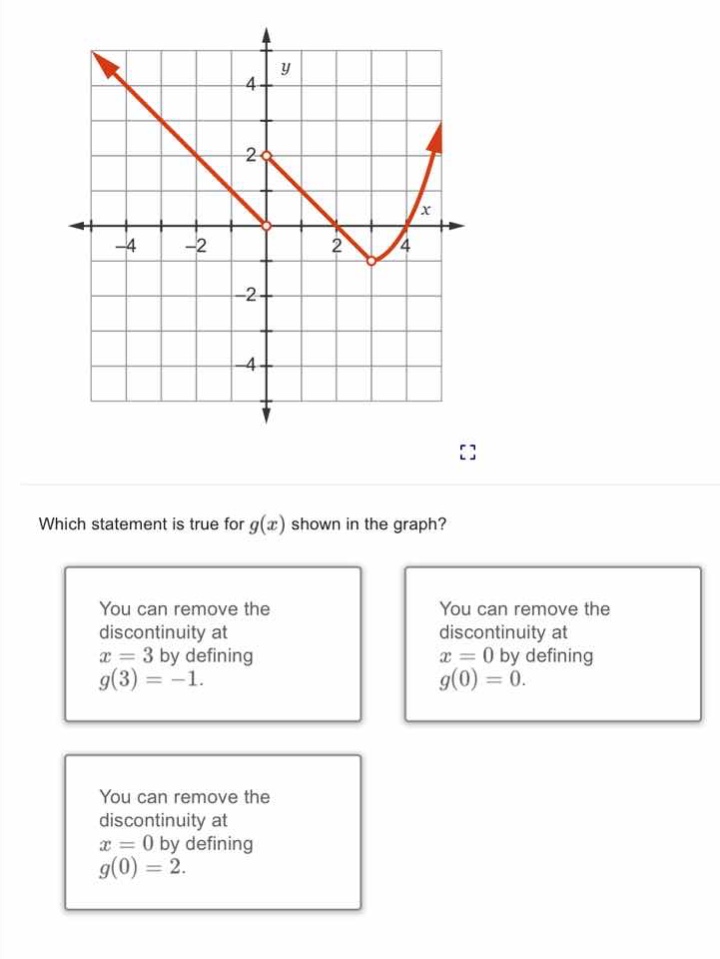
which statement is true for ( g(x) ) shown in the graph?
you can remove the discontinuity at ( x = 3 ) by defining ( g(3) = -1 ).
you can remove the discontinuity at ( x = 0 ) by defining ( g(0) = 0 ).
you can remove the discontinuity at ( x = 0 ) by defining ( g(0) = 2 ).
Brief Explanations
A removable discontinuity (hole) exists when the limit of the function at a point exists, but the function is not defined there, or the defined value does not match the limit.
- For $x=3$: The graph has a point (not a hole), so there is no removable discontinuity here.
- For $x=0$: The graph has a hole at $y=2$, meaning $\lim_{x \to 0} g(x) = 2$, but $g(0)$ is undefined. Defining $g(0)=2$ will fill the hole and remove the discontinuity. Defining $g(0)=0$ does not match the limit, so it does not remove the discontinuity.

Snap & solve any problem in the app
Get step-by-step solutions on Sovi AI
Photo-based solutions with guided steps
Explore more problems and detailed explanations
You can remove the discontinuity at $x = 0$ by defining $g(0) = 2$.