QUESTION IMAGE
Question
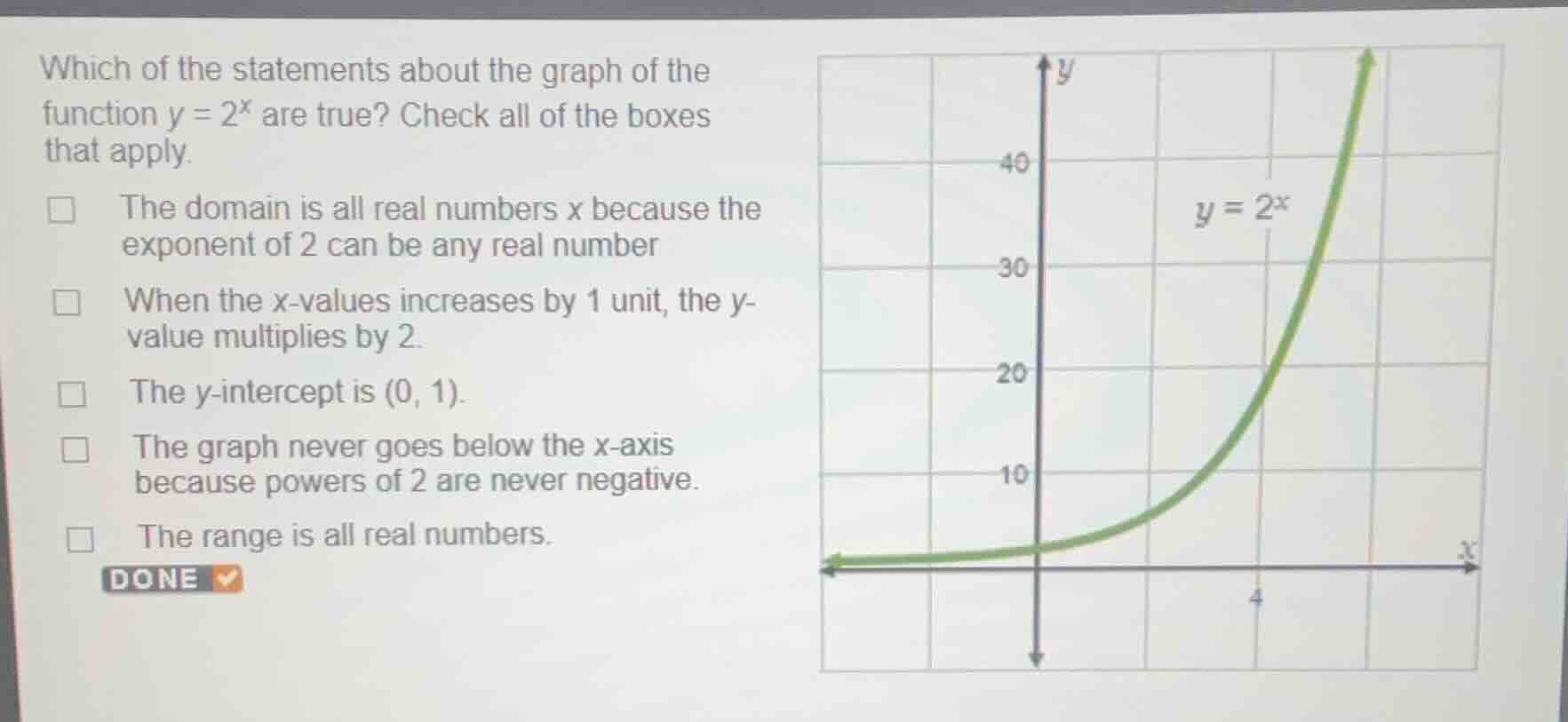
which of the statements about the graph of the function $y = 2^x$ are true? check all of the boxes that apply.
- the domain is all real numbers $x$ because the exponent of 2 can be any real number
- when the $x$-values increases by 1 unit, the $y$-value multiplies by 2.
- the $y$-intercept is $(0, 1)$.
- the graph never goes below the $x$-axis because powers of 2 are never negative.
- the range is all real numbers.
Brief Explanations
- Domain of \( y = 2^x \): The domain of an exponential function \( a^x \) (where \( a>0, a
eq1 \)) is all real numbers because any real number can be an exponent. So the first statement is true.
- Change in \( y \) for \( x \) increase by 1: If \( x \) becomes \( x + 1 \), then \( y \) becomes \( 2^{x + 1}=2^x\times2 \), so \( y \) multiplies by 2. The second statement is true.
- \( y \)-intercept: The \( y \)-intercept occurs at \( x = 0 \). Substituting \( x = 0 \), \( y = 2^0 = 1 \), so the \( y \)-intercept is \( (0, 1) \). The third statement is true.
- Graph below \( x \)-axis: For any real \( x \), \( 2^x>0 \) (since positive numbers raised to any real power are positive). Thus, the graph never goes below the \( x \)-axis. The fourth statement is true.
- Range of \( y = 2^x \): The range of \( 2^x \) is \( y>0 \) (all positive real numbers), not all real numbers. The fifth statement is false.

Snap & solve any problem in the app
Get step-by-step solutions on Sovi AI
Photo-based solutions with guided steps
Explore more problems and detailed explanations
- The domain is all real numbers \( x \) because the exponent of 2 can be any real number
- When the \( x \)-values increases by 1 unit, the \( y \)-value multiplies by 2.
- The \( y \)-intercept is \( (0, 1) \).
- The graph never goes below the \( x \)-axis because powers of 2 are never negative.