QUESTION IMAGE
Question
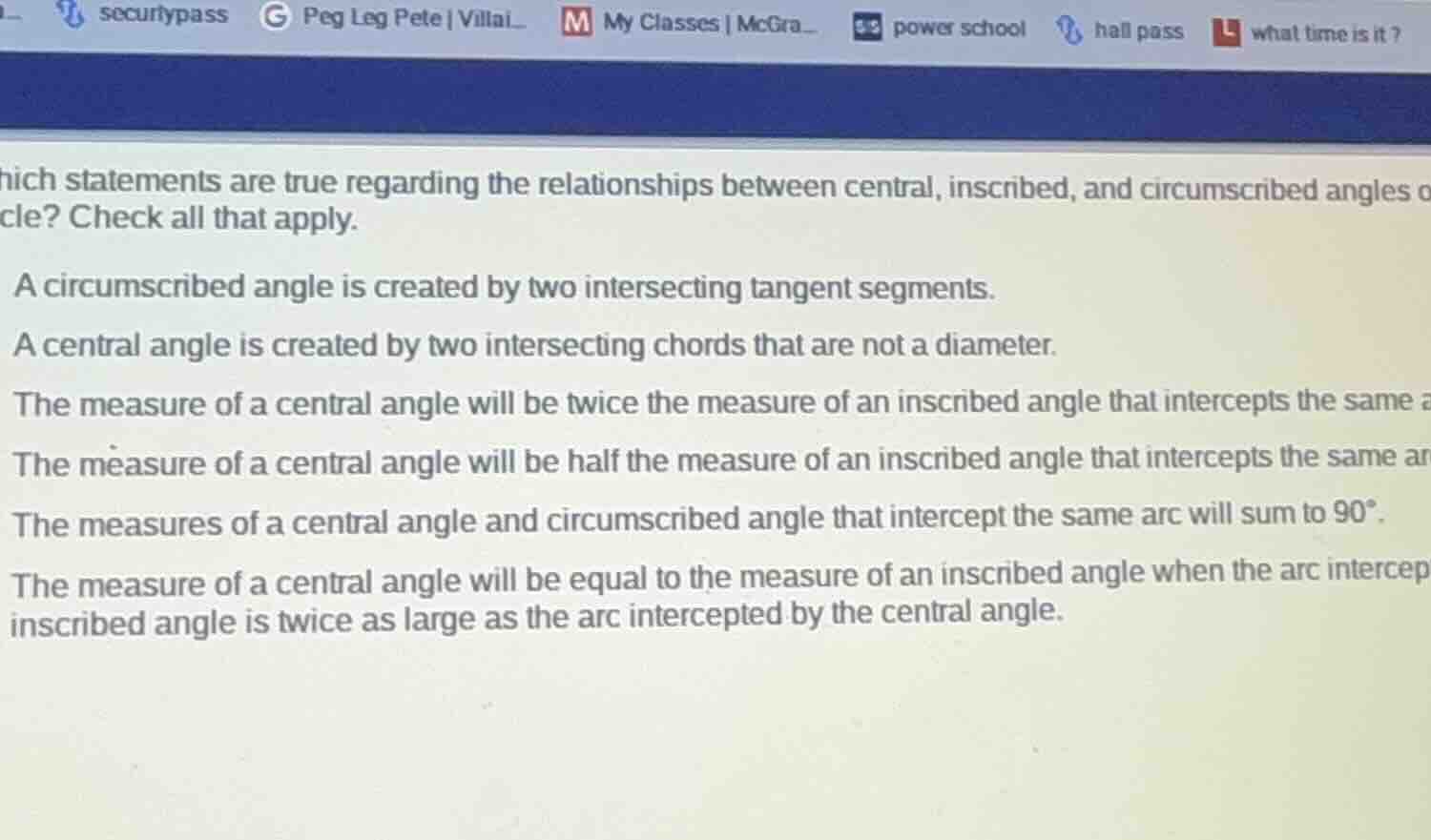
which statements are true regarding the relationships between central, inscribed, and circumscribed angles of a circle? check all that apply.
a circumscribed angle is created by two intersecting tangent segments.
a central angle is created by two intersecting chords that are not a diameter.
the measure of a central angle will be twice the measure of an inscribed angle that intercepts the same arc
the measure of a central angle will be half the measure of an inscribed angle that intercepts the same arc
the measures of a central angle and circumscribed angle that intercept the same arc will sum to $90^\circ$.
the measure of a central angle will be equal to the measure of an inscribed angle when the arc intercepted by the inscribed angle is twice as large as the arc intercepted by the central angle.
- A circumscribed angle is defined as an angle formed by two intersecting tangent segments to a circle, so this statement is true.
- A central angle is formed by two radii (not chords that are not diameters) with the vertex at the circle's center, so this statement is false.
- The central angle theorem states that the measure of a central angle intercepting an arc is twice the measure of an inscribed angle intercepting the same arc, so this statement is true.
- This directly contradicts the central angle theorem, so it is false.
- There is no rule that the sum of a central angle and circumscribed angle intercepting the same arc equals 90°, so this statement is false.
- The central angle is equal to its intercepted arc, and the inscribed angle is half its intercepted arc. For them to be equal, the inscribed angle's intercepted arc would need to be twice the central angle's, which aligns with the central angle theorem reversal, making this statement true.

Snap & solve any problem in the app
Get step-by-step solutions on Sovi AI
Photo-based solutions with guided steps
Explore more problems and detailed explanations
A circumscribed angle is created by two intersecting tangent segments.
The measure of a central angle will be twice the measure of an inscribed angle that intercepts the same arc.
The measure of a central angle will be equal to the measure of an inscribed angle when the arc intercepted by the inscribed angle is twice as large as the arc intercepted by the central angle.