QUESTION IMAGE
Question
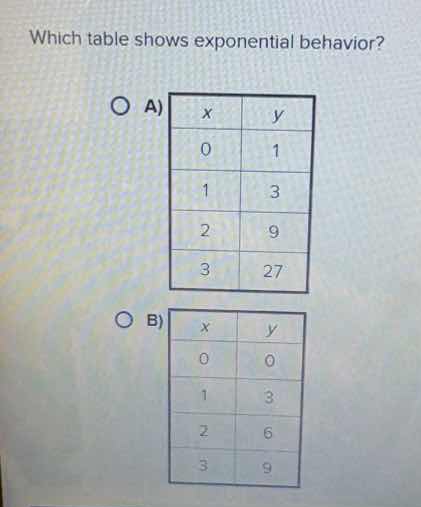
which table shows exponential behavior? a) | x | y | | 0 | 1 | | 1 | 3 | | 2 | 9 | | 3 | 27 | b) | x | y | | 0 | 0 | | 1 | 3 | | 2 | 6 | | 3 | 9 |
Step1: Recall exponential function property
An exponential function has the form \( y = a \cdot b^x \), where \( a
eq0 \), \( b > 0 \), \( b
eq1 \). For discrete values (table), the ratio of consecutive \( y \)-values (when \( x \) increases by 1) should be constant (equal to \( b \)).
Step2: Analyze Table A
- When \( x = 0 \), \( y = 1 \); \( x = 1 \), \( y = 3 \). Ratio: \( \frac{3}{1}=3 \).
- When \( x = 1 \), \( y = 3 \); \( x = 2 \), \( y = 9 \). Ratio: \( \frac{9}{3}=3 \).
- When \( x = 2 \), \( y = 9 \); \( x = 3 \), \( y = 27 \). Ratio: \( \frac{27}{9}=3 \).
The ratio between consecutive \( y \)-values is constant (\( 3 \)), so it follows exponential behavior (\( y = 1\cdot3^x \)).
Step3: Analyze Table B
- When \( x = 0 \), \( y = 0 \); \( x = 1 \), \( y = 3 \). Ratio: \( \frac{3}{0} \) (undefined, and starting from \( y = 0 \) is not exponential as exponential functions have \( y
eq0 \) for all \( x \) if \( a
eq0 \)).
- When \( x = 1 \), \( y = 3 \); \( x = 2 \), \( y = 6 \). Ratio: \( \frac{6}{3}=2 \).
- When \( x = 2 \), \( y = 6 \); \( x = 3 \), \( y = 9 \). Ratio: \( \frac{9}{6}=\frac{3}{2} \).
The ratios are not constant, so it is linear (since \( y \) increases by 3 each time \( x \) increases by 1: \( y = 3x \)), not exponential.

Snap & solve any problem in the app
Get step-by-step solutions on Sovi AI
Photo-based solutions with guided steps
Explore more problems and detailed explanations
A)
| \( x \) | \( y \) |
|---|---|
| 1 | 3 |
| 2 | 9 |
| 3 | 27 |