QUESTION IMAGE
Question
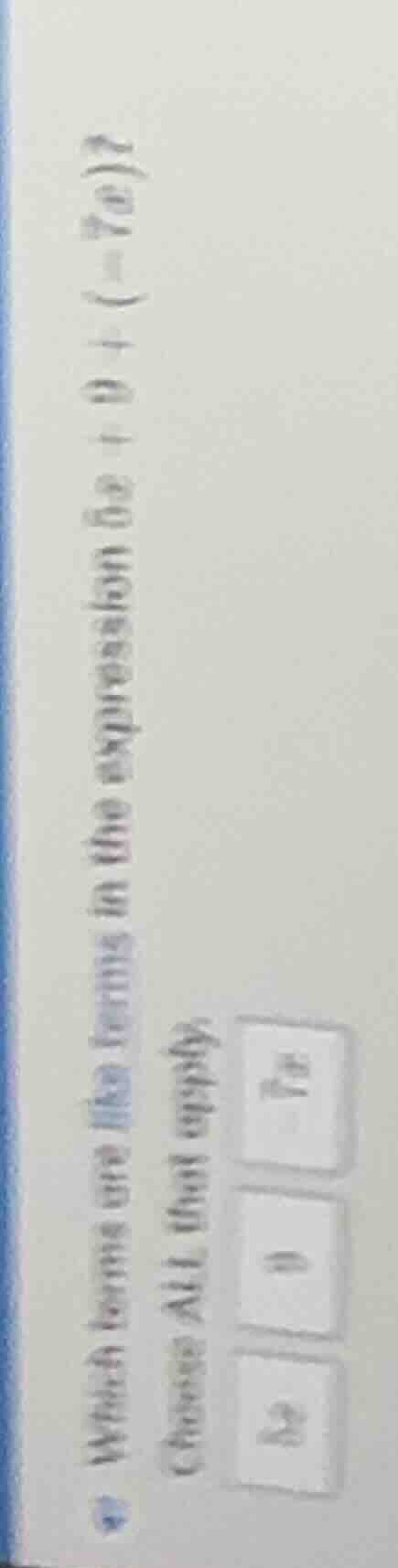
which terms are like terms in the expression (6a + 9 + (-7a))? choose all that apply.
options: (6a), (9), (-7a)
Step1: Identify like terms
Like terms are terms with the same variable (or no variable for constant terms) raised to the same power. In the expression \(6a + 9+(-7a)\), we can rewrite it as \(6a + 9 - 7a\). The terms with the variable \(a\) are \(6a\) and \(-7a\). The constant term is \(9\), and there's no other term with just a constant (other than 9) or a different variable. So we check each option:
- For \(6a\): It has the variable \(a\), same as \(-7a\) (since \(-7a\) also has \(a\)), so they are like terms.
- For \(9\): It's a constant term, and there's no other constant term in the expression to be like with (the other terms have \(a\)), so 9 is not a like term with \(6a\) or \(-7a\) (since those have \(a\)). Wait, no—wait, the question is "Which terms are like terms in the expression \(6a + 9+(-7a)\)? Choose ALL that apply." Wait, maybe I misread. Wait, the terms are \(6a\), \(9\), and \(-7a\). Like terms are terms with the same variable part. So \(6a\) and \(-7a\) have the same variable \(a\) (same exponent, which is 1), so they are like terms. \(9\) is a constant, so it's only like with other constants, but there are none here. Wait, but the options are \(6a\), \(9\), \(-7a\). Wait, maybe the question is which terms are like terms among these three. So \(6a\) and \(-7a\) are like terms because they have the same variable \(a\) with exponent 1. \(9\) is a constant, so it's not like with \(6a\) or \(-7a\). Wait, but let's re-express the expression: \(6a + 9 - 7a\). Combining like terms: \( (6a - 7a) + 9 = -a + 9\). So the like terms are \(6a\) and \(-7a\). Wait, but the options are \(6a\), \(9\), \(-7a\). So we need to check which of these are like terms. So \(6a\) and \(-7a\) are like terms (same variable, same exponent). \(9\) is a constant, so it's not like with \(6a\) or \(-7a\) (since those have \(a\)). Wait, maybe the question is a bit different—maybe a typo? Wait, no, let's check again. The expression is \(6a + 9 + (-7a)\), which is \(6a + 9 - 7a\). The terms are \(6a\) (term 1), \(9\) (term 2), \(-7a\) (term 3). Like terms are terms with identical variable parts. So term 1 (\(6a\)) and term 3 (\(-7a\)) have the same variable \(a\) (exponent 1), so they are like terms. Term 2 (\(9\)) is a constant, so it's not like with the others. So the like terms are \(6a\) and \(-7a\). Wait, but the options are \(6a\), \(9\), \(-7a\). So we need to select \(6a\) and \(-7a\) as the like terms. Wait, maybe I made a mistake. Wait, no—like terms are terms that can be combined because they have the same variable (or no variable, for constants) with the same exponent. So \(6a\) and \(-7a\) have the variable \(a\) with exponent 1, so they are like terms. \(9\) is a constant, so it's only like with other constants, but there are none here. So the like terms are \(6a\) and \(-7a\). Wait, but the options are \(6a\), \(9\), \(-7a\). So we need to choose \(6a\) and \(-7a\) (and maybe \(9\) is not, but wait, maybe the question is phrased differently. Wait, maybe the original problem is "Which terms are like terms in the expression \(6a + 9 + (-7a)\)? Choose ALL that apply." So the terms are \(6a\), \(9\), \(-7a\). So \(6a\) and \(-7a\) are like terms (same variable \(a\), same power). \(9\) is a constant, so it's not like with \(6a\) or \(-7a\). So the correct like terms are \(6a\) and \(-7a\). Wait, but let's check the options again. The options are \(6a\), \(9\), \(-7a\). So we need to select \(6a\) and \(-7a\). Wait, maybe I misread the expression. Let me confirm: the expression is \(6a + 9 + (-7a)\), which is \(6a + 9 - 7a\). So terms: \(…

Snap & solve any problem in the app
Get step-by-step solutions on Sovi AI
Photo-based solutions with guided steps
Explore more problems and detailed explanations
\(6a\), \(-7a\)