QUESTION IMAGE
Question
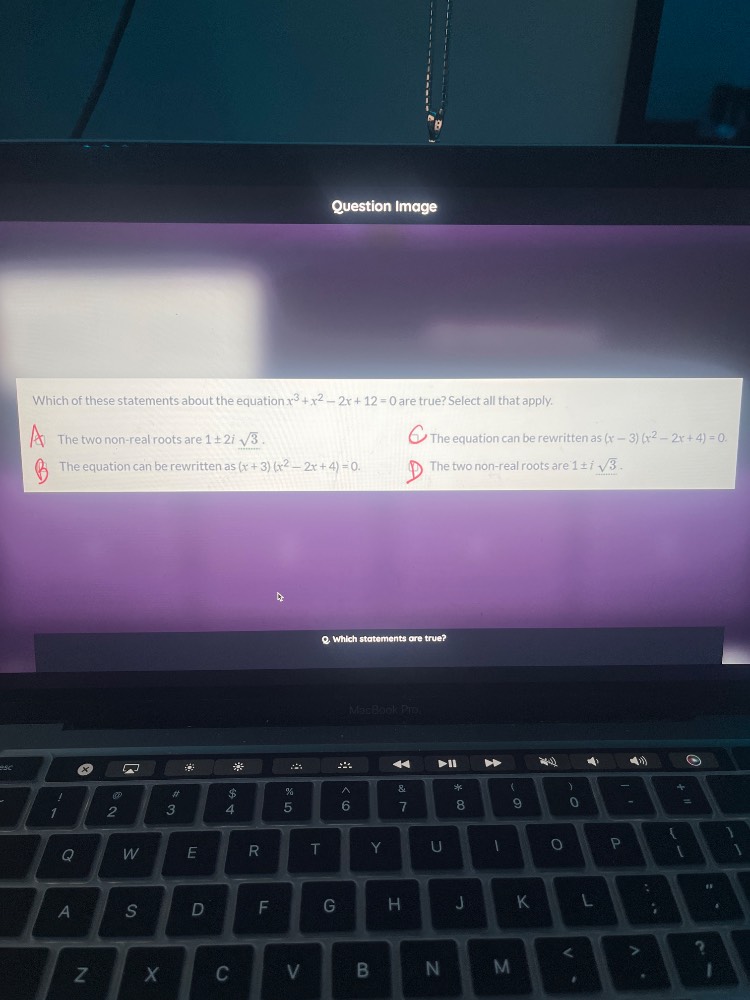
which of these statements about the equation (x^{3}+x^{2}-2x + 12 = 0) are true? select all that apply.
a the two non - real roots are (1pm2isqrt{3}).
c the equation can be rewritten as ((x - 3)(x^{2}-2x + 4)=0).
b the equation can be rewritten as ((x + 3)(x^{2}-2x + 4)=0).
d the two non - real roots are (1pm isqrt{3}).
which statements are true?
Step1: Factor the cubic equation
Use rational root theorem: test $x=-3$:
$$(-3)^3+(-3)^2-2(-3)+12=-27+9+6+12=0$$
So $x+3$ is a factor. Perform polynomial division:
$$\frac{x^3+x^2-2x+12}{x+3}=x^2-2x+4$$
Thus, $x^3+x^2-2x+12=(x+3)(x^2-2x+4)=0$
Step2: Find non-real roots
Solve $x^2-2x+4=0$ with quadratic formula $x=\frac{-b\pm\sqrt{b^2-4ac}}{2a}$, where $a=1,b=-2,c=4$:
$$x=\frac{2\pm\sqrt{4-16}}{2}=\frac{2\pm\sqrt{-12}}{2}=\frac{2\pm2i\sqrt{3}}{2}=1\pm i\sqrt{3}$$
Step3: Verify options
- A is false (roots are $1\pm i\sqrt{3}$, not $1\pm2i\sqrt{3}$)
- B is true (matches factored form)
- C is false (factor is $x+3$, not $x-3$)
- D is true (matches calculated non-real roots)

Snap & solve any problem in the app
Get step-by-step solutions on Sovi AI
Photo-based solutions with guided steps
Explore more problems and detailed explanations
B. The equation can be rewritten as $(x + 3)(x^2 - 2x + 4) = 0$,
D. The two non-real roots are $1\pm i\sqrt{3}$.