QUESTION IMAGE
Question
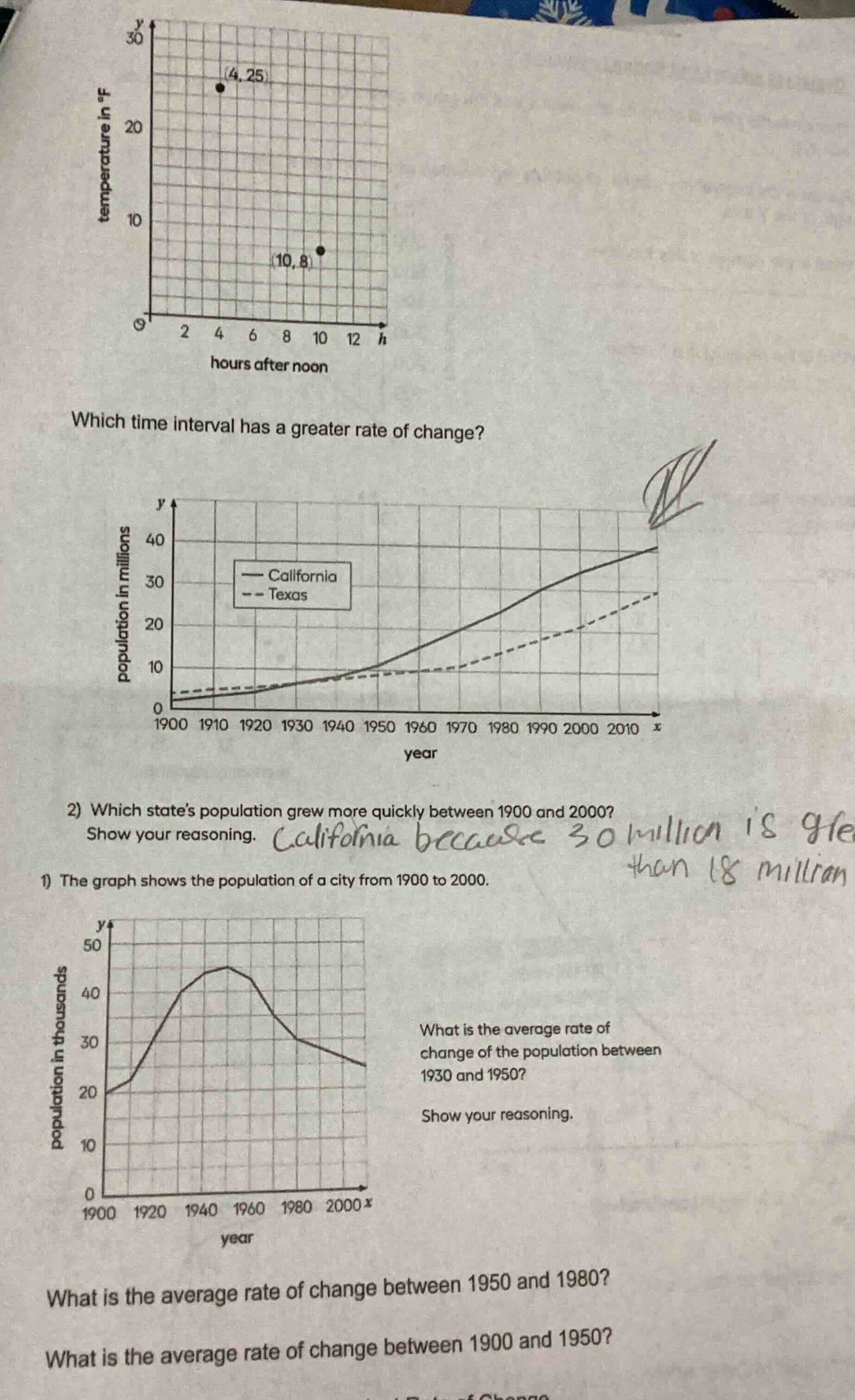
which time interval has a greater rate of change?
- which states population grew more quickly between 1900 and 2000?
show your reasoning.
- the graph shows the population of a city from 1900 to 2000.
what is the average rate of
change of the population between
1930 and 1950?
show your reasoning.
what is the average rate of change between 1950 and 1980?
what is the average rate of change between 1900 and 1950?
Step1: Find temp rate of change
The average rate of change formula is $\frac{y_2 - y_1}{x_2 - x_1}$. For the temperature points $(4,25)$ and $(10,8)$:
$\frac{8 - 25}{10 - 4} = \frac{-17}{6} \approx -2.83 \, ^\circ\text{F/hour}$
This is the only interval given, so it is the rate for that period.
Step2: Calculate CA/TX population change
California:
1900 population: $2$ million, 2000 population: $33$ million.
Rate = $\frac{33 - 2}{2000 - 1900} = \frac{31}{100} = 0.31$ million/year
Texas:
1900 population: $4$ million, 2000 population: $20$ million.
Rate = $\frac{20 - 4}{2000 - 1900} = \frac{16}{100} = 0.16$ million/year
Step3: 1930-1950 city population rate
1930 population: $30$ thousand, 1950 population: $45$ thousand.
Rate = $\frac{45 - 30}{1950 - 1930} = \frac{15}{20} = 0.75$ thousand/year
Step4: 1950-1980 city population rate
1950 population: $45$ thousand, 1980 population: $30$ thousand.
Rate = $\frac{30 - 45}{1980 - 1950} = \frac{-15}{30} = -0.5$ thousand/year
Step5: 1900-1950 city population rate
1900 population: $20$ thousand, 1950 population: $45$ thousand.
Rate = $\frac{45 - 20}{1950 - 1900} = \frac{25}{50} = 0.5$ thousand/year

Snap & solve any problem in the app
Get step-by-step solutions on Sovi AI
Photo-based solutions with guided steps
Explore more problems and detailed explanations
- Temperature rate of change: $\frac{-17}{6} \approx -2.83 \, ^\circ\text{F/hour}$ (the only interval provided, so it is the measured rate)
- California's population grew more quickly (0.31 million/year vs. Texas's 0.16 million/year)
- Average rate of change 1930-1950: $0.75$ thousand people per year
- Average rate of change 1950-1980: $-0.5$ thousand people per year
- Average rate of change 1900-1950: $0.5$ thousand people per year