QUESTION IMAGE
Question
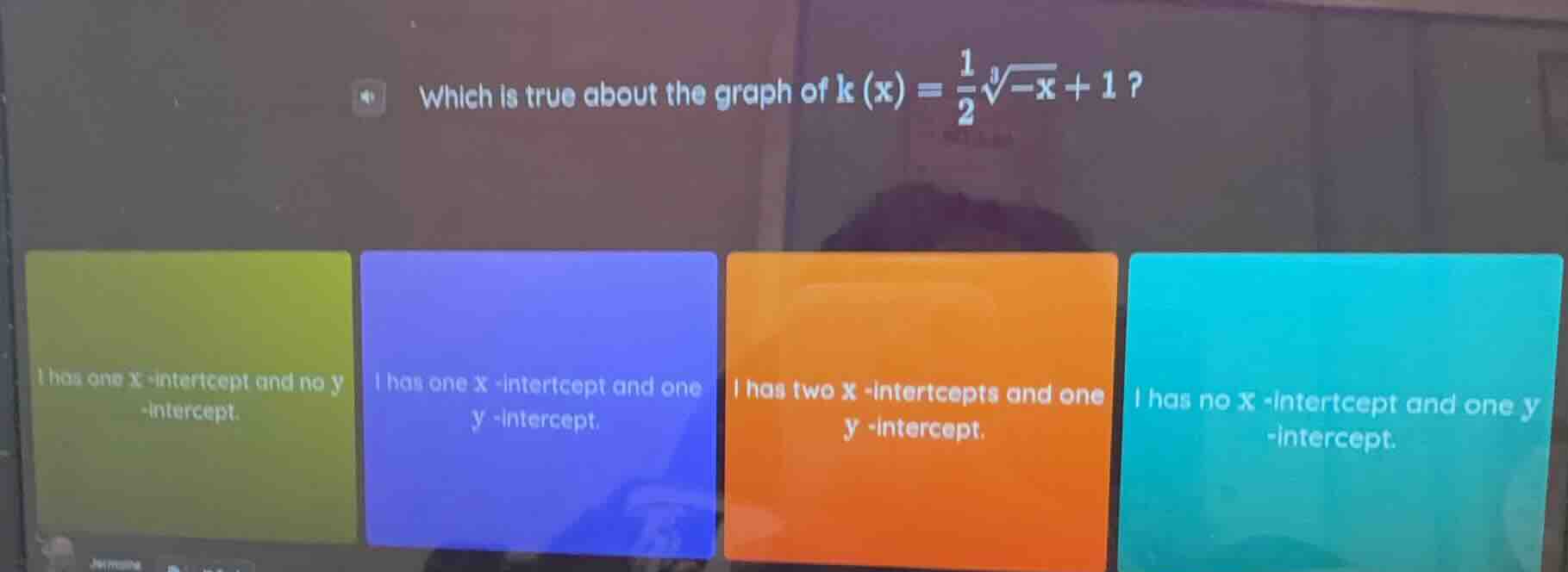
which is true about the graph of $k(x) = \frac{1}{2}\sqrt3{-x} + 1$?
i has one x -intercept and no y -intercept.
i has one x -intercept and one y -intercept.
i has two x -intercepts and one y -intercept.
i has no x -intercept and one y -intercept.
Step1: Find x-intercept (set k(x)=0)
Set $\frac{1}{2}\sqrt[3]{-x} + 1 = 0$
Step2: Isolate the radical term
$\frac{1}{2}\sqrt[3]{-x} = -1$
Step3: Eliminate the coefficient
$\sqrt[3]{-x} = -2$
Step4: Cube both sides
$-x = (-2)^3 = -8$
Step5: Solve for x
$x = 8$
Step6: Find y-intercept (set x=0)
$k(0) = \frac{1}{2}\sqrt[3]{-0} + 1 = 0 + 1 = 1$

Snap & solve any problem in the app
Get step-by-step solutions on Sovi AI
Photo-based solutions with guided steps
Explore more problems and detailed explanations
B. I has one x-intercept and one y-intercept.