QUESTION IMAGE
Question
which is true about the solution to the system of inequalities shown?
y ≥ 3x + 1
y ≤ 3x − 3
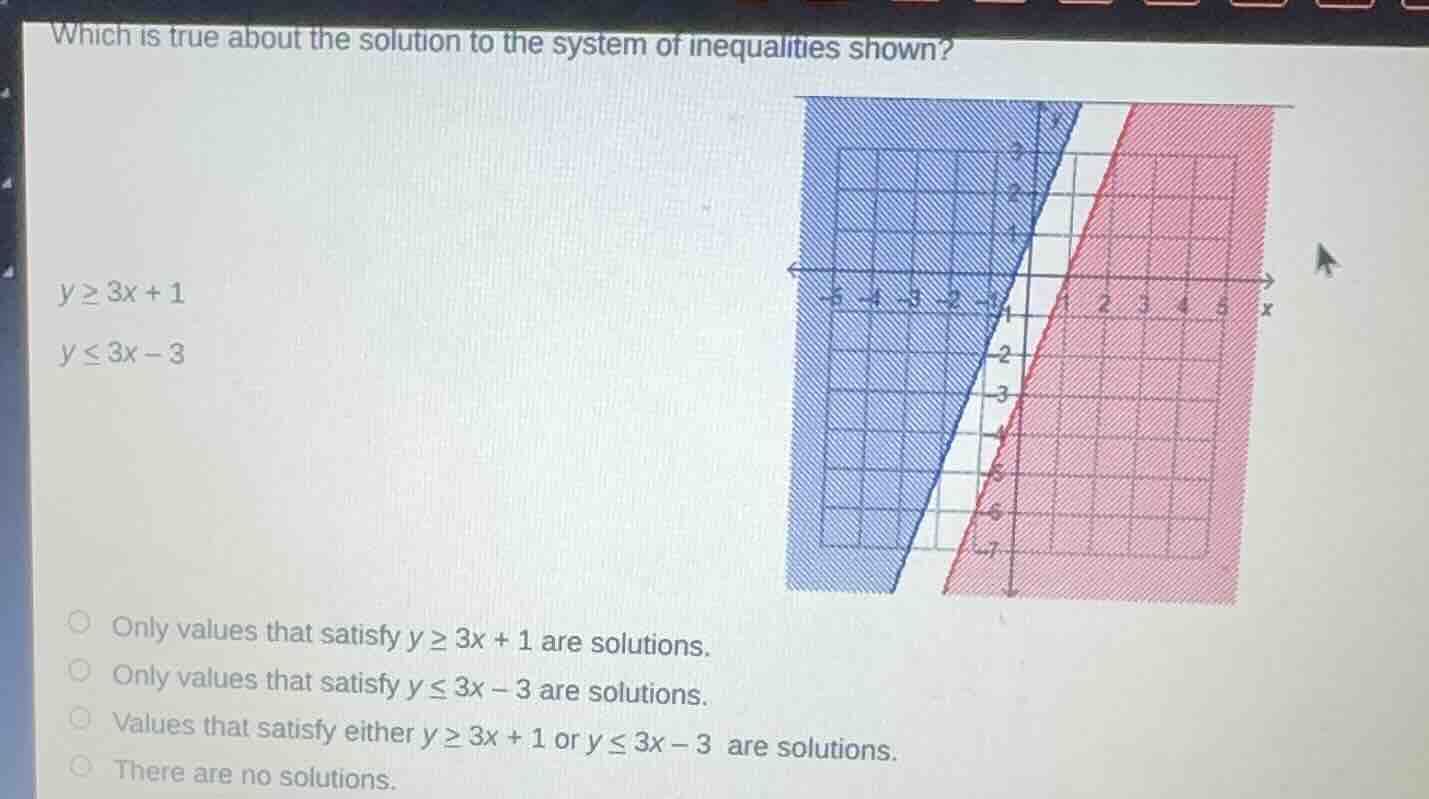
graph of two parallel lines with shaded regions: blue for y ≥ 3x + 1, red for y ≤ 3x − 3
options:
- only values that satisfy y ≥ 3x + 1 are solutions.
- only values that satisfy y ≤ 3x − 3 are solutions.
- values that satisfy either y ≥ 3x + 1 or y ≤ 3x − 3 are solutions.
- there are no solutions.
Step1: Analyze the slopes of the lines
The two inequalities are \( y \geq 3x + 1 \) and \( y \leq 3x - 3 \). The slope of both lines \( y = 3x + 1 \) and \( y = 3x - 3 \) is \( 3 \), so they are parallel lines.
Step2: Analyze the regions of the inequalities
For \( y \geq 3x + 1 \), the region is above the line \( y = 3x + 1 \). For \( y \leq 3x - 3 \), the region is below the line \( y = 3x - 3 \). Since the lines are parallel and the region above \( y = 3x + 1 \) and the region below \( y = 3x - 3 \) do not overlap (because \( 3x + 1>3x - 3 \) for all \( x \), so there is no point that can be both above \( y = 3x + 1 \) and below \( y = 3x - 3 \) at the same time). Also, the system is a "and" system (since it's a system of inequalities, we need to satisfy both, but here they are parallel and non - overlapping). Wait, but let's check the options. Wait, the options have "or" and "no solutions". Wait, first, let's recall the definition of a system of inequalities. A system of inequalities \(
\) requires a solution to satisfy both \( A \) and \( B \). But since the two lines are parallel and the region of \( y\geq3x + 1 \) and \( y\leq3x - 3 \) have no intersection (because for any \( x \), \( 3x+1>3x - 3 \), so \( y \) can't be both greater than or equal to \( 3x + 1 \) and less than or equal to \( 3x - 3 \) simultaneously), so there are no solutions that satisfy both. But wait, let's check the options again. Wait, the options:
Option 1: Only values that satisfy \( y\geq3x + 1 \) are solutions. But the system is two inequalities, so we need to satisfy both, so this is wrong.
Option 2: Only values that satisfy \( y\leq3x - 3 \) are solutions. Similarly, wrong, because we need to satisfy both.
Option 3: Values that satisfy either \( y\geq3x + 1 \) or \( y\leq3x - 3 \) are solutions. But a system of inequalities (the way it's written as \(
\)) requires to satisfy both. But if we consider the "or", but the system is a conjunction (both). However, since the two regions (above \( y = 3x+1 \) and below \( y = 3x - 3 \)) are disjoint (no overlap) and the lines are parallel, there is no point that satisfies both. Wait, but let's check the last option.
Option 4: There are no solutions. Let's verify. Suppose there is a point \( (x,y) \) that satisfies both \( y\geq3x + 1 \) and \( y\leq3x - 3 \). Then \( 3x + 1\leq y\leq3x - 3 \), which implies \( 3x+1\leq3x - 3 \). Subtract \( 3x \) from both sides, we get \( 1\leq - 3 \), which is false. So there are no solutions that satisfy both inequalities. So the correct option is the one that says there are no solutions.

Snap & solve any problem in the app
Get step-by-step solutions on Sovi AI
Photo-based solutions with guided steps
Explore more problems and detailed explanations
There are no solutions. (The option corresponding to "There are no solutions" among the given options)