QUESTION IMAGE
Question
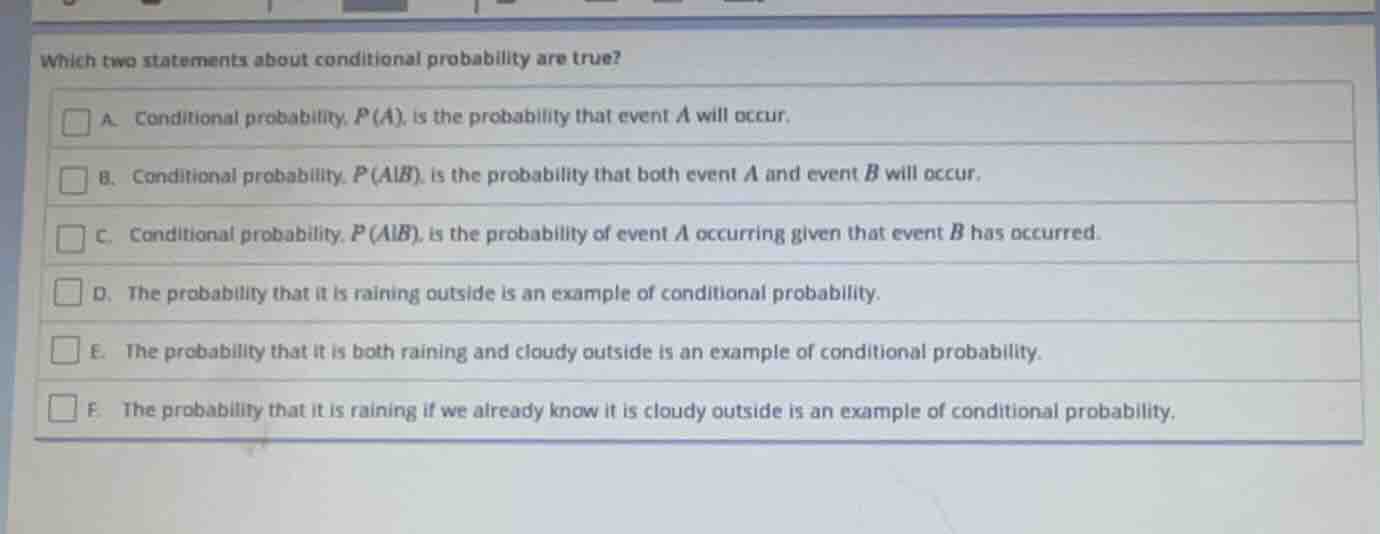
which two statements about conditional probability are true?
a. conditional probability, ( p(a) ), is the probability that event ( a ) will occur.
b. conditional probability, ( p(a|b) ), is the probability that both event ( a ) and event ( b ) will occur.
c. conditional probability, ( p(a|b) ), is the probability of event ( a ) occurring given that event ( b ) has occurred.
d. the probability that it is raining outside is an example of conditional probability.
e. the probability that it is both raining and cloudy outside is an example of conditional probability.
f. the probability that it is raining if we already know it is cloudy outside is an example of conditional probability.
- Option A: $P(A)$ is marginal, not conditional probability.
- Option B: $P(A \cap B)$ is joint probability, not $P(A|B)$.
- Option C: This matches the definition of conditional probability $P(A|B)$.
- Option D: This is a marginal probability, no given condition.
- Option E: This is a joint probability of two events, not conditional.
- Option F: This uses a given condition (it is cloudy) to find rain probability, fitting conditional probability.

Snap & solve any problem in the app
Get step-by-step solutions on Sovi AI
Photo-based solutions with guided steps
Explore more problems and detailed explanations
C. Conditional probability, $P(A|B)$, is the probability of event $A$ occurring given that event $B$ has occurred.
F. The probability that it is raining if we already know it is cloudy outside is an example of conditional probability.