QUESTION IMAGE
Question
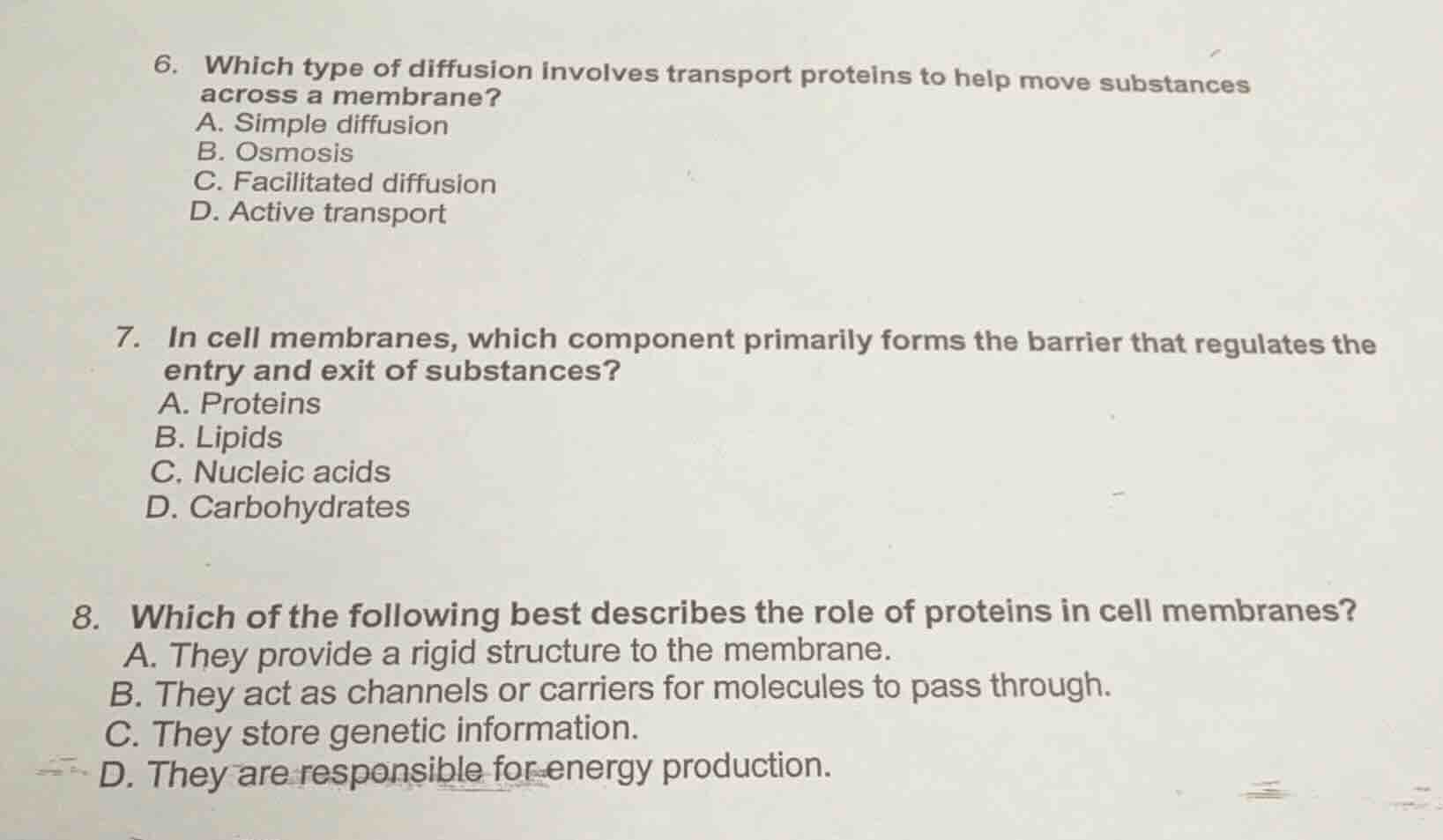
- which type of diffusion involves transport proteins to help move substances across a membrane?
a. simple diffusion
b. osmosis
c. facilitated diffusion
d. active transport
- in cell membranes, which component primarily forms the barrier that regulates the entry and exit of substances?
a. proteins
b. lipids
c. nucleic acids
d. carbohydrates
- which of the following best describes the role of proteins in cell membranes?
a. they provide a rigid structure to the membrane.
b. they act as channels or carriers for molecules to pass through.
c. they store genetic information.
d. they are responsible for energy production.
Response
Question 6
Brief Explanations
- Simple diffusion (A) moves substances without transport proteins, just through the lipid bilayer.
- Osmosis (B) is the diffusion of water, also without transport proteins for the water movement in the basic concept here (though aquaporins are involved in some cases, the option here refers to the general osmosis concept without transport proteins for the substance movement in the question's context).
- Facilitated diffusion (C) specifically uses transport proteins (like channel or carrier proteins) to help move substances across the membrane, down their concentration gradient.
- Active transport (D) uses energy and transport proteins but moves substances against the concentration gradient, and the question is about diffusion (which is passive), so facilitated diffusion is the correct answer for diffusion with transport proteins.
Brief Explanations
- Proteins (A) in cell membranes have roles like transport, signaling, etc., but they don't form the main barrier.
- Lipids (specifically phospholipids, B) form the lipid bilayer, which is the primary structural component of the cell membrane and acts as the main barrier regulating substance entry/exit because it's hydrophobic in the middle, preventing most polar/charged substances from freely crossing.
- Nucleic acids (C) are in the nucleus, not the membrane barrier.
- Carbohydrates (D) on the membrane are for cell recognition, not the main barrier.
Brief Explanations
- Option A: Proteins don't provide rigid structure (the lipid bilayer and cytoskeleton - if present - contribute to structure, but proteins are more for function).
- Option B: Membrane proteins (channel or carrier proteins) act as channels or carriers to let molecules pass (e.g., ions through channel proteins, glucose through carrier proteins), which is a key role.
- Option C: Nucleic acids (DNA/RNA) store genetic info, not proteins.
- Option D: Energy production is done by mitochondria, not membrane proteins. So B is correct.

Snap & solve any problem in the app
Get step-by-step solutions on Sovi AI
Photo-based solutions with guided steps
Explore more problems and detailed explanations
C. Facilitated diffusion