QUESTION IMAGE
Question
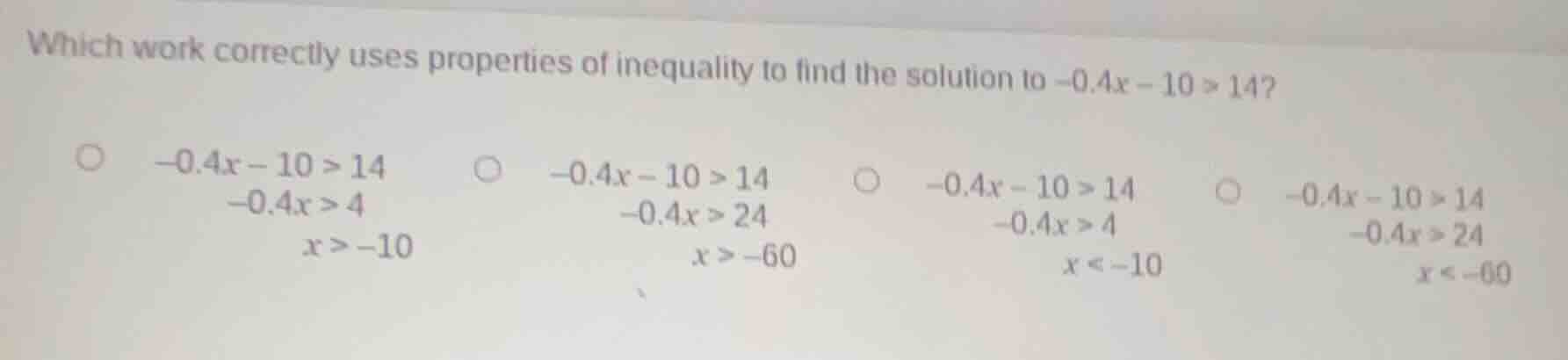
which work correctly uses properties of inequality to find the solution to -0.4x - 10 > 14?
-0.4x - 10 > 14
-0.4x > 4
x > -10
-0.4x - 10 > 14
-0.4x > 24
x > -60
-0.4x - 10 > 14
-0.4x > 4
x < -10
-0.4x - 10 > 14
-0.4x > 24
x < -60
Step1: Add 10 to both sides
To isolate the term with \( x \), we add 10 to both sides of the inequality \( -0.4x - 10 > 14 \). Using the addition property of inequality (adding the same number to both sides preserves the inequality direction), we get:
\( -0.4x - 10 + 10 > 14 + 10 \)
Simplifying both sides, we have \( -0.4x > 24 \).
Step2: Divide by -0.4 (reverse inequality)
Now, we divide both sides by \( -0.4 \) to solve for \( x \). When dividing (or multiplying) both sides of an inequality by a negative number, the direction of the inequality sign reverses. So we have:
\( \frac{-0.4x}{-0.4} < \frac{24}{-0.4} \)
Simplifying, \( x < -60 \).

Snap & solve any problem in the app
Get step-by-step solutions on Sovi AI
Photo-based solutions with guided steps
Explore more problems and detailed explanations
The correct work is the fourth option: \(-0.4x - 10 > 14\)
\(-0.4x > 24\)
\(x < -60\)